


WBJEE · Physics · Oscillations
The displacement of a particle in a periodic motion is given by \(y=4 \cos ^{2}\left(\frac{t}{2}\right) \sin (1000 t)\). This displacement may be considered as the result of superposition of \(n\) independent harmonic oscillations. Here \(n\) is
- A 1
- B 2
- C 3
- D 4
Answer & Solution
Correct Answer
(C) 3
Step-by-step Solution
Detailed explanation
Given, \(Y=4 \cos ^{2}\left(\frac{t}{2}\right) \cdot \sin (1000 t)\) \(=2 \times 2 \cos ^{2}\left(\frac{t}{2}\right) \cdot \sin (1000 t)\) \(\quad\left[\because 2 \cos ^{2} \frac{t}{2}=(1+\cos t)\right]\) \(=2(1+\cos t) \sin (1000 t)\)…
See the Complete Solution
Get step-by-step explanations for this and 2.5 Lakh+ more JEE, NEET & CET questions.
- Unlock all solutions
- Practice the full chapter
- Track accuracy across PYQs
4.8 rated on Google Play · 14,000+ reviews
More questions from Physics
- A particle of mass ' \(m\) ' moves in one dimension under the action of a conservative force whose potential energy has the form of \(U(x)=-\frac{\alpha x}{x^2+\beta^2}\) where \(\alpha\) and \(\beta\) are dimensional parameters. The angular frequency of the oscillation is proportional toWBJEE 2024 Easy
- An electric bulb, a capacitor, a battery and a switch are all in series in a circuit. How does the intensity of light vary when the switch is
turn on?WBJEE 2018 Easy - In a common emitter configuration, a transistor has \(\beta=50\) and input resistance \(1 \mathrm{k} \Omega\). If the peak value of a.c. input is \(0.01 \mathrm{~V}\) then the peak value of collector current isWBJEE 2010 Easy
- The distance between a light source and photoelectric cell is d. If the distance is decreased to \(\frac{d}{2},\) thenWBJEE 2016 Medium
- Four small objects each of mass \(m\) are fixed at the corners of a rectangular wire-frame of negligible mass and of sides \(a\) and \(b(a>b)\) If the wire frame is now roated about an axig passing along the side of length \(b,\) then the moment of inertia of the system for this axis of rotation isWBJEE 2013 Medium
- A convex lens of focal length \(30 \mathrm{~cm}\) produces 5 times magnified real image of an object. What is the object distance ?WBJEE 2011 Easy
More PYQs from WBJEE
- Consider the following two first order reactions occurring at 298 K with same initial concentration of \(A\) :(1) \(A \rightarrow B ;\) rate constant, \(k=0.693 \mathrm{min}^{-1}\) (2) \(A \rightarrow C\); half-life, \(l_{1 / 2}=0.693\) min Choose the correct option.WBJEE 2019 Medium
- Identify ' \(P\) ' and ' \(Q\) ' in the following reaction
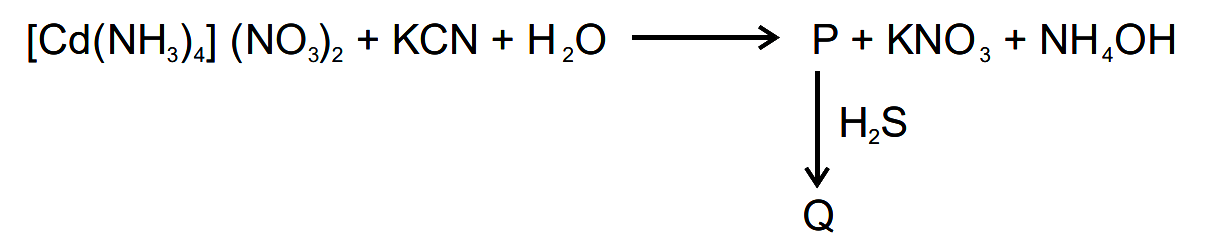 WBJEE 2025 Medium
 - There are \(n\) elastic balls placed on a smooth horizontal plane. The masses of the balls are \(m, \frac{m}{2}, \frac{m}{2^2}, \ldots . \frac{m}{2^{n-1}}\) respectively. If the first ball hits the second ball with velocity \(\mathrm{v}_0\), then the velocity of the \(\mathrm{n}^{\text {th }}\) ball will be,WBJEE 2023 Medium
- Which one of the following is the correct set of four quantum numbers \((n, l, m, s)\) ?WBJEE 2022 Easy
- The de-Broglie wavelength of an electron (mass \(=1 \times 10^{-30} \mathrm{kg},\) charge \(\left.=16 \times 10^{-19} \mathrm{C}\right)\) with a kinetic energy of \(200 \mathrm{eV}\) is (Planck's constant \(=6.6 \times 10^{-34} \mathrm{Js}\)WBJEE 2013 Medium
- The equation of auxiliary circle of the ellipse \(16 x^{2}+25 y^{2}+32 x-100 y=284\) isWBJEE 2016 Easy