


WBJEE · Physics · Magnetic Effects of Current
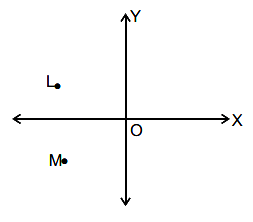
Consider two infinitely long wires parallel to Z-axis carrying same current I in the positive Z direction. One wire passes through the point \(L\) at coordinates \((-1,+1)\) and the other wire passes through the point \(M\) at coordinates \((-1,-1)\). The resultant magnetic field at the origin \(\mathrm{O}\) will be
- A \(\frac{\mu_{0} I}{2 \sqrt{2 \pi}} \hat{\mathrm{j}}\)
- B \(\frac{\mu_{0} I}{2 \pi} \hat{j}\)
- C \(\frac{\mu_{0} \mathrm{I}}{2 \sqrt{2 \pi}} \hat{\mathrm{i}}\)
- D \(\frac{\mu_{0} I}{4 \pi} \hat{j}\)
Answer & Solution
Correct Answer
(B) \(\frac{\mu_{0} I}{2 \pi} \hat{j}\)
Step-by-step Solution
Detailed explanation
\(\mathrm{B}_{\text {net }}=\sqrt{2} \mathrm{~B}\) where \(\mathrm{B}=\frac{\mu_{0} \mathrm{I}}{2 \pi \mathrm{r}}\) \(\mathrm{B}_{\text {net }}=\frac{\mu_{0} \mathrm{I}}{2 \pi \mathrm{r}} \sqrt{2} \hat{\mathrm{j}}\)…
See the Complete Solution
Get step-by-step explanations for this and 2.5 Lakh+ more JEE, NEET & CET questions.
- Unlock all solutions
- Practice the full chapter
- Track accuracy across PYQs
4.8 rated on Google Play · 14,000+ reviews
More questions from Physics
- If the potential energy of a hydrogen atom in the first excited state is assumed to be zero, then the total energy of \(n\) \(=\infty\) state is,WBJEE 2023 Medium
- A NOR gate and a NAND gate are connected as shown in the figure. Two different sets of inputs are given to this setup. In the first case, the inputs to the gates are \(A=0, B=0\), \(C=0 .\) In the second case, the inputs are \(A=1, B=0, C=1 .\) The output \(D\) in the first case and second case respectively are
 WBJEE 2013 Easy
 - A smooth massless string passes over a smooth fixed pulley. Two masses \(m_{1}\) and \(m_{2},\left(m_{1}>m_{2}\right)\) are tied at the two ends of the string. The masses are allowed to move under gravity starting from rest. The total external force acting on the two masses isWBJEE 2014 Easy
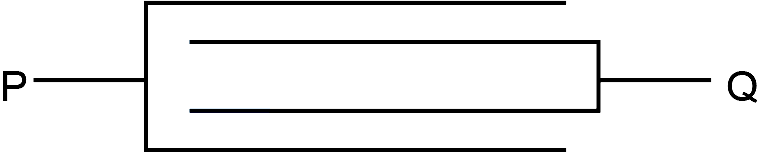
- Four identical plates each of area \(a\) are separated by a distance \(d\). The connection is shown below. what is the capacitance between \(P\) and \(Q ?\)
 WBJEE 2013 Hard
 - In which of the following pairs, the two physical quantities have different dimensions?WBJEE 2014 Easy
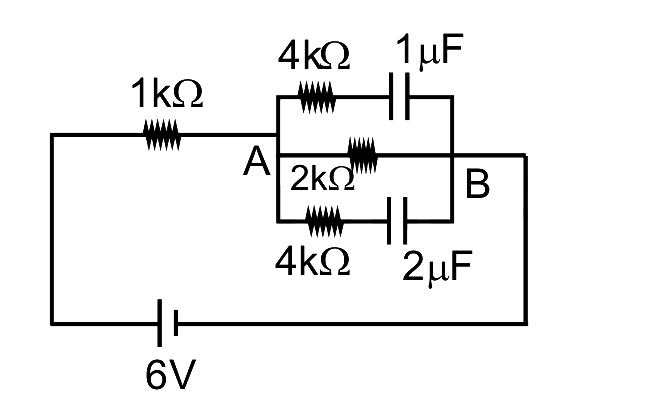
- What are the charges stored in the \(1 \mu \mathrm{~F}\) and \(2 \mu \mathrm{~F}\) capacitors in the circuit as shown in figure once the current (I) become steady?
 WBJEE 2025 Medium
More PYQs from WBJEE
- The points representing the complex number z for which arg \(\left(\frac{z-2}{z+2}\right)=\frac{\pi}{3}\) lie onWBJEE 2012 Medium
- The hydrides of the first elements in groups \(15-17,\) namely \(\mathrm{NH}_{3}, \mathrm{H}_{2} \mathrm{O}\) and \(\mathrm{HF}\) respectively show abnormally high values for melting and boiling points. This is due toWBJEE 2014 Easy
- If the vertices of a square are \(z_1, z_2, z_3\) and \(z_4\) taken in the anti-clockwise order, then \(z_3=\)WBJEE 2023 Medium
- The number of irrational terms in the expansion of \(\left(3^{\frac{1}{8}}+5^{\frac{1}{4}}\right)^{84}\) isWBJEE 2019 Medium
- If \(x y^{\prime}+y-e^x=0, y(a)=b\), then \(\lim _{x \rightarrow 1} y(x)\) isWBJEE 2024 Easy
- Applying Lagrange's Mean Value Theorem for a suitable function \(f(x)\) in \([0, h],\) we have \(f(h)=f(0)+h f^{\prime}(\theta h), \quad 0 < \theta < 1 . \quad\) Then, for \(f(x)=\cos x,\) the value of \(\lim _{h \rightarrow 0^{*}} \theta\) isWBJEE 2014 Medium