


WBJEE · Maths · Application of Derivatives
Applying Lagrange's Mean Value Theorem for a suitable function \(f(x)\) in \([0, h],\) we have \(f(h)=f(0)+h f^{\prime}(\theta h), \quad 0 < \theta < 1 . \quad\) Then, for \(f(x)=\cos x,\) the value of \(\lim _{h \rightarrow 0^{*}} \theta\) is
- A 1
- B 0
- C \(1 / 2\)
- D \(1 / 3\)
Answer & Solution
Correct Answer
(C) \(1 / 2\)
Step-by-step Solution
Detailed explanation
We know that in a Lagrange mean value theorem there exist \(c \in(a, b)\) such that \[ f^{\prime}(c)=\frac{f(b)-f(a)}{b-a} \] \(\therefore \quad f^{\prime}(\theta h)=\frac{f(h)-\cos 0}{h-0}\)…
See the Complete Solution
Get step-by-step explanations for this and 2.5 Lakh+ more JEE, NEET & CET questions.
- Unlock all solutions
- Practice the full chapter
- Track accuracy across PYQs
4.8 rated on Google Play · 14,000+ reviews
More questions from Maths
- Let \(p, q\) and \(r\) be the altitudes of a triangle with area \(S\) and perimeter \(2 t .\) Then, the value of \(\frac{1}{p}+\frac{1}{q}+\frac{1}{r}\) isWBJEE 2012 Easy
- The incentre of an equilateral triangle is (1,1) and the equation of ene side is \(3 x+4 y+3=0 .\) Then, the equation of the circumeircle of the triangle isWBJEE 2012 Medium
- The value of \(\int_0^{\infty} \frac{d x}{\left(x^2+4\right)\left(x^2+9\right)}\) isWBJEE 2009 Hard
- Let \(A=\left(\begin{array}{ccc}1 & 0 & 0 \\ 0 & \text { cost } & \text { sint } \\ 0 & -\sin t & \cos t\end{array}\right)\)
Let \(\lambda_{1}, \lambda_{2}, \lambda_{3}\) be the roots of \(\operatorname{det}\left(A-\lambda I_{3}\right)=0\), where \(I_{3}\) denotes the identity matrix. If \(\lambda_{1}+\lambda_{2}+\lambda_{3}=\sqrt{2}+1\), then the set of possible values of \(t,-\pi \leq t < \pi\) isWBJEE 2021 Hard - Let \(\phi(x)=f(x)+f(1-x)\) and \(f^{\prime \prime}(x) < 0\) in \([0,1]\), thenWBJEE 2020 Medium
- \(\mathrm{A}\) student appears for tests 1 , 11 and \(\mathrm{III}\). The student is successful if he passes in tests I,II or I, III. The probabilities of the student passing in tests I. II and III are respectively,
p,q and \(1 / 2 .\) If the probability of the student to be successful is \(1 / 2 .\) ThenWBJEE 2018 Easy
More PYQs from WBJEE
- A compressive force is applied to a uniform rod of rectangular cross-section so that its length decreases by \(1 \%\). If the Poisson's ratio for the material of the rod be \(0.2,\) which of the following statements is correct? "The volume approximately ...........WBJEE 2019 Medium
- Number of hydrogen ions present in 10 milionth part of \(1.33 \mathrm{cm}^{3}\) of pure water at \(25^{\circ} \mathrm{C}\) isWBJEE 2013 Hard
- A horizontal semi-circular wire of radius \(\mathrm{r}\) is connected to a battery through two similar springs \(\mathrm{X}\) and \(\mathrm{Y}\) to an electric cell, which sends current I through it. A vertically downward uniform magnetic field B is applied on the wire, as shown in the figure. What is the force acting on each spring?
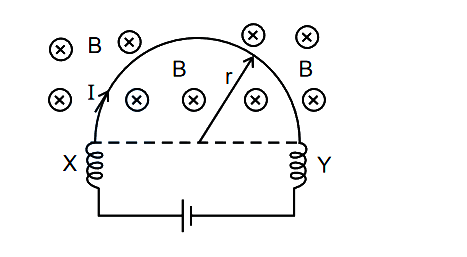 WBJEE 2022 Medium
 - Let \(f_n(x)=\tan \frac{x}{2}(1+\sec x)(1+\sec 2 x) \ldots\left(1+\sec 2^n x\right)\), thenWBJEE 2025 Medium
- For a chemical reaction at \(27^{\circ} \mathrm{C},\) the activation energy is \(600 \mathrm{R}\). The ratio of the rate constants at \(327^{\circ} \mathrm{C}\) to that of at \(27^{\circ} \mathrm{C}\)
will beWBJEE 2013 Medium - Let \(I_{n}=\int_{0}^{1} x^{n} \tan ^{-1} x d x .\) If \(a_{n} I_{n+2}+b_{n} I_{n}=c_{n}\) for all \(n \geq 1,\) thenWBJEE 2019 Medium