


WBJEE · Physics · Laws of Motion
A block of mass \(m_{2}\) is placed on a horizontal table and another block of mass \(m_{1}\) is placed on top of it. An increasing horizontal force \(F=\alpha t\) is exerted on the upper block but the lower block never moves as a result. If the coefficient of friction between the blocks is \(\mu_{i}\) and that between the lower block and the table is \(\mu_{2}\), then what is the maximum possible value of \(\mu_{1} / \mu_{2} ?\)
- A \(\frac{m_{2}}{m}\)
- B \(1+\frac{m_{2}}{m_{1}}\)
- C \(\frac{m_{1}}{m_{2}}\)
- D \(1+\frac{m_{1}}{m_{2}}\)
Answer & Solution
Correct Answer
(B) \(1+\frac{m_{2}}{m_{1}}\)
Step-by-step Solution
Detailed explanation
According to the question. \(\therefore \quad N_{2}=m_{2} g+N_{1}=\left(m_{1}+m_{2}\right) g\) : Lower block never moves. \(\therefore \quad f_{r_{2}} \geq f_{n}\) \(\quad \mu_{2} N_{2} \geq \mu_{1} N_{1} \Rightarrow \mu_{2}\left(m_{1}+m_{2}\right) g \geq \mu_{1} m_{1} g\)…
See the Complete Solution
Get step-by-step explanations for this and 2.5 Lakh+ more JEE, NEET & CET questions.
- Unlock all solutions
- Practice the full chapter
- Track accuracy across PYQs
4.8 rated on Google Play · 14,000+ reviews
More questions from Physics
- A particle moves with constant acceleration along a straight line starting from rest. The percentage increase in its displacement during the 4th second compared to that in the 3rd second isWBJEE 2014 Easy
- A simple pendulum of length \(\ell\) is displaced so that its taught string is horizontal and then released. A uniform bar pivoted at one end is simultaneously released from its horizontal position. If their motions are synchronous, what is the length of the bar?WBJEE 2020 Medium
- An electron of charge \(e\) and mass \(m\) is moving in a circular of radius \(r\) with a uniform angular speed \(\omega .\) Then which of the following statements are correct?WBJEE 2013 Easy
- Average distance of the Earth from the Sun is \(L_{1}\) : If one year of the Earth \(=D\) days, one year of another planet whose average distance from the Sun is \(L_{2}\) will beWBJEE 2012 Easy
-
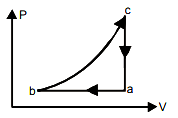
An ideal gas undergoes the cyclic process abca as shown in the given \(\mathrm{P}-\mathrm{V}\) diagram. It rejects \(50 \mathrm{~J}\) of heat during \(a b\) and absorbs \(80 \mathrm{~J}\) of heat during ca. During \(b c\), there is no transfer of heat and \(40 \mathrm{~J}\) of work is done by the gas. What should be the area of the closed curve abca?WBJEE 2020 Medium -
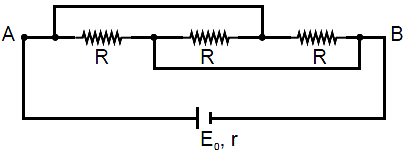
Consider a circuit where a cell of emf \(\mathrm{E}_0\) and internal resistance \(r\) is connected across the terminal \(A\) and \(B\) as shown in figure. The value of \(R\) for which the power generated in the circuit is maximum, is given byWBJEE 2024 Medium
More PYQs from WBJEE
- If the tangent to the curve \(y^{2}=x^{3}\) at \(\left(m^{2}, m^{3}\right)\) is also a normal to the curve at \(\left(M^{2}, M^{3}\right)\), then the value of \(m M\) isWBJEE 2020 Medium
- Let \(z_{1}\) and \(z_{2}\) be two imaginary roots of \(z^{2}+p z+q=0\), where \(p\) and \(q\) are real. The points \(z_{1}, z_{2}\) and origin form an equilateral triangle ifWBJEE 2020 Medium
- The kinetic study of a reaction like \(v A \rightarrow P\) at \(300 \mathrm{K}\) provides the following curve, where concentration is taken in mol \(\mathrm{dm}^{-3}\) and time in min.
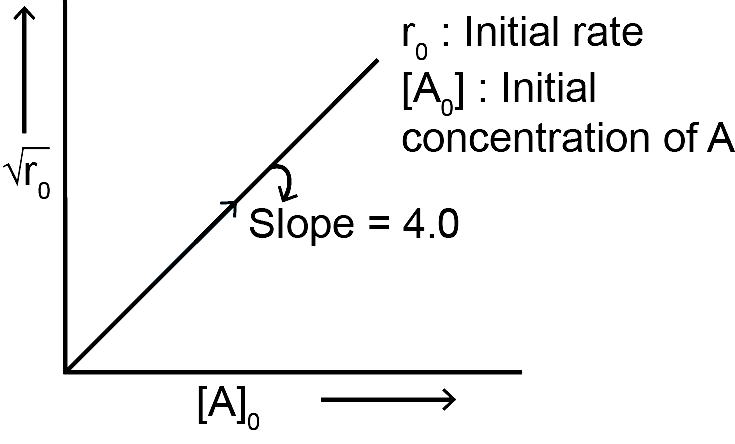
Identify the correct order \((n)\) and rate constant \((k)\)WBJEE 2019 Medium - The angle between the lines joining the foci of an ellipse to one particular extremity of the minor axis is \(90^{\circ}\). The eccentricity of the ellipse isWBJEE 2009 Medium
- Let the eccentricity of the hyperbola \(\frac{x^{2}}{a^{2}}-\frac{y^{2}}{b^{2}}=1\) be reciprocal to that of the ellipse \(x^{2}+9 y^{2}=9,\) then the ratio \(a^{2}: b^{2}\) equalsWBJEE 2018 Easy
- If \(\mathrm{c}_{0}, \mathrm{c}_{1}, \mathrm{c}_{2}, \ldots \ldots \mathrm{c}{15}\) are the Binomial co-efficients in the expansion of \((1+\mathrm{x})^{15}\), then the value of \(\frac{\mathrm{C}{1}}{\mathrm{c}{0}}+2 \frac{\mathrm{C}{2}}{\mathrm{c}{1}}+3 \frac{\mathrm{c}{3}}{\mathrm{c}{2}}+\ldots \ldots+15 \frac{\mathrm{c}{15}}{\mathrm{c}{14}}\) isWBJEE 2020 Medium