


WBJEE · Maths · Probability
There are two coins, one unbiased with probaility \(\frac{1}{2}\) or getting heads and the other one is biased with probability \(\frac{3}{4}\) of getting heads. A coin is selected at random and tossed. It shows heads up. Then, the probability that the unbiased coin wa selected is
- A \(\frac{2}{3}\)
- B \(\frac{3}{5}\)
- C \(\frac{1}{2}\)
- D \(\frac{2}{5}\)
Answer & Solution
Correct Answer
(D) \(\frac{2}{5}\)
Step-by-step Solution
Detailed explanation
Let \(E \rightarrow\) Event of head showing up \(E_{1} \rightarrow\) Event of biased coin chosen \(E_{2} \rightarrow\) Event of unbiased coin chosen Now, \(P\left(E_{2}\right)=\frac{1}{2}\) and \(P\left(E_{1}\right)=\frac{1}{2}\) Also,…
See the Complete Solution
Get step-by-step explanations for this and 2.5 Lakh+ more JEE, NEET & CET questions.
- Unlock all solutions
- Practice the full chapter
- Track accuracy across PYQs
4.8 rated on Google Play · 14,000+ reviews
More questions from Maths
- The smallest positive root of the equation \(\tan x-x=0\) lies inWBJEE 2016 Easy
- Let \(P\) be the mid-point of a chord joining the vertex of the parabola \(y^{2}=8 x\) to another point on it. Then, the locus of \(P\) isWBJEE 2012 Medium
- If \(\sqrt{y}=\cos ^{-1} x\), then it satisfies the differential equation \(\left(1-x^{2}\right) \frac{d^{2} y}{d x^{2}}-x \frac{d y}{d x}=c,\) where \(c\) is equal toWBJEE 2014 Medium
- The equations of the lines through \((1,1)\) and making angles of \(45^{\circ}\) with the line \(x+y=0\) areWBJEE 2010 Medium
- Let \(\mathrm{A}=\left(\begin{array}{ccc}1 & -1 & 0 \\ 0 & 1 & -1 \\ 1 & 1 & 1\end{array}\right), \mathrm{B}=\left(\begin{array}{l}2 \\ 1 \\ 7\end{array}\right)\)
Then for the validity of the result \(\mathrm{AX}=\mathrm{B}, \mathrm{X}\) isWBJEE 2024 Easy - If \(\alpha, \beta\) are the roots of the quadratic equation \(x^{2}+p x+q=0,\) then the values of \(\alpha^{3}+\beta^{3}\) and \(\alpha^{4}+\alpha^{3} \beta^{2}+\beta^{4}\) are respectivelyWBJEE 2014 Medium
More PYQs from WBJEE
- The possible values of \(x\), which satisfy the trigonometric equation
\(\tan ^{-1}\left(\frac{x-1}{x-2}\right)+\tan ^{-1}\left(\frac{x+1}{x+2}\right)=\frac{\pi}{4}\) areWBJEE 2017 Medium - If \(A, B\) are two events such that \(P(A \cup B) \geq \frac{3}{4}\) and \(\frac{1}{8} \leq P(A \cap B) \leq \frac{3}{8},\) thenWBJEE 2016 Medium
- Three concentric metallic shells A, B and C of radii \(a, b\) and \(c(a < b < c)\) have surface charge densities \(+\sigma,-\sigma\) and \(+\sigma\) respectively. The potential of shell B is
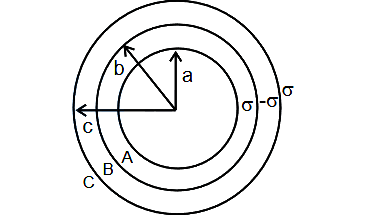 WBJEE 2022 Hard
 - If \(\alpha, \beta\) are the roots of the equation \(a x^2+b x+c=0\) then \(\lim _{x \rightarrow \beta} \frac{1-\cos \left(a x^2+b x+c\right)}{(x-\beta)^2}\) isWBJEE 2024 Hard
- If \(P=\left[\begin{array}{lll}1 & 2 & 1 \\ 1 & 3 & 1\end{array}\right] Q=P P^{T}\), then the value of the
determinant of \(Q\) isWBJEE 2012 Easy - A shell of mass \(5 M\), acted upon by no external force and initially at rest, bursts into three fragments of masses \(M, 2 M\) and \(2 M\) respectively. The first two fragments move in opposite directions with velocities of magnitudes 2v and \(v\) respectively. The third fragment willWBJEE 2013 Easy