


WBJEE · Maths · Differential Equations
The general solution of the differential equation \(\frac{d y}{d x}=e^{y+x}+e^{y-x}\) is
where \(c\) is an arbitrary constant
- A \(\mathrm{e}^{-\mathrm{y}}=\mathrm{e}^{\mathrm{x}}-\mathrm{e}^{-\mathrm{x}}+\mathrm{c}\)
- B \(\mathrm{e}^{-\mathrm{y}}=\mathrm{e}^{-\mathrm{x}}-\mathrm{e}^{\mathrm{x}}+\mathrm{c}\)
- C \(e^{-y}=e^x+e^{-x}+c\)
- D \(e^y=e^x+e^{-x}+c\)
Answer & Solution
Correct Answer
(B) \(\mathrm{e}^{-\mathrm{y}}=\mathrm{e}^{-\mathrm{x}}-\mathrm{e}^{\mathrm{x}}+\mathrm{c}\)
Step-by-step Solution
Detailed explanation
Hints: \(e^{-y} d y=\left(e^x+e^{-x}\right) d x\) Integrate \(-\mathrm{e}^{-\mathrm{y}}=e^x-e^{-x}+c, \quad \mathrm{e}^{-\mathrm{y}}=e^{-x}-e^{+x}+c\)
See the Complete Solution
Get step-by-step explanations for this and 2.5 Lakh+ more JEE, NEET & CET questions.
- Unlock all solutions
- Practice the full chapter
- Track accuracy across PYQs
4.8 rated on Google Play · 14,000+ reviews
More questions from Maths
- Let N be the number of quadratic equations with coefficients from {0, 1, 2, ....., 9) such that 0 is a solution of each equation. Then the value of N isWBJEE 2024 Medium
- If \(\mathrm{P}(\mathrm{x})=a \mathrm{x}^{2}+\mathrm{bx}+\mathrm{c}\) and \(\mathrm{Q}(\mathrm{x})=-\mathrm{ax}^{2}+\mathrm{dx}+\mathrm{c}\), where \(\mathrm{ac} \neq 0 \quad[\mathrm{a}, \mathrm{b}, \mathrm{c}, \mathrm{d}\) are all real], then \(\mathrm{P}(\mathrm{x}) \cdot \mathrm{Q}(\mathrm{x})=0\) hasWBJEE 2020 Medium
- If \(\cos ^{-1} \alpha+\cos ^{-1} \beta+\cos ^{-1} \gamma=3 \pi\), then \(\alpha(\beta+\gamma)+\beta(\gamma+\alpha)+\gamma(\alpha+\beta)\) is equal toWBJEE 2025 Medium
- The value of integral \(\int_{-1}^1 \frac{|x+2|}{x+2} d x\) isWBJEE 2009 Easy
- Let \(f(x)=x^{4}-4 x^{3}+4 x^{2}+c, c \in R .\) Then,WBJEE 2019 Medium
- Equation of a tangent to the hyperbola \(5 x^{2}-y^{2}=5\) and which passes through an external point (2,8) isWBJEE 2019 Medium
More PYQs from WBJEE
- Two identical springs are connected to mass \(\mathrm{m}\) as shown \((\mathrm{k}=\) spring constant). If the period of the configuration in (a) is \(2 \mathrm{~S}\), the period of the configuration (b) isWBJEE 2011 Medium
-
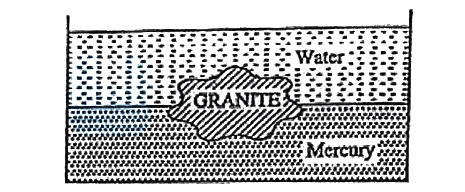
A piece of granite floats at the interface of mercury and water contained in a beaker as in figure. If the densities of granite, water and mercury are \(\rho, \rho_1\) and \(\rho_2\) respectively, the ratio of the volume of granite in water to the volume of granite in mercury isWBJEE 2025 Medium - Six wires, each of resistance \(r\), are connected so as to form a tetrahedron. The equivalent resistance of the combination when current enters through one corner and leaves through some other corner isWBJEE 2017 Hard
- An object placed in front of a concave mirror at a distance of \(x\) cm from the pole gives a 3 times magnified real image. If it is moved to a distance of \((x+5) \mathrm{cm},\) the magnification of the image becomes 2 . The focal length of the mirror isWBJEE 2012 Medium
- Two solid spheres \(S_{1}\) and \(S_{2}\) of same uniform density fall from rest under gravity in a viscous medium and after some time, reach terminal velocities \(v_{1}\) and \(v_{2}\) respectively. If ratio of masses \(\frac{m_{1}}{m_{2}}=8\), then \(\frac{v_{1}}{v_{2}}\) will be equal toWBJEE 2021 Easy
- If \(P=1+\frac{1}{2 \times 2}+\frac{1}{3 \times 2^{2}}+\ldots\)
and \(Q=\frac{1}{1 \times 2}+\frac{1}{3 \times 4}+\frac{1}{5 \times 6}+\ldots,\) thenWBJEE 2013 Medium