


WBJEE · Maths · Application of Derivatives
Let \(f(x)=x^{4}-4 x^{3}+4 x^{2}+c, c \in R .\) Then,
- A \(f(x)\) has infinitely many zeros in (1,2) for all \(c\)
- B \(f(x)\) has exactly one zero in (1,2) if \(-1 < c < 0\)
- C \(f(x)\) has double zeros in (1,2) if \(-1 < c < 0\)
- D whatever be the value of \(c, f(x)\) has no zero in (1,2)
Answer & Solution
Correct Answer
(B) \(f(x)\) has exactly one zero in (1,2) if \(-1 < c < 0\)
Step-by-step Solution
Detailed explanation
Given, \[ \begin{array}{ll} f(x) & =x^{4}-4 x^{3}+4 x^{2}+c \\ f(1) & =1+c \\ \text { and } \quad f(2) & =2^{4}-4(2)^{3}+4(2)^{2}+c \end{array} \]…
See the Complete Solution
Get step-by-step explanations for this and 2.5 Lakh+ more JEE, NEET & CET questions.
- Unlock all solutions
- Practice the full chapter
- Track accuracy across PYQs
4.8 rated on Google Play · 14,000+ reviews
More questions from Maths
- Let \(A(2,-3)\) and \(B(-2,1)\) be two angular points of \(\Delta A B C\). If the centroid of the triangle moves on the line \(2 x+3 y=1\), then the locus of the angular point \(C\) is given byWBJEE 2017 Medium
- Let \(f(x)=\left\{\begin{array}{ccc}\frac{x^{p}}{(\sin x)^{q}} & , & \text { if } 0 < x \leq \frac{\pi}{2} \\ 0 & , & \text { if } x=0\end{array}\right.\)
\((p, q \in R) .\) Then, Lagrange's mean value theorem is applicable to \(f(x)\) in closed interval \([0, x]\)WBJEE 2017 Medium - Let \(P\) be the foot of the perpendicular from focus \(S\) of hyperbola \(\frac{x^{2}}{a^{2}}-\frac{y^{2}}{b^{2}}=1\) on the line \(b x-a y=0\) and let \(C\) be the centre of the hyperbola. Then, the area of the rectangle whose sides are equal to that of \(S P\) and \(C P\) isWBJEE 2017 Medium
- If \(z=x\) - iy and \(z^{1 / 3}=p+\) iq \((x, y, p, q \in \mathbb{R})\), then \(\frac{\left(\frac{x}{p}+\frac{y}{q}\right)}{\left(p^2+q^2\right)}\) is equal toWBJEE 2022 Easy
- The number of diagonals in a polygon is 20 . The number of sides of the polygon isWBJEE 2011 Medium
- In the expansion of \((x-1)(x-2) \ldots(x-18)\) the coefficient of \(x^{17}\) isWBJEE 2016 Hard
More PYQs from WBJEE
- The straight lines \(x+2 y-9=0,3 x+5 y-5=0\) and \(a x+\) by \(-1=0\) are concurrent if the straight line \(35 x-22 y+\) \(1=0\) passes through the pointWBJEE 2023 Easy
- The dimension of the universal constant of gravitation, \(G\) isWBJEE 2017 Easy
- Consider the function f(x) = x(x - 1) (x - 2) ... (x - 100). Which one of the following is correct?WBJEE 2024 Easy
- The domain of definition of \(f(x)=\sqrt{\frac{1-|x|}{2-|x|}}\) is Here \((a, b)=\{x: a < x < b\}\) and
\([a, b]=\{x: a \leq x \leq b\}\)WBJEE 2018 Medium - How many moles of electrons will weigh one kilogram?WBJEE 2018 Hard
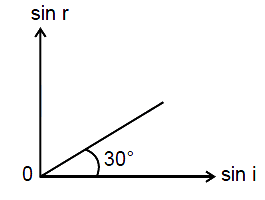
- A ray of monochromatic light is incident on the plane surface of separation between two media \(X\) and \(Y\) with angle of incidence 'i' in medium \(X\) and angle of refraction ' \(r\) ' in medium \(Y\). The given graph shows the relation between sin \(i\) and \(\sin r\). If \(V_x\) and \(V_{\mathrm{Y}}\) are the velocities of the ray in media \(X\) and \(Y\) respectively, then which of the following is true?
 WBJEE 2023 Hard