


WBJEE · Maths · Quadratic Equation
If \(\mathrm{P}(\mathrm{x})=a \mathrm{x}^{2}+\mathrm{bx}+\mathrm{c}\) and \(\mathrm{Q}(\mathrm{x})=-\mathrm{ax}^{2}+\mathrm{dx}+\mathrm{c}\), where \(\mathrm{ac} \neq 0 \quad[\mathrm{a}, \mathrm{b}, \mathrm{c}, \mathrm{d}\) are all real], then \(\mathrm{P}(\mathrm{x}) \cdot \mathrm{Q}(\mathrm{x})=0\) has
- A at least two real roots
- B two real roots
- C four real roots
- D no real root
Answer & Solution
Correct Answer
(A) at least two real roots
Step-by-step Solution
Detailed explanation
Hint: If \(P(x)=a x^{2}+b x+c, Q(x)=-a x^{2}+d x+c\) \(\mathrm{D}_{1}=\mathrm{b}^{2}-4 \mathrm{ac}\) \(\mathrm{D}_{2}=\mathrm{d}^{2}+4 \mathrm{ac}\) \(\Rightarrow \mathrm{D}_{1}+\mathrm{D}_{2}>0\) Atleast two real roots.
See the Complete Solution
Get step-by-step explanations for this and 2.5 Lakh+ more JEE, NEET & CET questions.
- Unlock all solutions
- Practice the full chapter
- Track accuracy across PYQs
4.8 rated on Google Play · 14,000+ reviews
More questions from Maths
- \(\begin{array}{llll}\text { 3. The sum } & \text { of } & \text { the } & \text { series }\end{array}\) \(1+\frac{1}{2}{ }^{n} C_{1}+\frac{1}{3}{ }^{n} C_{2}+\quad+\frac{1}{n+1}{ }^{n} C_{n}\) is equal toWBJEE 2012 Hard
- The least value of \(2 x^{2}+y^{2}+2 x y+2 x-3 y+8\) for real
numbers \(x\) and \(y,\) isWBJEE 2015 Easy - The probability that a non-leap year selected at random will have 53 Sundays or 53 Saturdays isWBJEE 2025 Easy
- If \(\cos \theta+i \sin \theta, \theta \in \mathbb{R}\), is the root of the equation
\(a_0 x^n+a_1 \cdot x^{n-1}+\ldots .+a_{n-1} x+a_n=0, a_0, a_1, \ldots \ldots . a_n \in \mathbb{R}, a_0 \neq 0\)
then the value of \(a_1 \sin \theta+a_2 \sin 2 \theta+\ldots .+a_n \sin n \theta\) isWBJEE 2024 Medium - Let \(f\) and \(g\) be periodic functions with the periods \(T_{1}\) and \(T_{2}\) respectively. Then \(f+g\) isWBJEE 2021 Easy
- A candidate is required to answer 6 out of 12 questions which are divided into two parts A and \(B\), each containing 6 questions and he/she is not permitted to attempt more than 4 questions from any part. In how many different ways can he/she make up hisher choice of 6 questions?WBJEE 2019 Medium
More PYQs from WBJEE
- Let \(f(x)=2 x^{2}+5 x+1\). If we write \(f(x)\) as \(f(x)=a(x+1)(x-2)+b(x-2)(x-1)+c(x-1)(x+1)\)
for real numbers \(a, b, c,\) thenWBJEE 2014 Hard - An ideal gas of molar mass \(\mathrm{M}\) is contained in a very tall vertical cylindrical column in the uniform gravitational field. Assuming the gas temperature to be \(\mathrm{T}\), the height at which the centre of gravity of the gas is located is (R: universal gas constant)WBJEE 2021 Hard
- A body of mass \(2 \mathrm{~kg}\) moves in a horizontal circular path of radius \(5 \mathrm{~m}\). At an instant, its speed is \(2 \sqrt{5} \mathrm{~m} / \mathrm{s}\) and is increasing at the rate of \(3 \mathrm{~m} / \mathrm{s}^2\). The magnitude of force acting on the body at the instant is,WBJEE 2023 Easy
- If \(\alpha\) and \(\beta\) are roots of \(a x^{2}+b x+c=0,\) then
the equation whose roots are \(\alpha^{2}\) and \(\beta^{2},\) isWBJEE 2016 Easy - How many faradays are required to reduce \(1 \mathrm{mol}\) of \(\mathrm{Cr}_{2} \mathrm{O}_{7}^{2-}\) to \(\mathrm{Cr}^{3}\) - in acid medium?WBJEE 2017 Easy
- The equivalent capacitance of a combination of connected capacitors shown in the figure between the points P and N
is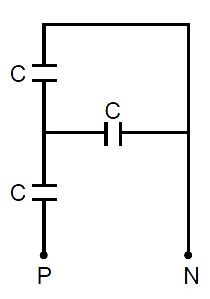 WBJEE 2024 Easy