


WBJEE · Maths · Differentiation
Let \(f: R \rightarrow R\) be twice continuously differentiable. Let \(f(0)=f(1)=f^{\prime}(0)=0 .\) Then,
- A \(f^{\prime \prime}(x) \neq 0\) for all \(x\)
- B \(f^{\prime \prime}(c)=0\) for some \(c \in R\)
- C \(f^{\prime \prime}(x) \neq 0\) if \(x \neq 0\)
- D \(f^{\prime}(x)>0\) for all \(x\)
Answer & Solution
Correct Answer
(B) \(f^{\prime \prime}(c)=0\) for some \(c \in R\)
Step-by-step Solution
Detailed explanation
Let function \(f(x)=x^{2}(x-1)\) \(\Rightarrow \quad f^{\prime}(x)=3 x^{2}-2 x\) and \(\quad f^{\prime \prime}(x)=6 x-2\) \(\begin{array}{ll}\text { Now, } & f(0)=f(1)=f^{\prime}(0)=0\end{array}\) Then, according to question, at \(x=\frac{1}{3}, \quad f^{\prime \prime}(x)=0\)…
See the Complete Solution
Get step-by-step explanations for this and 2.5 Lakh+ more JEE, NEET & CET questions.
- Unlock all solutions
- Practice the full chapter
- Track accuracy across PYQs
4.8 rated on Google Play · 14,000+ reviews
More questions from Maths
- The sum of the series
\(\frac{1}{1 \times 2}^{25} C_{0}+\frac{1}{2 \times 3}{ }^{25} C_{1}+\frac{1}{3 \times 4}{ }^{25} C_{2}+\ldots \\
+\frac{1}{26 \times 27}{ }^{25} C_{25} \text { is }\)WBJEE 2013 Hard - Let \(X_{n}=\left\{z=x+i y:|z|^{2} \leq \frac{1}{n}\right\}\) for all integers \(n \geq 1 .\) Then, \(\underset{n=1}{\cap} X_{n}\) isWBJEE 2014 Medium
- Value of \(\tan ^{-1}\left(\frac{\sin 2-1}{\cos 2}\right)\) isWBJEE 2010 Medium
- The area enclosed by \(y=\sqrt{5-x^{2}}\) and
\(y=|x-1|\) isWBJEE 2016 Hard - If the distance between the foci of an ellipse is equal to the length of the latusrectum, then its eccentricity isWBJEE 2013 Easy
- The equation \(2 x^{2}+5 x y-12 y^{2}=0\) represents aWBJEE 2013 Medium
More PYQs from WBJEE
- Let \(A=\left(\begin{array}{lll}3 & 0 & 3 \\ 0 & 3 & 0 \\ 3 & 0 & 3\end{array}\right) .\) Then, the roots of the equation \(\operatorname{det}\left(A-\lambda I_{3}\right)=0\) (where \(I_{3}\) is the identity matrix of order 3 ) areWBJEE 2019 Easy
- \(\int \sqrt{1+\cos x} d x\) is equal toWBJEE 2010 Easy
- Let \(f(x)=\int_{\sin x}^{\cos x} e^{-t^2} d t\). Then \(f^{\prime}\left(\frac{\pi}{4}\right)\) equalsWBJEE 2022 Easy
- The bob of a pendulum of mass \(m\), suspended by an inextensible string of length \(L\) as shown in the figure carries a small charge \(a\). An infinite horizontal plane conductor with uniform surface charge density \(\sigma\) is placed below it. What will be the time period of the pendulum for small amplitude oscillations?
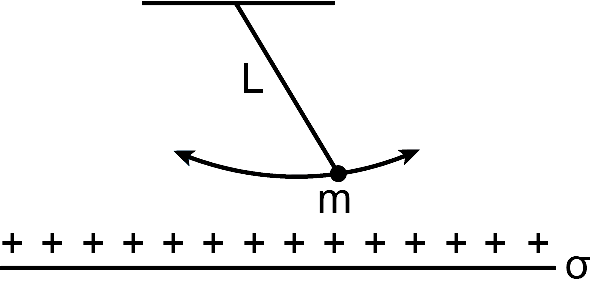 WBJEE 2018 Hard
 - A wooden block is floating on water kept in a beaker. \(40 \%\) of the block is above the water surface. Now the beaker is kept inside a lift that starts going upward with acceleration equal to \(g / 2\). The block will thenWBJEE 2014 Medium
- A Mapping from IN to IN is defined as follows :
\[
\begin{aligned}
& \mathrm{f}: \mathrm{IN} \rightarrow \mathrm{IN} \\
& \mathrm{f}(\mathrm{n})=(\mathrm{n}+5)^2, \mathrm{n} \in \mathrm{IN}
\end{aligned}
\]
(IN is the set of natural numbers). ThenWBJEE 2009 Easy