


WBJEE · Maths · Straight Lines
Let \(A(2,-3)\) and \(B(-2,1)\) be two angular points of \(\Delta A B C\). If the centroid of the triangle moves on the line \(2 x+3 y=1\), then the locus of the angular point \(C\) is given by
- A \(2 x+3 y=9\)
- B \(2 x-3 y=9\)
- C \(3 x+2 y=5\)
- D \(3 x-2 y=3\)
Answer & Solution
Correct Answer
(A) \(2 x+3 y=9\)
Step-by-step Solution
Detailed explanation
Let the coordinates of \(C\) be \((\alpha, \beta)\). \(\therefore\) Coordinates of centroid \[ \begin{array}{l} =\left(\frac{2-2+\alpha}{3}, \frac{-3+1+\beta}{3}\right) \\ =\left(\frac{\alpha}{3}, \frac{\beta-2}{3}\right) \end{array} \] Since, centroid lie on \(2 x+3 y=1\)…
See the Complete Solution
Get step-by-step explanations for this and 2.5 Lakh+ more JEE, NEET & CET questions.
- Unlock all solutions
- Practice the full chapter
- Track accuracy across PYQs
4.8 rated on Google Play · 14,000+ reviews
More questions from Maths
- The smallest value of \(5 \cos \theta+12\) isWBJEE 2009 Easy
- The law of motion of a body moving along a straight line is \(x=\frac{1}{2}\) vt. \(x\) being its distance from a fixed point on the line at time \(t\) and \(v\) is its velocity there, ThenWBJEE 2018 Medium
- Let \(p, q\) be real numbers. If \(\alpha\) is the root of \(x^{2}+3 p^{2} x+5 q^{2}=0, \quad \beta \quad\) is \(\quad\) a \(\quad\) root \(\quad\) of \(x^{2}+9 p^{2} x+15 q^{2}=0\) and \(0 < \alpha < \beta,\) then the equation \(x^{2}+6 p^{2} x+10 q^{2}=0\) has a root \(\gamma\) that always satisfiesWBJEE 2014 Medium
- The value of \(\cos 15^{\circ}-\sin 15^{\circ}\) isWBJEE 2011 Medium
- If the point \((2 \cos \theta, 2 \sin \theta)\) for \(0 \in(0,2 \pi)\) lies in the region between the lines \(x+y=2\) and \(x-y=2\) containing the origin, then \(\theta\) lies inWBJEE 2015 Hard
- The direction ratios of the normal to the plane passing through the points (1,2,-3) ,(-1,-2,1) and parallel to \(\frac{x-2}{2}=\frac{y+1}{3}=\frac{z}{4}\) isWBJEE 2019 Medium
More PYQs from WBJEE
- The equation \(8 x^2+12 y^2-4 x+4 y-1=0\) representsWBJEE 2011 Easy
- Assume that each diode as shown in the tịgure has a forvard bias resistance of \(50 \Omega\) and an infinite reverse bias resistance. The current through the resistance \(150 \Omega\) is
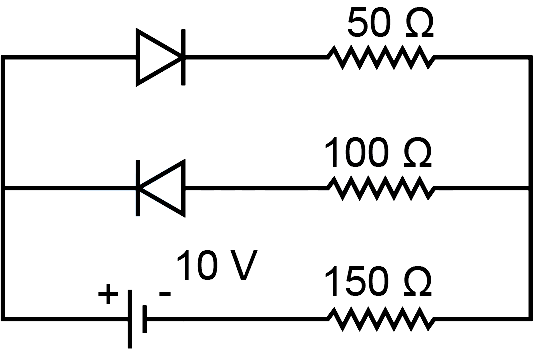 WBJEE 2015 Easy
 - The common chord of the circles \(x^{2}+y^{2}-4 x-4 y=0 \quad\) and \(\quad 2 x^{2}+2 y^{2}=32\) subtends at the origin an angle equal toWBJEE 2017 Medium
- A unit vector in \(X Y\)-plane making an angle \(45^{\circ}\) with \(\hat{i}+\hat{j}\) and an angle \(60^{\circ}\) with \(3 \hat{i}-4 \hat{j}\) isWBJEE 2024 Easy
- Identify \([\mathrm{A}]\) and \([\mathrm{B}]\) in the following
\[
{ }_{89}^{227} \mathrm{Ac} \stackrel{-\beta}{\longrightarrow}[\mathrm{A}] \stackrel{-\alpha}{\longrightarrow}[\mathrm{B}] \stackrel{-\alpha}{\longrightarrow} \mathrm{Rn}
\]WBJEE 2010 Medium - Identify the ion having \(4 f^6\) electronic configuration.WBJEE 2024 Medium