


WBJEE · Maths · Quadratic Equation
Let \(p, q\) be real numbers. If \(\alpha\) is the root of \(x^{2}+3 p^{2} x+5 q^{2}=0, \quad \beta \quad\) is \(\quad\) a \(\quad\) root \(\quad\) of \(x^{2}+9 p^{2} x+15 q^{2}=0\) and \(0 < \alpha < \beta,\) then the equation \(x^{2}+6 p^{2} x+10 q^{2}=0\) has a root \(\gamma\) that always satisfies
- A \(\gamma=\frac{\alpha}{4}+\beta\)
- B \(\beta < \gamma\)
- C \(\gamma=\frac{\alpha}{2}+\beta\)
- D \(\alpha < \gamma < \beta\)
Answer & Solution
Correct Answer
(D) \(\alpha < \gamma < \beta\)
Step-by-step Solution
Detailed explanation
Since, \(\alpha\) is a root of \(\therefore\) \[ \begin{array}{l} x^{2}+3 p^{2} x+5 q^{2}=0 \\ \alpha^{2}+3 p^{2} \alpha+5 q^{2}=0 \end{array} \] and \(\beta\) is a root of \(\therefore\)…
See the Complete Solution
Get step-by-step explanations for this and 2.5 Lakh+ more JEE, NEET & CET questions.
- Unlock all solutions
- Practice the full chapter
- Track accuracy across PYQs
4.8 rated on Google Play · 14,000+ reviews
More questions from Maths
- Let \(f(x)=x^{4}-4 x^{3}+4 x^{2}+c, c \in R .\) Then,WBJEE 2019 Medium
- The smallest positive root of the equation \(\tan x-x=0\) lies inWBJEE 2016 Easy
- If the equation \(x^{2}+y^{2}-10 x+21=0\) has real roots \(x=\alpha\) and \(y=\beta,\) thenWBJEE 2016 Medium
- For positive integer \(n, n^{3}+2 n\) is always divisible byWBJEE 2016 Easy
- Let \(y(x)\) be a solution of \(\left(1+x^{2}\right) \frac{d y}{d x}+2 x y-4 x^{2}=0\) and \(y(0)=-1 .\) Then y(1) s equal toWBJEE 2018 Hard
- If the following three linear equations have a non-trivial solution, then
\[
\begin{array}{l}
x+4 a y+a z=0 \\
x+3 b y+b z=0 \\
x+2 c y+c z=0
\end{array}
\]WBJEE 2018 Easy
More PYQs from WBJEE
- The reagents to carry out the following conversion are
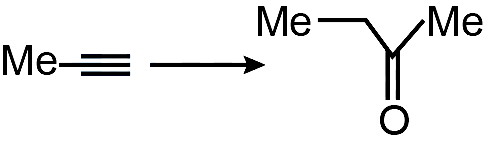 WBJEE 2014 Easy
 - If the co-efficients of \(x^2\) and \(x^3\) in the expansion of \((3+a x)^9\) be same, then the value of ' \(a\) ' isWBJEE 2009 Medium
- The number of onto functions from the set \(\{1,2, \ldots, 11\}\) to the set \(\{1,2, \ldots, 10\}\) isWBJEE 2013 Easy
- If in a triangle \(A B C, \sin A, \sin B, \sin C\) are in A.P., thenWBJEE 2011 Hard
- A point object is held above a thin equiconvex lens at its focus. The focal length is \(0.1 \mathrm{m}\) and the lens rests on a horizontal thin plane mirror. The final image will be formed atWBJEE 2017 Medium
- The line \(x=2 y\) intersects the ellipse \(\frac{x^{2}}{4}+y^{2}=1\) at the points \(P\) and \(Q .\) The equation of the circle with \(P Q\) as diameter isWBJEE 2012 Medium