


WBJEE · Maths · Area Under Curves
If the point \((2 \cos \theta, 2 \sin \theta)\) for \(0 \in(0,2 \pi)\) lies in the region between the lines \(x+y=2\) and \(x-y=2\) containing the origin, then \(\theta\) lies in
- A \(\left(\theta, \frac{\pi}{2}\right) \cup\left(\frac{3 \pi}{2}, 2 \pi\right)\)
- B \([0, n]\)
- C \(\left(\frac{\pi}{2} \cdot \frac{3 \pi}{2}\right)\)
- D \(\left[\frac{\pi}{4}, \frac{\pi}{2}\right]\)
Answer & Solution
Correct Answer
(C) \(\left(\frac{\pi}{2} \cdot \frac{3 \pi}{2}\right)\)
Step-by-step Solution
Detailed explanation
Given that \((2 \cos \theta, 2 \sin \theta)\) will lie on the circle \(x^{2}+y^{2}=4\) (from the given figure). Since, point lies on the region containing origin. So, point will be on the shaded region. \(\therefore\) \(\theta \in\left(\frac{\pi}{2}, \frac{3 \pi}{2}\right)\)
See the Complete Solution
Get step-by-step explanations for this and 2.5 Lakh+ more JEE, NEET & CET questions.
- Unlock all solutions
- Practice the full chapter
- Track accuracy across PYQs
4.8 rated on Google Play · 14,000+ reviews
More questions from Maths
- The area of the region bounded by the curves \(y=x^{2}\) and \(x=y^{2}\) isWBJEE 2014 Medium
- If \(\alpha_1, \alpha_2, \cdots, \alpha_n\) are in A.P. with common difference \(\theta\), then the sum of the series \(\sec \alpha_1 \sec \alpha_2+\sec \alpha_2 \sec \alpha_3+\cdots \cdot+\sec \alpha_{n-1} \sec \alpha_n=k\left(\tan \alpha_n-\tan \alpha_1\right)\) where \(k=\)WBJEE 2024 Medium
- The integrating factor of the first order differential equation \(x^{2}\left(x^{2}-1\right) \frac{d y}{d x}+x\left(x^{2}+1\right) y=x^{2}-1\) isWBJEE 2017 Hard
- Let \(f:[a, b] \rightarrow R\) be such that \(f\) is differentiable in \((a, b)\) is continuous at \(x=a\) and \(x=b\) and moreover \(f(a)=0=f(b)\). ThenWBJEE 2018 Medium
- For non-zero verctors a and b, \(\mid a+b \mid < \mid a-b\mid\), then a and b areWBJEE 2016 Medium
- The general solution of the differential equation \(\log _{\mathrm{e}}\left(\frac{d y}{d x}\right)=x+y\) isWBJEE 2011 Easy
More PYQs from WBJEE
- The velocity of a particle executing a simple harmonic motion is \(13 \mathrm{ms}^{-1}\), when its distance from the equilibrium position \((Q)\) is \(3 \mathrm{m}\) and its velocity is \(12 \mathrm{ms}^{-1},\) when it is \(5 \mathrm{m}\) away from \(Q .\) The frequency of the simple harmonic motion isWBJEE 2017 Medium
-
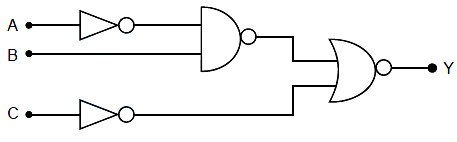
Consider the logic circuit with inputs A, B, C and output \(Y\). How many combinations of \(A, B\) and \(C\) gives the output \(Y=0\) ?WBJEE 2023 Easy - A plane meets the co-ordinate axes at the points \(A, B, C\) respectively in such a way that the centroid of \(\triangle A B C\) is \(\left(1, r, r^{2}\right)\) for some real \(r\). If the plane passes through the point \((5,5,-12)\) then \(r=\)WBJEE 2021 Medium
- If \(y=e^{-x} \cos 2 x\), then which of the following differential equation is satisfied?WBJEE 2015 Easy
- If the coordinates of one end of a diameter of the circle \(x^2+y^2+4 x-8 y+5=0\), is \((2,1)\), the coordinates of the other end isWBJEE 2011 Easy
- The perfect gas equation for \(4 \mathrm{g}\) of hydrogen gas isWBJEE 2016 Easy