


WBJEE · Maths · Permutation Combination
If \(x\) and \(y\) are digits such that \(17 !=3556xy428096000,\) then \(x+y\) equals
- A 15
- B 6
- C 12
- D 13
Answer & Solution
Correct Answer
(A) 15
Step-by-step Solution
Detailed explanation
Given, \(171=3556 \times 4428096000\) Since, 17! is divisible by \(9,\) so sum of the digits \((48+x+y)\) must be divisible by 9 So, \(x+y\) can be 15 or 6 . Also, 17! is divisible by \(11,\) so \(|10+x-y \mid\) must be multiple of 11 or \(0 .\) The only possibility is…
See the Complete Solution
Get step-by-step explanations for this and 2.5 Lakh+ more JEE, NEET & CET questions.
- Unlock all solutions
- Practice the full chapter
- Track accuracy across PYQs
4.8 rated on Google Play · 14,000+ reviews
More questions from Maths
- Let \(A\) be the point \((0,4)\) in the xy-plane and let \(B\) be the point \((2 t, 0)\). Let \(L\) be the midpoint of \(A B\) and let the perpendicular bisector of \(A B\) meet the \(y\)-axis \(M\). Let \(N\) be the midpoint of LM. Then locus of \(N\) isWBJEE 2023 Medium
- Let \(p, q\) be real numbers. If \(\alpha\) is the root of \(x^{2}+3 p^{2} x+5 q^{2}=0, \quad \beta \quad\) is \(\quad\) a \(\quad\) root \(\quad\) of \(x^{2}+9 p^{2} x+15 q^{2}=0\) and \(0 < \alpha < \beta,\) then the equation \(x^{2}+6 p^{2} x+10 q^{2}=0\) has a root \(\gamma\) that always satisfiesWBJEE 2014 Medium
- The angular points of a triangle are \(A(-1,-7)\) \(B(5,1)\) and \(C(1,4)\). The equation of the bisector of the angle \(\angle A B C\) isWBJEE 2018 Medium
- The locus of the centre of a circle which passes through two variable points \((a, 0),(-a, 0)\) isWBJEE 2011 Medium
- \(\int \frac{d x}{x(x+1)}\) equals
where \(c\) is an arbitrary constant.WBJEE 2009 Medium - The function \(f(x)=2 x^3-3 x^2-12 x+4, x \in \mathbb{R}\) hasWBJEE 2025 Medium
More PYQs from WBJEE
- A particle with charge \(q\) moves with a velocity \(v\) in a direction perpendicular to the directions of uniform clectric and magnetic ficlds, \(E\) and \(B\) respectively, which are mutually perpendicular to each other. Which one of the following gives the condition for which the particle moves undeflected in its original trajectory?
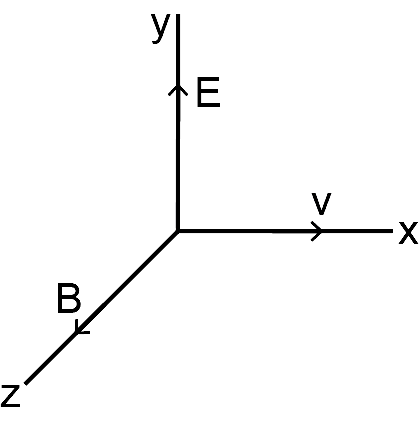 WBJEE 2019 Easy
 - The line \(\mathrm{y}=2 \mathrm{t}^2\) intersects the ellipse \(\frac{x^2}{9}+\frac{y^2}{4}=1\) in real points ifWBJEE 2009 Medium
- Let \(f\) be any continuously differentiable function on \([a, b]\) and twice differentiable on \((a, b)\) such that \(f(a)=f^{\prime}(a)=0\) and \(f(b)=0\) Then.WBJEE 2015 Easy
- Let \(\exp (x)\) denote exponential function ex. If \(f(x)=\exp \left(x^{\frac{1}{x}}\right), x>0\) then the minimum value of \(f\) in the interval \([2,5]\) isWBJEE 2013 Medium
- If the distance between the foci of an ellipse is equal to the length of the latusrectum, then its eccentricity isWBJEE 2013 Easy
- Let \(p, q\) and \(r\) be the side4s opposite to the angles \(P, Q\) and \(R,\) respectively in a \(\Delta P Q R\). Then, \(2 p r \sin \left(\frac{p-Q+R}{2}\right)\) equalsWBJEE 2012 Easy