


WBJEE · Maths · Quadratic Equation
If \(P(x)=a x^2+b x+c\) and \(Q(x)=-a x^2+d x+c\) where \(a c \neq 0\), then \(P(x) \cdot Q(x)=0\) has \((a, b, c, d\) are real)
- A 2 real roots
- B at least two real roots
- C 4 real roots
- D no real root
Answer & Solution
Correct Answer
(B) at least two real roots
Step-by-step Solution
Detailed explanation
\(\begin{aligned} & \text { Hint: } D_1=b^2-4 a c \\ & D_2=d^2+4 a c \\ & D_1+D_2=b^2+d^2\gt0 \\ & D_1+D_2\gt0 \end{aligned}\) At least one of \(D_1\) or \(D_2\) is +ve so at least two real roots
See the Complete Solution
Get step-by-step explanations for this and 2.5 Lakh+ more JEE, NEET & CET questions.
- Unlock all solutions
- Practice the full chapter
- Track accuracy across PYQs
4.8 rated on Google Play · 14,000+ reviews
More questions from Maths
- If the straight line \((a-1) x-b y+4=0\) is normal to the hyperbola \(x y=1\), then which of the following does not hold?WBJEE 2015 Easy
- The sum \(1 \times 1!+2 \times 2!+\ldots+50 \times 50\) ! equalsWBJEE 2012 Hard
- If \(f(x)=\left\{\begin{array}{ll}2 x^{2}+1, & x \leq 1 \\ 4 x^{3}-1, & x>1\end{array},\right.\) then \(\int_{0}^{2} f(x) d x\) isWBJEE 2014 Easy
- If \(\alpha, \beta\) be the roots of \(x^2-a(x-1)+b=0\), then the value of \(\frac{1}{\alpha^2-a \alpha}+\frac{1}{\beta^2-a \beta}+\frac{2}{a+b}\)WBJEE 2009 Easy
- \(\lim _{n \rightarrow \infty} \frac{3}{n}\left\{1+\sqrt{\frac{n}{n+3}}+\sqrt{\frac{n}{n+6}}+\sqrt{\frac{n}{n+9}}\right.$$+\ldots+\sqrt{\frac{1}{n+3}(n-1)}\)WBJEE 2019 Hard
- The remainder obtained when \(11+2 !+95 !\) is divided by 15 isWBJEE 2012 Easy
More PYQs from WBJEE
- A magnetic field \(B=2 t+4 t^{2}\) (where, \(t_{x}\) time) is applied perpendicular to the plany of a circular wire of radius \(r\) and resistance
R. If all the units are in SI the electric charge that flows through the circular wire during \(t=0 \mathrm{s}\) to \(t=2 \mathrm{s}\) isWBJEE 2013 Medium - The integrating factor of the first order differential equation \(x^{2}\left(x^{2}-1\right) \frac{d y}{d x}+x\left(x^{2}+1\right) y=x^{2}-1\) isWBJEE 2017 Hard
- Cyclo [18] carbon is an allotrope of carbon with molecular formula \(\mathrm{C}_{18}\). It is a ring of 18 carbon atoms, connected by single and triple bonds. The total number of triple bonds present in this cyclocarbon areWBJEE 2021 Easy
- The displacement \(\mathrm{x}\) of a particle at time \(\mathrm{t}\) is given by \(\mathrm{x}=\mathrm{At}^2+\mathrm{Bt}+\mathrm{C}\) where \(\mathrm{A}, \mathrm{B}, \mathrm{C}\) are constants and \(\mathrm{v}\) is velocity of a particle, then the value of \(4 \mathrm{Ax}-\mathrm{v}^2\) isWBJEE 2010 Easy
- Angle between an equipotential surface and electric lines of force isWBJEE 2016 Easy
-
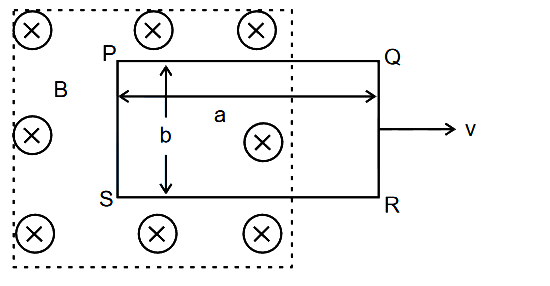
As shown in figure, a rectangular loop of length ' a' and width ' \(b\) ' and made of a conducting material of uniform crosssection is kept in a horizontal plane where a uniform magnetic field of intensity \(B\) is acting vertically downward. Resistance per unit length of the loop is \(\lambda \Omega / \mathrm{m}\). If the loop is pulled with uniform velocity ' \(v\) ' in horizontal direction, which of the following statement is / are true?WBJEE 2022 Hard