


WBJEE · Maths · Sequences and Series
A particle starts at the origin and moves l unit horizontally to the right and reaches \(P_{1}\), then it moves \(\frac{1}{2}\) unit vertically up and 2 reaches \(P_{2}\), then it moves \(\frac{1}{4}\) unit horizontally to right and reaches \(P_{3}\), then it moves \(\frac{1}{8}\) unit vertically down and reaches \(P_{4}\), then it moves \(\frac{1}{16}\) unit horizontally to right and reaches \(P_{\mathrm{S}}\) and so on. Let \(P_{n}=\left(x_{n}, y_{n}\right)\) and \(\lim _{n \rightarrow \infty} x_{n}=\alpha\) and \(\lim _{n \rightarrow \infty} y_{n}=\beta .\) Then, \((\alpha, \beta)\) is
- A (2,3)
- B \(\left(\frac{4}{3}, \frac{2}{5}\right)\)
- C \(\left(\frac{2}{5}, 1\right)\)
- D \(\left(\frac{4}{3}, 3\right)\)
Answer & Solution
Correct Answer
(B) \(\left(\frac{4}{3}, \frac{2}{5}\right)\)
Step-by-step Solution
Detailed explanation
According to the given information in question, we can draw the situation of particle at different stages as following Here, \(x_{1}=1, x_{2}=1, x_{3}=\frac{5}{4}, x_{4}=\frac{5}{4}\) and \(x_{5}=\frac{21}{16}\)…
See the Complete Solution
Get step-by-step explanations for this and 2.5 Lakh+ more JEE, NEET & CET questions.
- Unlock all solutions
- Practice the full chapter
- Track accuracy across PYQs
4.8 rated on Google Play · 14,000+ reviews
More questions from Maths
- If \({ }^{n} C_{r-1}=36,{ }^{n} C_{r}=84\) and \({ }^{n} C_{r+1}=126\) then the value of \({ }^{n} C_{8}\) isWBJEE 2016 Easy
- Let \(x_{n}=\left(1-\frac{1}{3}\right)^{2}\left(1-\frac{1}{6}\right)^{2}\left(1-\frac{1}{10}\right)^{2} \ldots\) \(\left(1-\frac{1}{\frac{n(n+1)}{2}}\right)^{2}, n \geq 2\) Then, the value of \(\lim _{n \rightarrow \infty} x_{n}\) isWBJEE 2015 Hard
- Let \(\alpha, \beta\) be the roots of \(x^{2}-x-1=0\) and \(S_{n}=\alpha^{n}+\beta^{n},\) for all integers \(n \geq 1 .\) Then, for every integer \(n \geq 2\)WBJEE 2014 Medium
- The quadratic expression \((2 x+1)^{2}-p x+q \neq 0\) for any real \(x,\) ifWBJEE 2015 Medium
- Four persons A, B, C and D throw an unbiased die, turn by turn, in succession till one gets an even number and win the game. What is the probability that A wins if A begins?WBJEE 2020 Medium
- The value of \(\tan \frac{\pi}{5}+2 \tan \frac{2 \pi}{5}+4 \cot \frac{4 \pi}{5}\) isWBJEE 2014 Medium
More PYQs from WBJEE
- Let \(P\) be the foot of the perpendicular from focus \(S\) of hyperbola \(\frac{x^{2}}{a^{2}}-\frac{y^{2}}{b^{2}}=1\) on the line \(b x-a y=0\) and let \(C\) be the centre of the hyperbola. Then, the area of the rectangle whose sides are equal to that of \(S P\) and \(C P\) isWBJEE 2017 Medium
- An amount of charge Q passes through a coil of resistance R. If the current in the coil decreases to zero at a uniform rate during time \(T\), then the amount of heat generated in the coil will be,WBJEE 2023 Medium
- \(\mathrm{K}_{f}\) (water) \(=1.86 \mathrm{~K} \mathrm{~kg} \mathrm{~mol}^{-1}\). The temperature at which ice begins to separate from a mixture of 10 mass \(\%\) ethylene glycol isWBJEE 2020 Easy
- The molar solubility (in mol \(\mathrm{L}^{-1}\) ) of a sparingly soluble salt \(M X_{4}\) is \({ }^{\prime} S\). The corresponding solubility product is \(K_{\mathrm{sp}} . S\) in terms of \('K_{\text {ip }}\)' s given by the relationWBJEE 2016 Hard
- If the function \(f(x)=2 x^{3}-9 a x^{2}+12 a^{2} x+1[a>0]\) attains its maximum and minimum at \(p\) and \(q\) respectively such that \(\mathrm{p}^{2}=\mathrm{q}\), then \(\mathrm{a}\) is equal toWBJEE 2020 Medium
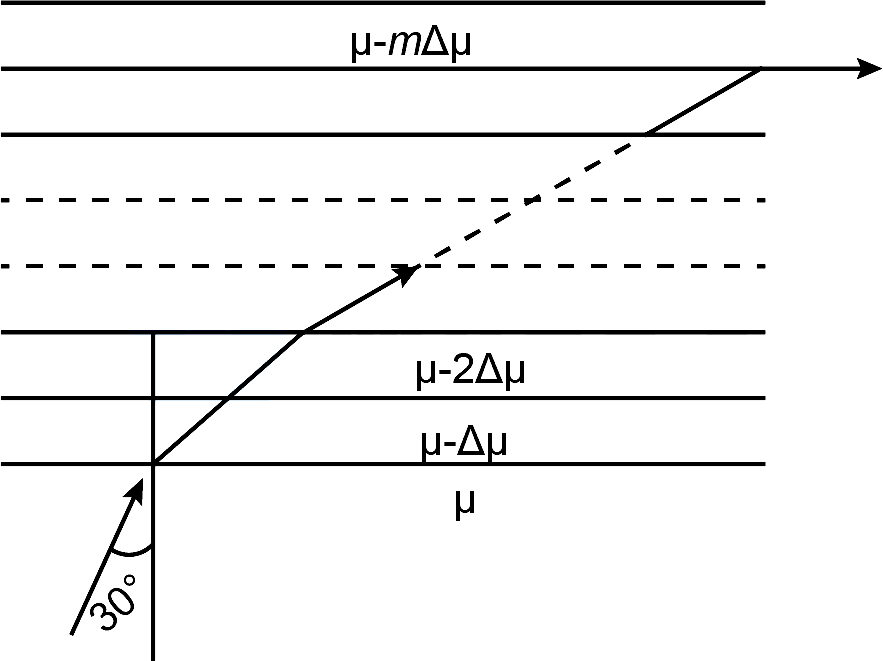
- A glass slab consists of thin uniform layers of progressively decreasing refractive indices RI (see figure) such that the RI of any layer is \(\mu-m \Delta \mu\). Here, \(\mu\) and \(\Delta \mu\) denote the \(\mathrm{RI}\) of 0 th layer and the difference in RI between any two consecutive layers, respectively. The integer \(m=0,1,2,3, \ldots\) denotes the numbers of the successive layers. A ray of light from the oth layer enters the 1st layer at an angle of incidence of \(30^{\circ}\). After undergoing the mth refraction, the ray emerges parallel to the interface. If \(\mu=1.5\) and \(\Delta \mu=0.015,\) the value of \(m\) is
 WBJEE 2014 Medium