


WBJEE · Chemistry · Chemical Equilibrium
The equilibrium constant for the reaction \(\mathrm{N}_{2}(\mathrm{~g})+\mathrm{O}_{2}(\mathrm{~g}) \rightleftharpoons 2 \mathrm{NO}(\mathrm{g})\) is \(4 \times 10^{-4}\) at \(2000 \mathrm{~K}\). In presence of a catalyst the equilibrium is attained 10 times faster. Therefore, the equilibrium constant, in presence of the catalyst at \(2000 \mathrm{~K}\) is
- A \(4 \times 10^{-4}\)
- B \(4 \times 10^{-3}\)
- C \(4 \times 10^{-5}\)
- D \(2.5 \times 10^{-4}\)
Answer & Solution
Correct Answer
(A) \(4 \times 10^{-4}\)
Step-by-step Solution
Detailed explanation
As per Van't Hoff Equation \(\frac{\mathrm{d}\left(\ln \mathrm{K}_{\mathrm{eq}}\right)}{\mathrm{dT}}=\frac{\Delta \mathrm{H}_{\mathrm{T}}}{\mathrm{RT}^{2}}\) As catalyst don't affect enthalpy of reaction \(\left(\Delta \mathrm{H}_{\mathrm{r}}\right)\) and Temperature is…
See the Complete Solution
Get step-by-step explanations for this and 2.5 Lakh+ more JEE, NEET & CET questions.
- Unlock all solutions
- Practice the full chapter
- Track accuracy across PYQs
4.8 rated on Google Play · 14,000+ reviews
More questions from Chemistry
- The correct statement(s) about \(\mathrm{B}_2 \mathrm{H}_6\) is / are :WBJEE 2022 Easy
- \([P] \stackrel{\text { Br }_{2}}{\longrightarrow} C_{2} \mathrm{H}_{4}\) Br \(_{2} \frac{\text { NaNH }_{2}}{\mathrm{NH}_{3}}\) ? \([Q]\)
\([Q] \frac{20 \% \mathrm{H}_{2} \mathrm{SO}_{4}}{\mathrm{Hg}^{2+} \cdot \Delta}[R] \stackrel{\mathrm{Zn}-\mathrm{Hg} / \mathrm{HC}}{\longrightarrow}[S]\)
The species \(P, Q, R\) and \(S\) respectively areWBJEE 2018 Medium - A van der Waals' gas may behave ideally whenWBJEE 2013 Easy
- The potential of a hydrogen electrode at \(\mathrm{pH}=10\) isWBJEE 2010 Medium
- Which one of the following formulae does not represent an organic compound?WBJEE 2009 Medium
- An LPG (Liquified Petroleum Gas) cylinder weighs 15.0 kg when empty. When full, it weighs 30.0 kg and shows a pressure of 3.0 atm . In the course of usage at \(27^{\circ} \mathrm{C}\), the mass of the full cylinder is reduced to 24.2 kg . The volume of the used gas in cubic metre at the normal usage condition ( 1 atm and \(27^{\circ} \mathrm{C}\) ) is (assume LPG to be normal butane and it behaves ideally)WBJEE 2025 Medium
More PYQs from WBJEE
- The locus of the point of intersection of the straight lines \(\frac{x}{a}+\frac{y}{b}=K\) and \(\frac{x}{a}-\frac{y}{b}=\frac{1}{K}\),
where \(K\) is a non-zero real variable, is given byWBJEE 2016 Medium - The inputs to the digital circuit are as shown below. The output \(Y\) is
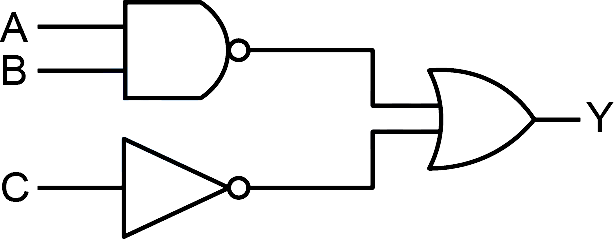 WBJEE 2015 Easy
 -
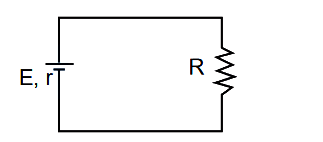
A battery of emf \(\mathrm{E}\) and internal resistance \(\mathrm{r}\) is connected with an external resistance \(\mathrm{R}\) as shown in the figure. The battery will act as a constant voltage source ifWBJEE 2022 Easy - Let \(A\) be a set containing \(n\) elements. \(A\) subset \(P\) of \(A\) is chosen, and the set \(A\) is reconstructed by replacing the elements of \(P\). A subset \(Q\) of \(A\) is chosen again. The number of ways of choosing \(P\) and \(Q\) such the \(Q\) contains just one element more than \(P\) isWBJEE 2023 Medium
- A drop of water detaches itself from the exit of a tap when \((\sigma=\) surface tension of water, \(\rho=\) density of water, \(R=\) radius of the tap exit, \(r=\) radius of the drop \()\)WBJEE 2016 Medium
- In which of the following mixed aqueous solutions, \(\mathrm{pH}=\mathrm{p} K_{a}\) at equilibrium?
(1) \(100 \mathrm{mL}\) of \(0.1 \mathrm{M} \mathrm{CH}_{3} \mathrm{COOH}+100 \mathrm{mL}\) of \(0.1 \mathrm{MCH}_{3} \mathrm{COONa}\)
(2) \(100 \mathrm{mL}\) of \(0.1 \mathrm{MCH}_{3} \mathrm{COOH}+50 \mathrm{mL}\) of 0.1 \(\mathrm{M} \mathrm{NaOH}\)
(3) \(100 \mathrm{mL}\) of \(0.1 \mathrm{M} \mathrm{CH}_{3} \mathrm{COOH}+100 \mathrm{mL}\) of \(0.1 \mathrm{M} \mathrm{NaOH}\)
(4) \(100 \mathrm{mL}\) of \(0.1 \mathrm{M} \mathrm{CH}_{3} \mathrm{COOH}+100 \mathrm{mL}\) of \(0.1 \mathrm{M} \mathrm{NH}_{3}\)WBJEE 2016 Hard