


TS EAMCET · Physics · Wave Optics
White light is used to illuminate the two slits in a Young's double experiment. The observed central fringe is
- A black
- B white
- C blue
- D red
Answer & Solution
Correct Answer
(B) white
Step-by-step Solution
Detailed explanation
White light is used to illuminate the two slits in a Young's double slit experiment. The central point of the fringe pattern is at the same distance from the two coherent sources. Hence, at this point, each of the colours (white light consists of seven different colours)…
See the Complete Solution
Get step-by-step explanations for this and 2.5 Lakh+ more JEE, NEET & CET questions.
- Unlock all solutions
- Practice the full chapter
- Track accuracy across PYQs
4.8 rated on Google Play · 14,000+ reviews
More questions from Physics
- A body cools from to in Calculate the time it takes to cool from to The temperature of the surrounding isTS EAMCET 2021 Easy
- A satellite revolving around the earth at a certain height experiences acceleration due to gravity equal to \(\frac{16}{49} g_0\), where \(g_0\) is the acceleration due to gravity on the earth's surface. If \(R\) is the radius of earth, then the square of time period of the satellite's revolution is equal to \(K\left[\frac{\pi^2 R^3}{G M}\right]\). The value of \(K\) isTS EAMCET 2021 Hard
- A bullet of mass \(25 \mathrm{~g}\) moves horizontally at a speed of \(250 \mathrm{~m} / \mathrm{s}\) is fired into a wooden block of mass \(1 \mathrm{~kg}\) suspended by a long string. The bullet crosses the block and emerges on the other side. If the centre of the mass of the block rises through a height of \(20 \mathrm{~cm}\). The speed of the bullet as it emerges from the block is (take, \(g=10 \mathrm{~m} / \mathrm{s}^2\) )TS EAMCET 2020 Medium
- Find the voltage \(V_2\) across \(R_2\) for the given circuit
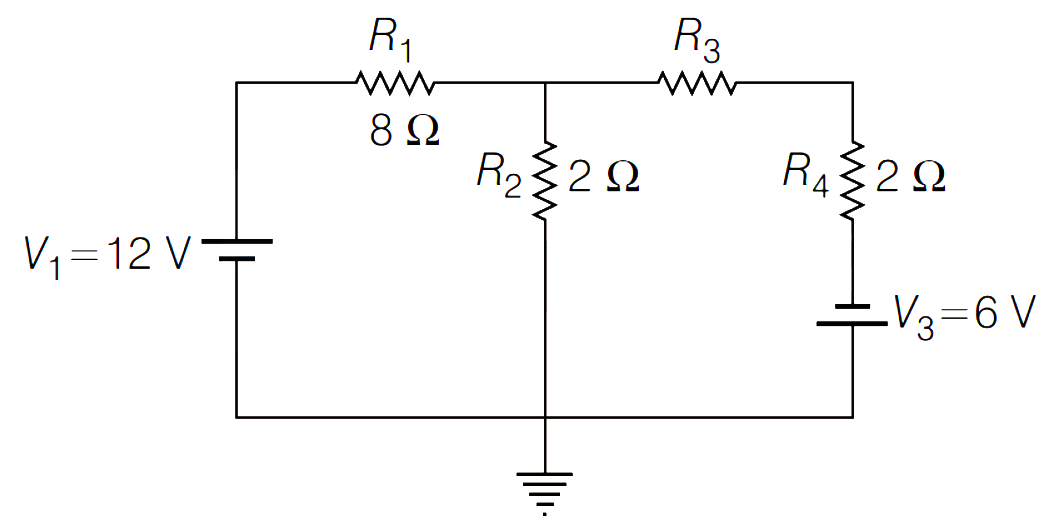 TS EAMCET 2018 Easy
 - Moment of inertia of a body about an axis is \(4 \mathrm{~kg}-\mathrm{m}^2\). The body is initially at rest and a torque of \(8 \mathrm{~N}\)-m starts acting on it along the same axis. Work done by the torque in \(20 \mathrm{~s}\), in joules, isTS EAMCET 2013 Medium
- The limit of resolution of a telescope is \(25 \times 10^{-7} \mathrm{rad}\). If the telescope is used to detect light of wavelength \(500 \mathrm{~nm}\) coming from a star, the diameter of the objective lens used by telescope isTS EAMCET 2019 Easy
More PYQs from TS EAMCET
- A movable steel plate is placed between fixed steel and brass plates and the stack of plates is subjected to a weight of \(100 \mathrm{~N}\) as shown in the figure. The coefficient of kinetic friction for steel on steel is 0.57 and for steel on brass is 0.44 . Assuming that the entire weight comes onto the stack and that the weight of the plates is negligible in comparison to the applied weight, the force required to move the middle plate (in \(\mathrm{N}\) ) is
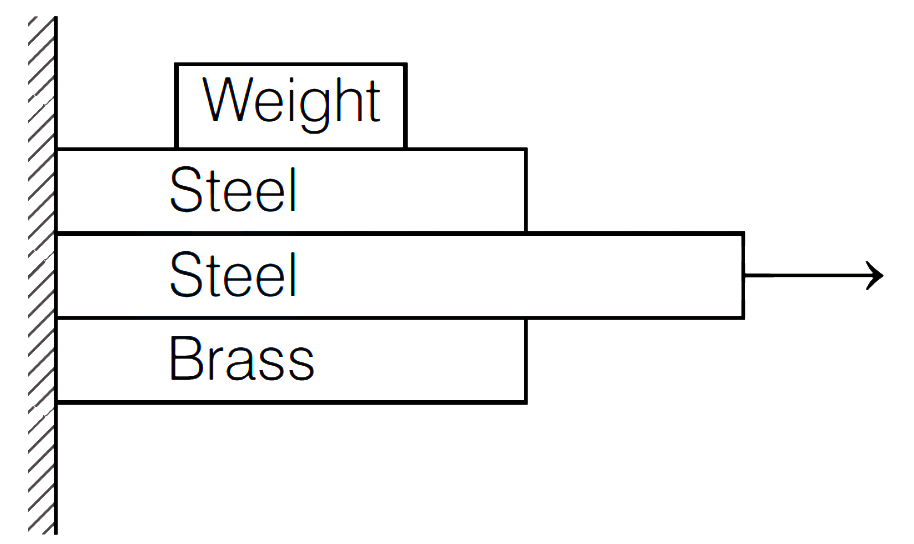 TS EAMCET 2018 Hard
 - An object of mass \(2 \mathrm{~kg}\) is hanging from a rope that is wrapped around a pulley of radius \(25 \mathrm{~cm}\). The mass of pulley is \(2 \mathrm{~kg}\). Find the acceleration of the object. (Assume, pulley to be a solid disk \(g=10 \mathrm{~m} / \mathrm{s}^2\) )
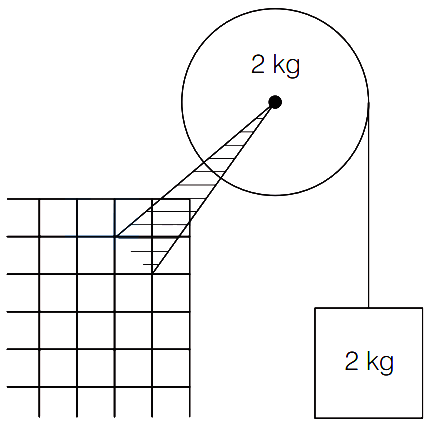 TS EAMCET 2020 Hard
 - A \(10 \mu \mathrm{~F}\) capacitor is charged by a 100 V battery. It is disconnected from the battery and is connected to another uncharged capacitor of capacitance \(30 \mu \mathrm{~F}\). During this process, the electrostatic energy lost by the first capacitor isTS EAMCET 2024 Easy
- A uniform circular disc of radius \(R\), lying on a frictionless horizontal plane is rotating with an angular velocity ' \(\omega\) ' about is its own axis. Another identical circular disc is gently placed on the top of the first disc coaxially. The loss in rotational kinetic energy due to friction between the two discs, as they acquire common angular velocity is ( \(I\) is moment of inertia of the disc)TS EAMCET 2013 Easy
- The resistance of a wire is \(20 \Omega\). It is stretched, so that the length becomes three times, then the new resistance of the wire will beTS EAMCET 2020 Easy
- A light rigid wire of length \(1 \mathrm{~m}\) is attached to a ball \(A\) of mass \(500 \mathrm{~g}\) to one end. The other end of the wire is fixed, so that the wire can rotate freely in the vertical plane about its fixed end. At the lowest point of the circular motion, the ball is given a horizontal velocity \(6 \mathrm{~m} / \mathrm{s}\). Determined the radial component of the acceleration of the ball, when this rigid wire makes an angle \(60^{\circ}\) with the upward vertical. (Take, \(g=10 \mathrm{~m} / \mathrm{s}^2\) )
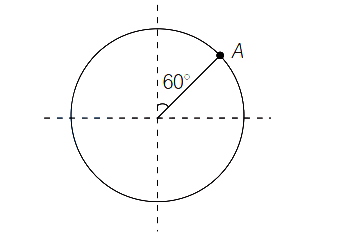 TS EAMCET 2019 Medium