


TS EAMCET · Physics · Rotational Motion
A uniform circular disc of radius \(R\), lying on a frictionless horizontal plane is rotating with an angular velocity ' \(\omega\) ' about is its own axis. Another identical circular disc is gently placed on the top of the first disc coaxially. The loss in rotational kinetic energy due to friction between the two discs, as they acquire common angular velocity is ( \(I\) is moment of inertia of the disc)
- A \(\frac{1}{8} / \omega^2\)
- B \(\frac{1}{4} / \omega^2\)
- C \(\frac{1}{2} / \omega^2\)
- D \(1 \omega^2\)
Answer & Solution
Correct Answer
(B) \(\frac{1}{4} / \omega^2\)
Step-by-step Solution
Detailed explanation
We know the KE of a rotational circular disc \[ \mathrm{KE}=\frac{1}{2} / \omega^2 \quad \text { and } \quad I=\frac{1}{2} M R^2 \] Hence, the resultant loss rotational KE will be the addition of both energy loss is \(=\frac{1}{4} / \omega^2\)
See the Complete Solution
Get step-by-step explanations for this and 2.5 Lakh+ more JEE, NEET & CET questions.
- Unlock all solutions
- Practice the full chapter
- Track accuracy across PYQs
4.8 rated on Google Play · 14,000+ reviews
More questions from Physics
- Two identical bar magnets of magnetic moment \(M\) each, are placed along \(X\) and \(Y\)-axes, respectively at a distance \(d\) from the origin (as shown in the figure). The origin lies on perpendicular bisector of magnet placed on \(X\)-axis and on the magnetic axis of magnet placed on \(Y\)-axis. If the magnitude of total magnetic field at the origin is \(B=\alpha\left[\frac{\mu_0}{4 \pi} \frac{M}{d^3}\right]\), then the value of constant \(\alpha\) will be \(\langle d>>l\), where \(l\) is the length of the bar magnets and direction of \(\mathrm{N}\) to \(\mathrm{S}\) in magnets is opposite with respect to each other)
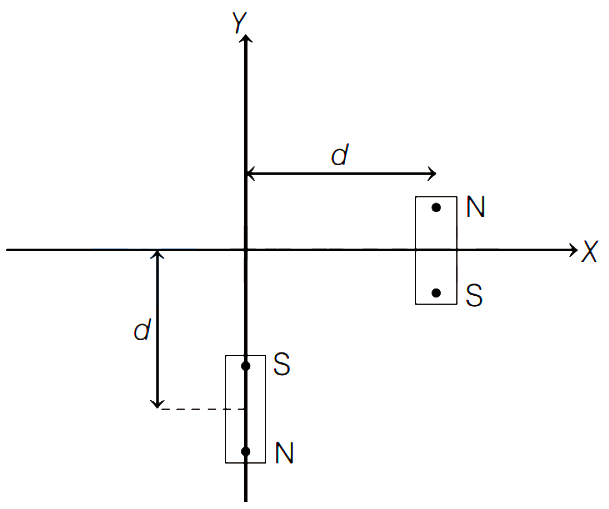 TS EAMCET 2018 Medium
 - Two coils have mutual inductance \(0.005 \mathrm{H}\). The current changes in the first coil according to equation \(I=I_0 \sin \omega t\), where \(I_0=10 \mathrm{~A}\) and \(\omega=100 \pi \mathrm{rad} \mathrm{s}\). The maximum value of induced emf in the second coil isTS EAMCET 2016 Medium
- A tension of \(20 \mathrm{~N}\) is applied to a copper wire of cross sectional area \(0.01 \mathrm{~cm}^2\), Young's modulus of copper is \(1.1 \times 10^{11} \mathrm{~N} / \mathrm{m}^2\) and Poisson's ratio is 0.32 . The decrease in cross sectional area of the wire isTS EAMCET 2013 Medium
- The electric flux from a cube of edge \(l\) is \(\phi\) in an enclosed charge. If the edge of the cube is made \(\frac{2}{3} l\) and the charge enclosed in the cube is doubled, then the electric flux value will beTS EAMCET 2020 Easy
- An electron revolves in a circle of radius \(0.4 Å\) with a speed of \(10^6 \mathrm{~m} / \mathrm{s}\) in a hydrogen atom. The magnetic field produced at the centre of the orbit due to the motion of the electron (in Tesla) is : \(\left[\mu_0=4 \pi \times 10^{-7} \mathrm{H} / \mathrm{m}\right.\), charge on the electron \(\left.=1.6 \times 10^{-19} \mathrm{C}\right]\)TS EAMCET 2002 Medium
- A metallic wire with tension \(T\) and at temperature \(30^{\circ} \mathrm{C}\) vibrates with its fundamental frequency of \(1 \mathrm{kHz}\). The same wire with the same tension but at \(10^{\circ} \mathrm{C}\) temperature vibrates with a fundamental frequency of \(1.001 \mathrm{kHz}\). The coefficient of linear expansion of the wire isTS EAMCET 2002 Hard
More PYQs from TS EAMCET
- The frequency of an alternating voltage is 50 Hz. The time taken for instantaneous voltage to increase from zero to half of its peak voltage isTS EAMCET 2025 Medium
- A solenoid of length \(2 \mathrm{~m}\) carries a current of \(20 \mathrm{~A}\). The diameter of the solenoid is \(3 \mathrm{~cm}\). If the magnetic field inside the solenoid is \(20 \mathrm{mT}\), then the length of wire forming the solenoid is (assume, \(\mu_0=4 \pi \times 10^{-7} \mathrm{H} / \mathrm{m}\) )TS EAMCET 2020 Easy
- A car driver is trying to jump across a path as shown in figure by driving horizontally off a cliff at the speed . When he touches peak (ignore air resistance), what would be speed? (use )
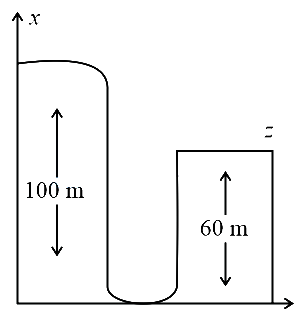 TS EAMCET 2021 Hard
 - Two strings \(A\) and \(B\) of lengths, \(L_A=80 \mathrm{~cm}\) and \(L_B=x \mathrm{~cm}\) respectively are used separately in a sonometer. The ratio of their densities \(\left(d_A / d_B\right)\) is 0.81 . The diameter of \(B\) is one-half that of \(A\). If the strings have the same tension and fundamental frequency the value of \(x\) is :TS EAMCET 2006 Medium
- A heavy uniform rope is suspended vertically from a ceiling and is in equilibrium. A pulse is generated at the bottom end of the rope as shown. As the pulse travels up the rope, its acceleration at any instant is ( \(\mathrm{g}\) is acceleration due to gravity)
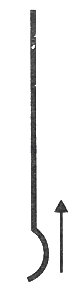 TS EAMCET 2023 Hard
 - A thin spherical shell of radius R and surface charge density \(\sigma\) is placed in a cube of side 5 R with their centers coinciding. The electric flux through one face of the cube is \(\left(\varepsilon_0=\right.\) Permittivity of free space \()\)TS EAMCET 2025 Medium