


TS EAMCET · Physics · Waves and Sound
Two identical wires have a fundamental frequency \(f_0\) when kept under the same tension \(T\). If the tension of one wire is increased by \(\Delta T\), then the \(N\) beats occur when both wires oscillate simultaneously.
- A \(\frac{\Delta T}{T}=\left(\frac{f_0+N}{f_0}\right)^2-1\)
- B \(\frac{\Delta T}{T}=\left(\frac{f_0}{f_0-N}\right)^2-1\)
- C \(\frac{\Delta T}{T}=\left(\frac{f_0-N}{f_0}\right)^2+1\)
- D \(\frac{\Delta T}{T}=\left(\frac{f_0+N}{f_0}\right)^2\)
Answer & Solution
Correct Answer
(A) \(\frac{\Delta T}{T}=\left(\frac{f_0+N}{f_0}\right)^2-1\)
Step-by-step Solution
Detailed explanation
Fundamental frequency of the wire, \[ f_0=\frac{v}{2 L}, \text { where } v=\sqrt{\frac{T}{\mu}} \] \(\begin{array}{ll}\Rightarrow & f_0=\frac{1}{2 L} \sqrt{\frac{T}{\mu}} \\ \Rightarrow & f_0 \propto \sqrt{T}\end{array}\) Dividing Eq. (ii) by Eq. (i), we get…
See the Complete Solution
Get step-by-step explanations for this and 2.5 Lakh+ more JEE, NEET & CET questions.
- Unlock all solutions
- Practice the full chapter
- Track accuracy across PYQs
4.8 rated on Google Play · 14,000+ reviews
More questions from Physics
- If the radius of the earth shrinks by \(1 \%\), its mass remaining the same, then the acceleration due to gravity on the earth surface wouldTS EAMCET 2020 Medium
- White light is used to illuminate the two slits in a Young's double experiment. The observed central fringe isTS EAMCET 2021 Easy
- A particle is executing simple harmonic motion (S.H.M.). Its acceleration at a distance of from the mean position is If its velocity is when it is at a distance of from its mean position, then the amplitude of S.H.M. is,TS EAMCET 2021 Hard
- The resistance of a wire is \(20 \Omega\). It is stretched, so that the length becomes three times, then the new resistance of the wire will beTS EAMCET 2020 Easy
- A transistor having a \(\beta\) equal to 80 has a change in base current of \(250 \mu \mathrm{A}\), then the change in collector current isTS EAMCET 2010 Easy
- The drift speed of electrons in a material is found to be \(0.3 \mathrm{~ms}^{-1}\) when an electric field of \(2 \mathrm{Vm}^{-1}\) is applied across it. The electron mobility (in \(\mathrm{m}^2 \mathrm{~V}^{-1} \mathrm{~s}^{-1}\) ) in the material isTS EAMCET 2025 Easy
More PYQs from TS EAMCET
- A meteor of mass ' \(m\) ' having a speed ' \(v\) ' at infinity reaches the surface of the earth with a speed of ( \(\mathrm{v}_{\mathrm{e}}\) is escape speed from the earth's surface)TS EAMCET 2025 Medium
- A capacitor of capacitance is charged to a potential difference of with a battery. The battery is then removed and in its place another capacitor of capacitance is introduced and the circuit is closed. The potential difference attained by each of the capacitors in isTS EAMCET 2019 Easy
- If the displacement of a body is given by \(x=3 \cos \left[2 \pi t+\frac{\pi}{4}\right] \mathrm{m}\), then the acceleration of the body at \(t=2 \mathrm{~s}\) isTS EAMCET 2019 Easy
- A piece of metal weighs \(45 \mathrm{~g}\) in air and \(25 \mathrm{~g}\) in a liquid of density \(1.5 \times 10^3 \mathrm{~kg}^{-3} \mathrm{~m}^{-3}\) kept at \(30^{\circ} \mathrm{C}\). When the temperature of the liquid is raised to \(40^{\circ} \mathrm{C}\), the metal piece weighs \(27 \mathrm{~g}\). The density of liquid at \(40^{\circ} \mathrm{C}\) is \(1.25 \times 10^3 \mathrm{~kg}-\mathrm{m}^{-3}\). The coefficient of linear expansion of metal isTS EAMCET 2009 Medium
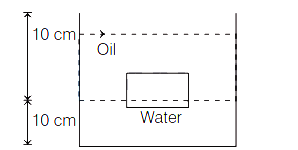
- A cubical block of wood, of length \(10 \mathrm{~cm}\), floats at the interface between oil of density \(800 \mathrm{~kg} / \mathrm{m}^3\) and water. The lower surface of the block is \(1.5 \mathrm{~cm}\) below the interface. If the depth of water is \(10 \mathrm{~cm}\) below the interface and oil is upto \(10 \mathrm{~cm}\) above the interface then the difference in pressure at the lower and the upper face of the wooden block is (Assume density of water, \(\rho=1000 \mathrm{~kg} / \mathrm{m}^3\) and acceleration of gravity, \(g=10 \mathrm{~m} / \mathrm{s}^2\) )
 TS EAMCET 2019 Medium
 - An electron revolves in a circle of radius \(0.4 Å\) with a speed of \(10^6 \mathrm{~m} / \mathrm{s}\) in a hydrogen atom. The magnetic field produced at the centre of the orbit due to the motion of the electron (in Tesla) is : \(\left[\mu_0=4 \pi \times 10^{-7} \mathrm{H} / \mathrm{m}\right.\), charge on the electron \(\left.=1.6 \times 10^{-19} \mathrm{C}\right]\)TS EAMCET 2002 Medium