


TS EAMCET · Physics · Ray Optics
Two convex lenses of focal lengths \(20 \mathrm{~cm}\) and \(30 \mathrm{~cm}\) are placed in contact with each other co-axially. The focal length of the combination is
- A \(60 \mathrm{~cm}\)
- B \(10 \mathrm{~cm}\)
- C \(12 \mathrm{~cm}\)
- D \(43 \mathrm{~cm}\)
Answer & Solution
Correct Answer
(C) \(12 \mathrm{~cm}\)
Step-by-step Solution
Detailed explanation
\(\mathrm{f}_1=20 \mathrm{~cm} ; \mathrm{f}_2=30 \mathrm{~cm}\) The focal length of the combination is \[ \begin{aligned} & \frac{1}{F}=\frac{1}{f_1}+\frac{1}{f_2}=\frac{1}{20}+\frac{1}{30}=\frac{3+2}{60}=\frac{5}{60}=\frac{1}{12} \\ & F=12 \mathrm{~cm} \end{aligned} \]
See the Complete Solution
Get step-by-step explanations for this and 2.5 Lakh+ more JEE, NEET & CET questions.
- Unlock all solutions
- Practice the full chapter
- Track accuracy across PYQs
4.8 rated on Google Play · 14,000+ reviews
More questions from Physics
- Two bar magnets \(A\) and \(B\) are placed one over the other and are allowed to vibrate in a vibration magnetometer. They make 20 oscillations per minute when the similar poles of \(A\) and \(B\) are on the same side, while they make 15 oscillations per minute when their opposite poles lie on the same side. If \(M_A\) and \(M_B\) are the magnetic moments of \(A\) and \(B\) and if \(M_A>M_B\), the ratio of \(M_A\) and \(M_B\) isTS EAMCET 2009 Easy
- A straight wire of length 20 cm carrying a current of \(\frac{3}{\pi^2}\) \(A\) is bent in the form of a circle. The magnetic field at the centre of the circle isTS EAMCET 2024 Medium
- If \(n_e\) and \(n_h\) are electron and hole concentrations in an extrinsic semiconductor and \(n_i\) is electron concentrations in an intrinsic semiconductor, thenTS EAMCET 2015 Easy
- The time period of a simple pendulum is \(T\). When the length is increased by \(10 \mathrm{~cm}\), its period is \(T_1\). When the length is decreased by \(10 \mathrm{~cm}\), its period is \(T_2\). Then, relation between \(T, T_1\) and \(T_2\) isTS EAMCET 2004 Medium
- Assertion A thermos bottle consists of a double walled glass vessel with the space between the two walls evacuated, so that the heat transfer between the contents of the bottle and outside is minimised. Reason The vacuum between the two walls inhibits the heat transfer by radiation mechanism. Which of the following is correct?TS EAMCET 2020 Easy
- The cold junction of a thermocouple is at \(0^{\circ} \mathrm{C}\). The thermo e.m.f produced in the thermocouple is given by an equation \(E=16 T-0.04 T^2\), where \(T\) is the temperature of the hot junction. The temperature of inversion and neutral temperature of the thermocouple areTS EAMCET 2002 Hard
More PYQs from TS EAMCET
- The gravitational force acting on a particle, due to a solid sphere of uniform density and radius \(R\), at a distance of \(3 R\) from the centre of the sphere is \(F_1\). A spherical hole of radius \((R / 2)\) is now made in the sphere as shown in the figure. The sphere with hole now exerts a force \(F_2\) on the same particle. Ratio of \(F_1\) and \(F_2\) is
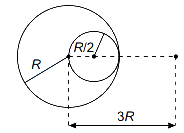 TS EAMCET 2013 Hard
 - A particle moves over a plane with a constant acceleration . At the time the velocity is The speed of the particle when it is displaced by parallel to the -axis is,TS EAMCET 2021 Medium
- The work function of a certain metal is \(3.31 \times 10^{-19} \mathrm{~J}\). Then, the maximum kinetic energy of photoelectrons emitted by incident radiation of wavelength \(5000 Å\) is \(\begin{aligned} & \text { (Given, } h=6.62 \times 10^{-34} \mathrm{~J}-\mathrm{s}, c=3 \times 10^8 \mathrm{~ms}^{-1} \text {, } \ & e=1.6 \times 10^{-19} \mathrm{C} \text { ) } \end{aligned}\)TS EAMCET 2009 Medium
- A wheel of radius \(0.4 \mathrm{~m}\) can rotate freely about its axis as shown in the figure. A string is wrapped over its rim and a mass of \(4 \mathrm{~kg}\) is hung. An angular acceleration of 8 rad- \(\mathrm{s}^{-2}\) is produced in it due to the torque. Then, moment of inertia of the wheel is \(\left(g=10 \mathrm{~ms}^{-2}\right)\)TS EAMCET 2009 Easy
- How much thermal energy is required to change a \(40 \mathrm{~g}\) ice cube from solid at \(-10^{\circ} \mathrm{C}\) to steam at \(110^{\circ} \mathrm{C}\) ? [Assume, latent heat of fusion for water \(=80 \mathrm{kcal} / \mathrm{kg}\), specific heat of water \(=1 \mathrm{kcal} / \mathrm{kg}^{\circ} \mathrm{C}\), specific heat of ice \(=0.5 \mathrm{kcal} / \mathrm{kg}^{\circ} \mathrm{C}\), specific heat of steam \(=0.48 \mathrm{kcal} / \mathrm{kg}^{\circ} \mathrm{C}\), latent heat of vaporisation of water \(\left.=540 \mathrm{kcal} / \mathrm{kg}^{\circ} \mathrm{C}\right]\)TS EAMCET 2020 Easy
- A point charge of is placed in the plane at a location with radius vector The electric field strength and its magnitude at a point with radius vector isTS EAMCET 2018 Medium