


TS EAMCET · Physics · Work Power Energy
The work done in displacing a particle from \(y=a\) to \(y=2 a\) by a force \(-\frac{\mathrm{K}}{y^2}\) acting along \(y\)-axis is
- A \(-\frac{5 \mathrm{~K}}{8 a}\)
- B \(-\frac{14 \mathrm{~K}}{8 a^3}\)
- C \(-\frac{ \mathrm{~K}}{ a^2}\)
- D \(-\frac{ \mathrm{~K}}{2 a}\)
Answer & Solution
Correct Answer
(D) \(-\frac{ \mathrm{~K}}{2 a}\)
Step-by-step Solution
Detailed explanation
\(W = \int_{a}^{2a} F \, dy\) \(W = \int_{a}^{2a} \left(-\frac{K}{y^2}\right) \, dy\) \(W = -K \left[ -\frac{1}{y} \right]_{a}^{2a}\) \(W = K \left( \frac{1}{2a} - \frac{1}{a} \right)\) \(W = K \left( \frac{1 - 2}{2a} \right)\) \(W = -\frac{K}{2a}\)
See the Complete Solution
Get step-by-step explanations for this and 2.5 Lakh+ more JEE, NEET & CET questions.
- Unlock all solutions
- Practice the full chapter
- Track accuracy across PYQs
4.8 rated on Google Play · 14,000+ reviews
More questions from Physics
- In a photoelectric effect experiment the cathode metal is exposed to light of wavelength \(600 \mathrm{~nm}\). The maximum kinetic energy of the ejected electron doubles when light of wavelength \(400 \mathrm{~nm}\) is used. The work function of the cathode metal is approximately. [Use \(h=6.63 \times 10^{-34} \mathrm{~J}-\mathrm{s}, c=3 \times 10^8 \mathrm{~m} / \mathrm{s}\) ]TS EAMCET 2021 Hard
- A particle moving along \(X\)-axis has acceleration \(f\) at time \(t\) given by \(f=f_0\left(1-\frac{t}{T}\right)\), where \(f_0\) and \(T\) are constants. The particle at \(t=0\) has zero velocity. In the time interval between \(t=0\) and the instant when \(f=0\), the particle's velocity isTS EAMCET 2020 Medium
- Consider a spongy block of mass \(m\) floating on a flowing river. The maximum mass of the block is related to the speed of the river flow \(v\), acceleration due to gravity \(g\) and the density of the block \(\rho\) such that \(m_{\max }=k v^x g^y \rho^z(k\) is constant \()\). The values of \(x, y\) and \(z\) should then respectively be
(Mass of the spongy block is assumed to vary due to absorption of water by it)TS EAMCET 2019 Medium - The tyre of a motor car contains air at \(15^{\circ} \mathrm{C}\). If the temperature increases to \(35^{\circ} \mathrm{C}\), the approximate percentage increase in pressure is (ignore to expansion of tyre)TS EAMCET 2005 Medium
- A sphere '1' with radius \(\mathrm{R}\) has charge \(\mathrm{q}\). Sphere '2' with radius \(3 \mathrm{R}\) is far from sphere ' 1 ' and is initially uncharged. If the two spheres are now connected with a thin conducting wire, then the ratio \(\frac{\sigma_1}{\sigma_2}\) of the surface charge densities isTS EAMCET 2022 Medium
- The amplitude of a particle executing simple harmonic motion is 6 cm. The distance of the point from the mean position at which the ratio of the potential and kinetic energies of the particle becomes 4:5 isTS EAMCET 2025 Medium
More PYQs from TS EAMCET
- Consider an object kept at the centre, in the \(X Y\)-plane, on which five coplanar forces act as shown in the figure. The resultant force on the object is
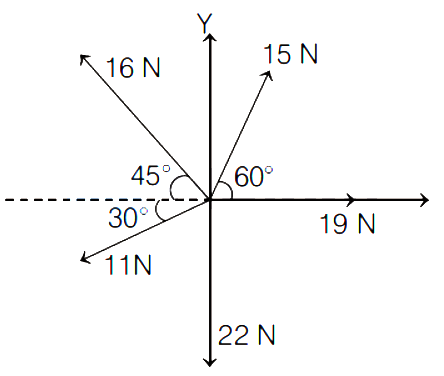 TS EAMCET 2018 Medium
 - Infinite number of spheres, each of mass \(m\) are placed on the \(X\)-axis at distances \(1,2,4,8\), 16 ...... metres from origin. The magnitude of the gravitational field at the origin isTS EAMCET 2015 Easy
- In an ideal step up transformer, if the input voltage and input power are \(\mathrm{V}_1\) and \(\mathrm{P}_1\) respectively and the output voltage and output power are \(\mathrm{V}_2\) and \(\mathrm{P}_2\) respectively, thenTS EAMCET 2023 Easy
- A uniform sphere of radius \(R\) and mass \(m\) is placed on an inclined plane which makes an angle \(45^{\circ}\) to the horizontal. For which of the following value of coefficient of friction, the sphere rolls without slipping. Select incorrect option.TS EAMCET 2019 Medium
- If the acceleration due to gravity \(g\) doubles and the radius of earth becomes half that of the present value, then the value of escape velocity is (Assume, \(g=10 \mathrm{~m} / \mathrm{s}^2\) and radius of earth, \(R=6400 \mathrm{~km}\) )TS EAMCET 2019 Easy
- The position of an object moving along \(X\)-axis is given by \(x=\alpha+\beta t^2\), where \(\alpha\) and \(\beta\) are constants with appropriate dimensions and \(t\) is time in seconds. The average velocity between \(t=2 \mathrm{~s}\) and \(4 \mathrm{~s}\) is \(12 \mathrm{~m} / \mathrm{s}\). If \(\alpha=8 \mathrm{~m}\), then the value of \(\beta\) isTS EAMCET 2020 Easy