


TS EAMCET · Physics · Motion In One Dimension
A particle moving along \(X\)-axis has acceleration \(f\) at time \(t\) given by \(f=f_0\left(1-\frac{t}{T}\right)\), where \(f_0\) and \(T\) are constants. The particle at \(t=0\) has zero velocity. In the time interval between \(t=0\) and the instant when \(f=0\), the particle's velocity is
- A \(\frac{1}{2} f_0 T^2\)
- B \(f_0 T^2\)
- C \(\frac{1}{2} f_0 T\)
- D \(f_0 T\)
Answer & Solution
Correct Answer
(C) \(\frac{1}{2} f_0 T\)
Step-by-step Solution
Detailed explanation
Acceleration of the particle is given as \(f=f_0\left(1-\frac{t}{T}\right)\) \(\ldots(\mathrm{i})\) \(\therefore\) Velocity of particle is given as, \(v=\int f d t=\int f_0\left(1-\frac{t}{T}\right) d t=f_0\left(t-\frac{t^2}{2 T}\right)+c\) \(\ldots(\mathrm{ii})\) Given that, at…
See the Complete Solution
Get step-by-step explanations for this and 2.5 Lakh+ more JEE, NEET & CET questions.
- Unlock all solutions
- Practice the full chapter
- Track accuracy across PYQs
4.8 rated on Google Play · 14,000+ reviews
More questions from Physics
- A horizontal aluminium rod of diameter \(4 \mathrm{~cm}\) projected \(6 \mathrm{~cm}\) from a wall. An object of mass \(400 \pi \mathrm{kg}\) is suspended from the end of the rod. The shearing modulus of aluminium is \(3.0 \times 10^{10} \mathrm{~N} / \mathrm{m}^2\). The vertical deflection of the end of the rod is \(\left(\because g=10 \mathrm{~m} / \mathrm{s}^2\right)\)TS EAMCET 2019 Easy
- As shown in the figure, a dielectric of constant K is placed between the plates of a parallel plate capacitor and is charged to a potential V using a battery. If the dielectric is pulled out after disconnecting the battery from the capacitor, the final potential difference across the plates of the capacitor is
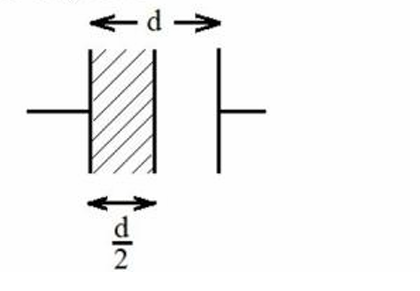 TS EAMCET 2025 Medium
 - Consider an ideal gas at pressure \(p\), volume \(V\) and temperature \(T\). The mean free path for molecules of the gas is \(L\). If the radius of gas molecules, as well as pressure, volume and temperature of the gas are doubled, then the mean free path will beTS EAMCET 2019 Medium
- Three logic gates are connected as shown in the figure. If the inputs are \(\mathrm{A}=1, \mathrm{~B}=0\) and \(\mathrm{C}=1\), then the values of \(y_1, y_2\) and \(y_3\) respectively are
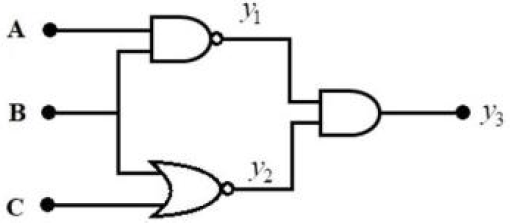 TS EAMCET 2025 Medium
 - The error in the measurement of resistance, when \((10 \pm 0.5)\) A current passing through it produces a potential difference of \((100 \pm 6) \mathrm{V}\) across it isTS EAMCET 2024 Easy
- A tank of height \(15 \mathrm{~m}\) and cross-section area \(10 \mathrm{~m}^2\) is filled with water. There is a small hole of cross-section area \(a\) which is much smaller than the container, located at a height of \(12 \mathrm{~m}\) from the base of the container. How much force should be applied with a piston at the top level, so that the water coming out of the hole hits the ground at a distance of \(16 \mathrm{~m}\) ? (Take, density of water \(=1000 \mathrm{~kg} \mathrm{~m}^{-3}\) )
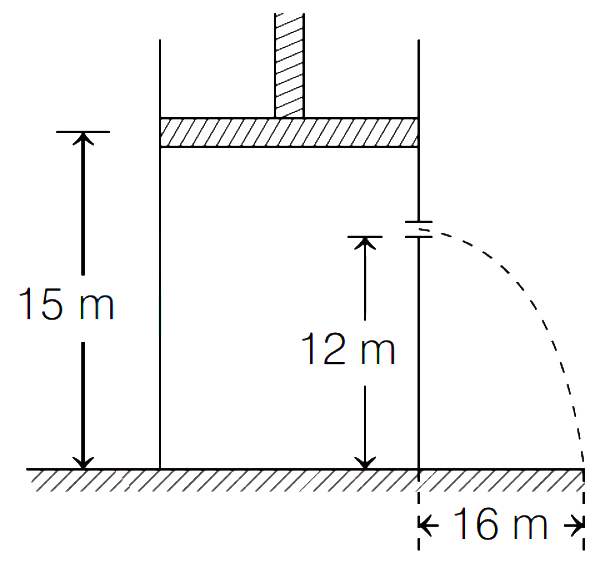 TS EAMCET 2018 Medium
More PYQs from TS EAMCET
- A message signal of frequency is used to modulate a carrier of frequency If the side bands are and then the ratio isTS EAMCET 2021 Medium
- An alpha particle moving with certain speed towards east enters a uniform magnetic field directed vertically up. The alpha particle will then move inTS EAMCET 2025 Easy
- An object moves along the circle with normal acceleration proportional to , where is the time and is a positive constant. The power developed by all the forces acting on the object will have time dependence proportional toTS EAMCET 2018 Hard
- An object moves in a straight line with deceleration whose magnitude varies with velocity as \(3 v^{2 / 3}\). If at an initial point, the velocity is \(8 \mathrm{~m} / \mathrm{s}\), then the distance travelled by the object before it stops isTS EAMCET 2018 Medium
- A \(10 \mu \mathrm{~F}\) capacitor is charged by a 100 V battery. It is disconnected from the battery and is connected to another uncharged capacitor of capacitance \(30 \mu \mathrm{~F}\). During this process, the electrostatic energy lost by the first capacitor isTS EAMCET 2024 Easy
- In a \(p-n\) junction diode, an electric field of magnitude \(2 \times 10^5 \mathrm{~V} /\) mexists in the depletion region. A particle with charge \(-3 e\) can diffuse from \(n\)-side to \(p\)-side, if it has minimum kinetic energy \(0.6 \mathrm{eV}\). The width of the depletion region of the \(p-n\) junction isTS EAMCET 2018 Easy