


TS EAMCET · Physics · Waves and Sound
The speed of a transverse wave on a string is \(160 \mathrm{~m} / \mathrm{s}\). If the three resonant frequencies of this string respectively are \(160 \mathrm{~Hz}, 240 \mathrm{~Hz}\) and \(400 \mathrm{~Hz}\), the length of the string is
- A \(80 \mathrm{~cm}\)
- B \(100 \mathrm{~cm}\)
- C \(160 \mathrm{~cm}\)
- D \(200 \mathrm{~cm}\)
Answer & Solution
Correct Answer
(B) \(100 \mathrm{~cm}\)
Step-by-step Solution
Detailed explanation
Resonant frequencies are 160,240 and \(400 \mathrm{~Hz}\), so their simplest ratios are 160:240:400. i.e. \[ 2: 3: 5 \] Hence, 160 is second harmonic \[ \Rightarrow \quad 160=\frac{n v}{2} \text {, where } n=2 \] Substituting \(n=2\) and \(v=160 \mathrm{~ms}^{-1}\), we get…
See the Complete Solution
Get step-by-step explanations for this and 2.5 Lakh+ more JEE, NEET & CET questions.
- Unlock all solutions
- Practice the full chapter
- Track accuracy across PYQs
4.8 rated on Google Play · 14,000+ reviews
More questions from Physics
- The ratio of radii of gyration of a thin circular ring and a circular disc of same radius about a tangential axis in their own planes is \(\sqrt{12}: \sqrt{\mathrm{K}}\). The value of K isTS EAMCET 2025 Medium
- A circular coil of area \(3 \times 10^{-2} \mathrm{~m}^2, 900\) turns and a resistance of \(1.8 \Omega\) is placed with its plane perpendicular to a uniform magnetic field of \(3.5 \times 10^{-5} \mathrm{~T}\). The current induced in the coil when it is rotated through \(180^{\circ}\) in half a second isTS EAMCET 2025 Medium
- In the Young's double slit experiment, the intensities at two points \(P_1\) and \(P_2\) on the screen are respectively \(I_1\) and \(I_2\). If \(P_1\) is located at the centre of a bright fringe and \(P_2\) is located at a distance equal to a quarter of fringe width from \(P_1\), then \(\frac{I_1}{I_2}\) isTS EAMCET 2009 Easy
- In Young's double slit experiment for what order does the wavelength of red light \((\lambda=780 \mathrm{~nm})\) coincide with \((\mathrm{m}+1)^{\text {th }}\) order of blue light \((\lambda=520 \mathrm{~nm})\)TS EAMCET 2022 Easy
- The ratio of the kinetic energies of the electrons in the third and fourth excited states of hydrogen atom isTS EAMCET 2025 Medium
- A metal disc of radius \(30 \mathrm{~cm}\) rotates with a constant angular velocity \(\omega=100 \mathrm{rad} / \mathrm{s}\) about its axis. Find the magnitude of potential difference between the centre and the rim of the disc of external uniform magnetic field of induction \(\mathrm{B}=4 \mathrm{mT}\) is directed perpendicular to the disc.TS EAMCET 2022 Medium
More PYQs from TS EAMCET
- A merry-go-round rotating at a constant angular speed completes 9 rotations in 18 seconds. What is its angular speed?TS EAMCET 2022 Easy
- A wooden cubical block of mass, \(m=20 \mathrm{~kg}\) is measured within an error of \(10 \mathrm{~g}\). Its side length, \(l=100 \mathrm{~cm}\) is measured within an error of \(1 \mathrm{~mm}\). Then, the relative error in the measurement of its density isTS EAMCET 2018 Easy
- The truth table of a logic gate is given below. then identify the gate.
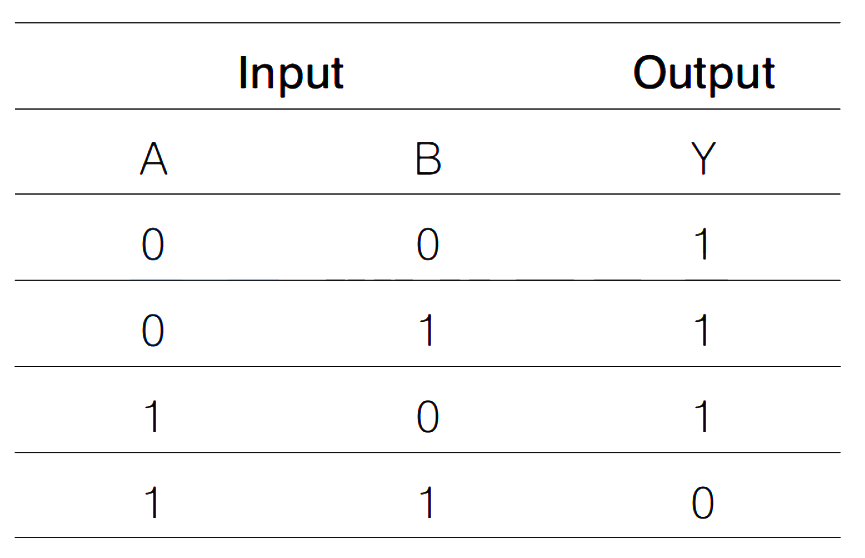 TS EAMCET 2019 Easy
 - A block of mass \(10 \mathrm{~kg}\), initially at rest, makes a downward motion on \(45^{\circ}\) inclined plane. Then the distance travelled by the block after \(2 \mathrm{~s}\) is (Assume the coefficient of kinetic friction to be 0.3 and \(g=10 \mathrm{~ms}^{-2}\) )TS EAMCET 2019 Hard
- A rectangular loop of wire is placed in the \(X Y\)-plane with its side of length \(3 \mathrm{~cm}\) parallel to the \(X\)-axis and the side of length \(4 \mathrm{~cm}\) parallel to the \(Y\)-axis. It is moving in the positive \(X\)-direction with the speed \(10 \mathrm{~cm} / \mathrm{s}\). A magnetic field exists in the space with its direction parallel to the \(Z\)-axis. The field decreases by \(2 \times 10^{-3} \mathrm{~T} / \mathrm{cm}\) along the positive \(X\)-axis and increases in time by \(2 \times 10^{-2} \mathrm{~T} / \mathrm{s}\). The induced emf in the wire isTS EAMCET 2018 Medium
- A TV transmission tower of height \(h\) covers a range of distance \(d\). By how much will be the range change, if the height is increased to \(3 / 2 \mathrm{~h} ?\)TS EAMCET 2021 Easy