


TS EAMCET · Physics · Wave Optics
Light consisting of a plane waves of wavelength, \(\lambda_1=8 \times 10^{-5} \mathrm{~cm}\) and \(\lambda_2=6 \times 10^{-5} \mathrm{~cm}\) generates an interference pattern in Young's double slit experiment. If \(n_1\) denotes the \(n_1\) th dark fringe due to light of wavelength \(\lambda_1\) which coincides with \(n_2\) th bright fringe due to light of wavelength \(\lambda_2\), then
- A \(n_1=3, n_2=1\)
- B \(n_1=4, n_2=5\)
- C \(n_1=1, n_2=2\)
- D \(n_1=3, n_2=2\)
Answer & Solution
Correct Answer
(C) \(n_1=1, n_2=2\)
Step-by-step Solution
Detailed explanation
Given, \(\lambda_1=8 \times 10^{-5} \mathrm{~cm}\) and \(\lambda_2=6 \times 10^{-5} \mathrm{~cm}\) Position \(n^{\text {h }}\), dark fringe (due to light of wavelength \(\lambda_1\) ) is given by, \(x_{n_1}=\left(2 n_1 \times 1\right) \frac{D \lambda_1}{2 d}\) Position of…
See the Complete Solution
Get step-by-step explanations for this and 2.5 Lakh+ more JEE, NEET & CET questions.
- Unlock all solutions
- Practice the full chapter
- Track accuracy across PYQs
4.8 rated on Google Play · 14,000+ reviews
More questions from Physics
- A body is projected vertically upwards from the surface of the earth with a velocity equal to half the escape velocity. If \(R\) is the radius of the earth, maximum height attained by the body from the surface of the earth isTS EAMCET 2009 Hard
- A fully charged capacitor has a capacitance \(C\). It is discharged through a small coil of resistance wire, embedded in a block of specific heat \(s\) and mass \(m\) under thermally isolated conditions. If the temperature of the block is raised by \(\Delta T\), the potential difference \(V\) across the capacitor initially isTS EAMCET 2011 Medium
- When a large bubble rises from the bottom of a lake to the surface, the volume of the bubble becomes 5 times its volume at the bottom of the lake. If \(\mathrm{H}\) is the atmospheric pressure expressed in terms of water column height, then the depth of the lake is (The temperature of the water in the lake is same at all points)TS EAMCET 2023 Medium
- The graph between the input voltage \(\left(\mathrm{V}_{\mathrm{i}}\right)\) and the output voltage \(\left(\mathrm{V}_{\mathrm{o}}\right)\) of a transistor connected in common emitter configuration is shown in the figure. The active, saturation and cutoff regions of the transistor are respectively
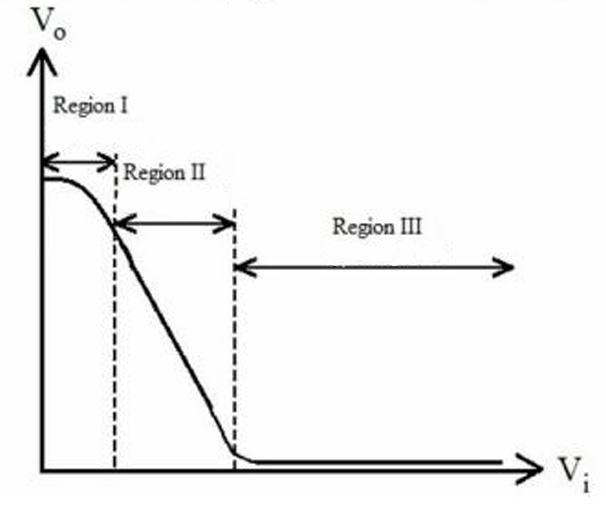 TS EAMCET 2025 Medium
 - A light bulb of power is placed at the centre of a hollow sphere of radius If the of the energy is converted into light, then the pressure exerted by the light on the surface of the sphere will be
(Assume the surface of sphere to be perfectly absorbing)TS EAMCET 2021 Easy - In Young's double slit interference experiment the wavelength of light used is \(6000 Å\). If the path difference between waves reaching a point \(P\) on the screen is 1.5 microns, then at that point \(P\).TS EAMCET 2002 Easy
More PYQs from TS EAMCET
- A carrier signal of frequency and peak voltage of is modulated by a message signal of frequency and peak voltage of . Let be the modulation index and be side bands produced. The correct statement isTS EAMCET 2020 Easy
- A block of mass \(4 m\) travelling at a velocity \(v_1\) in \(x\)-direction on a frictionless horizontal plane makes a head-on collision with another block of mass \(2 m\) travelling in opposite direction with a velocity \(v_2\). After collision, both the blocks travel as a single block along \(x\)-direction with a final velocity \(5 v_2\). The ratio of velocities \(\frac{v_1}{v_2}\) isTS EAMCET 2018 Easy
- If the amplitude of the magnetic field part of a harmonic electromagnetic wave in vacuum is 270 nT , the amplitude of the electric field part of the wave isTS EAMCET 2024 Easy
- A uniform rope of mass \(0.1 \mathrm{~kg}\) and length \(2.45 \mathrm{~m}\) hangs from a rigid support. The time taken by the transverse wave formed in the rope to travel through the full length of the rope is (Assume \(g=9.8 \mathrm{~m} / \mathrm{s}^2\) )TS EAMCET 2012 Easy
- X-rays of wavelength \(0.140 \mathrm{~nm}\) are scattered from a block of carbon. What will be the wavelengths of \(X\)-rays scattered at \(90^{\circ}\) ?TS EAMCET 2008 Medium
- A charged particle is accelerated from rest through a certain potential difference. The de-Broglie wavelength is \(\lambda_1\) when it is accelerated through \(V_1\) and is \(\lambda_2\) when accelerated through \(V_2\). The ratio \(\lambda_1 / \lambda_2\) isTS EAMCET 2016 Easy