


TS EAMCET · Physics · Kinetic Theory of Gases
If the rms speed of the molecules of a gas at a temperature of \(77^{\circ} \mathrm{C}\) is \(50 \mathrm{~ms}^{-1}\), then the rms speed of the same gas molecules at a temperature of \(150.5^{\circ} \mathrm{C}\) is
- A \(65 \mathrm{~ms}^{-1}\)
- B \(35 \mathrm{~ms}^{-1}\)
- C \(55 \mathrm{~ms}^{-1}\)
- D \(45 \mathrm{~ms}^{-1}\)
Answer & Solution
Correct Answer
(C) \(55 \mathrm{~ms}^{-1}\)
Step-by-step Solution
Detailed explanation
\(T_1 = 77 + 273 = 350 \mathrm{~K}\) \(T_2 = 150.5 + 273 = 423.5 \mathrm{~K}\) \(v_2 = v_1 \sqrt{\frac{T_2}{T_1}}\) \(v_2 = 50 \sqrt{\frac{423.5}{350}}\) \(v_2 = 50 \sqrt{1.21}\) \(v_2 = 50 \times 1.1 = 55 \mathrm{~ms}^{-1}\)
See the Complete Solution
Get step-by-step explanations for this and 2.5 Lakh+ more JEE, NEET & CET questions.
- Unlock all solutions
- Practice the full chapter
- Track accuracy across PYQs
4.8 rated on Google Play · 14,000+ reviews
More questions from Physics
- The resistance of a thermometer is \(100 \Omega\) at the triple point of water \((273 \mathrm{~K})\) ) and is \(300 \Omega\) at the melting point of gold \((-873 \mathrm{~K})\). The temperature at which the resistance of the thermometer is \(200 \Omega\) isTS EAMCET 2018 Easy
- How much pressure (in atm) is needed to compress a sample of water by \(0.4 \%\) ? (Assume, Bulk modulus of water \(\approx 2.0 \times 10^9 \mathrm{~Pa}\) )TS EAMCET 2019 Easy
- A thin prism of angle \(6^{\circ}\) made of glass of refractive index 1.5 is combined with another prism made of refractive index 1.75 to produce dispersion without deviation. Then, the angle of the second prism isTS EAMCET 2020 Easy
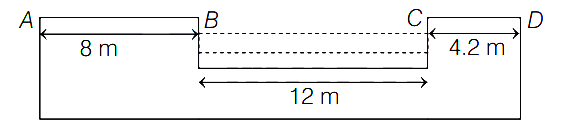
- A projectile is launched from point \(A\) of the given landscape with a water body as shown in the diagram. The launching angle is \(15^{\circ}\). From the following, identify the right initial velocity of the projectile with which it will fall somewhere in between the points \(C\) and D. [Assume, \(g=10 \mathrm{~m} / \mathrm{s}^2\) ]
 TS EAMCET 2020 Hard
 - A car is travelling with linear velocity ' \(\mathrm{V}\) ' on a circular road of radius ' \(r\) '. If its velocity is increasing at a rate of ' \(a\) ' \(\mathrm{ms}^{-2}\), then the resultant acceleration will beTS EAMCET 2023 Medium
- If the length of a thin uniform rod is ' \(L\) ' and the radius of gyration of the rod about an axis perpendicular to its length and passing through one end is \(K\), then \(K: L=\)TS EAMCET 2025 Medium
More PYQs from TS EAMCET
- A particle is moving in a circle of radius \(5 \mathrm{~cm}\) with uniform speed and completes the circle in \(5 \mathrm{~s}\). What is the magnitude of linear acceleration?TS EAMCET 2021 Easy
- A rod of length \(L\) revolves in a horizontal plane about the axis passing through its centre and perpendicular to its length. The angular velocity of the \(\operatorname{rod}\) is \(\omega\). If \(A\) is the area of cross-section of the rod and \(\rho\) is its density, then the rotational kinetic energy of the rod isTS EAMCET 2020 Medium
- If Planck's constant is \(6.63 \times 10^{-34} \mathrm{Js}\), then the slope of a graph drawn between cut off voltage and frequency of incident light in a photoelectric experiment isTS EAMCET 2024 Easy
- The work function of the nickel is \(5 \mathrm{eV}\). When a light of wavelength \(2000 Å\) falls on it, it emits photoelectrons in the circuit. Then the potential difference necessary to stop the fastest electrons emitted is (given \(\left.h=6.67 \times 10^{-34} \mathrm{~J}-\mathrm{s}\right)\)TS EAMCET 2007 Medium
- Statement (I) : A uniform electric field and a uniform magnetic field are pointed in the same direction. If an electron is projected in the same direction the electron velocity will decrease in magnitude. Statement (II) : Two infinite long parallel wires are carrying current in the same direction. The magnetic field at a point midway between the wires is zero. Statement (III) : No net force acts on a rectangular coil carrying a steady current when suspended in a uniform magnetic field. Which of the following is correct?TS EAMCET 2022 Medium
- An electron in n-region of a p-n junction moves towards the junction with a speed of \(5 \times 10^5 \mathrm{~ms}^{-1}\). If the barrier potential of the junction is 0.45 V, then the speed with which the electron enters the p-region after penetration through the barrier is (Charge of the electron \(=1.6 \times 10^{-19} \mathrm{C}\) and mass of the electron \(=9 \times 10^{-31} \mathrm{~kg}\) )TS EAMCET 2025 Medium