


TS EAMCET · Physics · Thermodynamics
An ideal gas has molar heat capacity \(C_V\) at constant volume. The gas undergoes a process where in the temperature changes as \(T=T_0\left(1+\alpha V^2\right)\), where, \(T\) and \(V\) are temperature and volume respectively, \(T_0\) and \(\alpha\) are positive constants. The molar heat capacity \(C\) of the gas is given as \(C=C_V+R f(V)\), where, \(f(V)\) is a function of volume. The expression for \(f(V)\) is
- A \(\frac{\alpha V^2}{1+\alpha V^2}\)
- B \(\frac{1+\alpha V^2}{2 \alpha V^2}\)
- C \(\alpha V^2\left(1+\alpha V^2\right)\)
- D \(\frac{1}{2 \alpha V^2\left(1+\alpha V^2\right)}\)
Answer & Solution
Correct Answer
(B) \(\frac{1+\alpha V^2}{2 \alpha V^2}\)
Step-by-step Solution
Detailed explanation
Given, \(T=T_0\left(1+\alpha V^2\right)\) \[ \begin{aligned} & \Rightarrow \quad \frac{d T}{d V}=\mathrm{T}_0 \cdot 2 \alpha V \\ & \Rightarrow \quad d V=\frac{d \mathrm{~T}}{\mathrm{~T}_0 \cdot 2 \alpha V} \end{aligned} \] From first law of thermodynamics,…
See the Complete Solution
Get step-by-step explanations for this and 2.5 Lakh+ more JEE, NEET & CET questions.
- Unlock all solutions
- Practice the full chapter
- Track accuracy across PYQs
4.8 rated on Google Play · 14,000+ reviews
More questions from Physics
- A steel wire can withstand a load up to \(2940 \mathrm{~N}\). A load of \(150 \mathrm{~kg}\) is suspended from a rigid support. The maximum angle through which the wire can be displaced from the mean position, so that the wire does not break when the load passes through the position of equilibrium, isTS EAMCET 2008 Medium
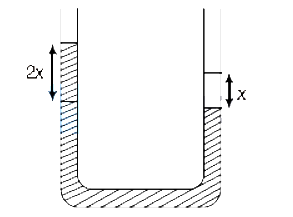
- \(9 \mathrm{~kg}\) solution is poured into a glass U-tube as shown in the figure below. The tube's inner diameter is \(2 \sqrt{\frac{\pi}{5}} \mathrm{~m}\) and the solution oscillates freely up and down about its position of equilibriwm \((x=0)\). The period of oscillation in seconds is \(\left(1 \mathrm{~m}^3\right.\) of solution has a mass \(\mu=900 \mathrm{~kg}, g=10 \mathrm{~m} / \mathrm{s}^2\), ignore frictional and swrface tension effects)
 TS EAMCET 2016 Hard
 - A radioactive material of half-life 2.5 hours emits radiation that is 32 times the safe maximum level. The time (in hours) after which the material can be handled safely isTS EAMCET 2025 Medium
- The half lives of two radioactive materials \(A\) and \(B\) are respectively \(T\) and \(2 T\). If the ratio of the initial masses of the materials \(A\) and \(B\) is \(8: 1\), then the time after which the ratio of the masses of the materials \(A\) and \(B\) becomes \(4: 1\) isTS EAMCET 2024 Easy
- Which of the following statement is correct?TS EAMCET 2021 Medium
- A convex lens of focal length \(0.15 \mathrm{~m}\) is made of a material of refractive index \(\frac{3}{2}\). When it is placed in a liquid, its focal length is increased by \(0.225 \mathrm{~m}\). The refractive index of the liquid isTS EAMCET 2002 Medium
More PYQs from TS EAMCET
- An electromagnetic wave of frequency 3.0 MHz passes from vacuum into a non-magnetic medium with permittivity, \(\epsilon=16 \epsilon_0\). Where, \(\epsilon_0\) is the free space permittivity. The change in wavelength isTS EAMCET 2019 Medium
- The distance for which ray optics becomes a good approximation for an aperture of 0.3 cm and a light of wavelength \(6000 Å\) isTS EAMCET 2025 Medium
- When a current ' \(\mathrm{i}\) ' through a solenoid is increasing at a constant rate then the induced current isTS EAMCET 2023 Easy
- The ratios of the voltage sensitivities, resistances and areas of the coils of two moving coil galvanometers \(A\) and \(B\) are \(4: 3,3: 4\) and \(1: 2\) respectively. If the number of turns of the coil of galvanometer A is 200, then the number of turns of the coil of galvanometer B is
(All other quantities remain same in both the cases)TS EAMCET 2025 Medium - If the average terminal velocity of rain drop is \(2 \mathrm{~ms}^{-1}\), then the energy transferred by rain to each square metre of the surface at a place which receives \(100 \mathrm{~cm}\) of rain in a year isTS EAMCET 2021 Medium
- In an \(n-p-n\) transistor, \(95 \%\) of emitted electrons reach the collector. If the base current is \(2 \mathrm{~mA}\), then collector current isTS EAMCET 2020 Easy