


TS EAMCET · Physics · Oscillations
A simple pendulum of length \(1 \mathrm{~m}\) and having a bob of mass \(100 \mathrm{~g}\) is suspended in a car, moving on a circular track of radius \(100 \mathrm{~m}\) with uniform speed \(10 \mathrm{~m} / \mathrm{s}\). If the pendulum makes small oscillation in a radial direction about its equilibrium position, then its time period can be given by \(\mathrm{T}=2 \pi / \alpha^{1 / 4}\). The value of \(\alpha\) is [Take \(\mathrm{g}=10 \mathrm{~m} / \mathrm{s}^2\) ] [Take g = 10 m/s2]
- A 11
- B 110
- C 101
- D 1100
Answer & Solution
Correct Answer
(C) 101
Step-by-step Solution
Detailed explanation
The bob of the simple pendulum will experience the acceleration due to gravity and the centripetal acceleration provided by the circular motion of the car. Acceleration due to gravity \(=\mathrm{g}\) Centripetal acceleration \(=\mathrm{v}^2 / \mathrm{R}\) Effective acceleration…
See the Complete Solution
Get step-by-step explanations for this and 2.5 Lakh+ more JEE, NEET & CET questions.
- Unlock all solutions
- Practice the full chapter
- Track accuracy across PYQs
4.8 rated on Google Play · 14,000+ reviews
More questions from Physics
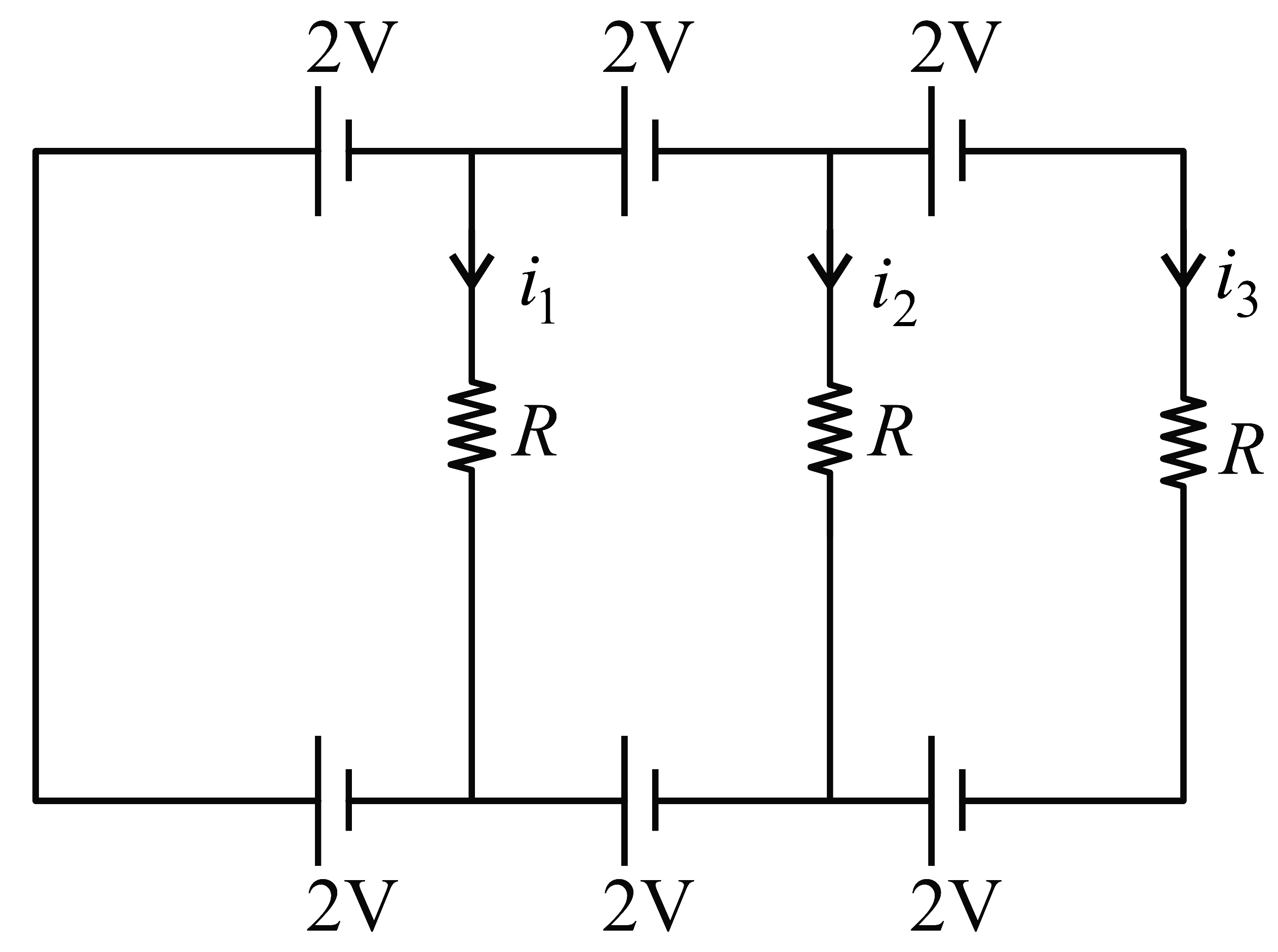
- Find the current in the three resistors as shown in the following figure?
 TS EAMCET 2022 Medium
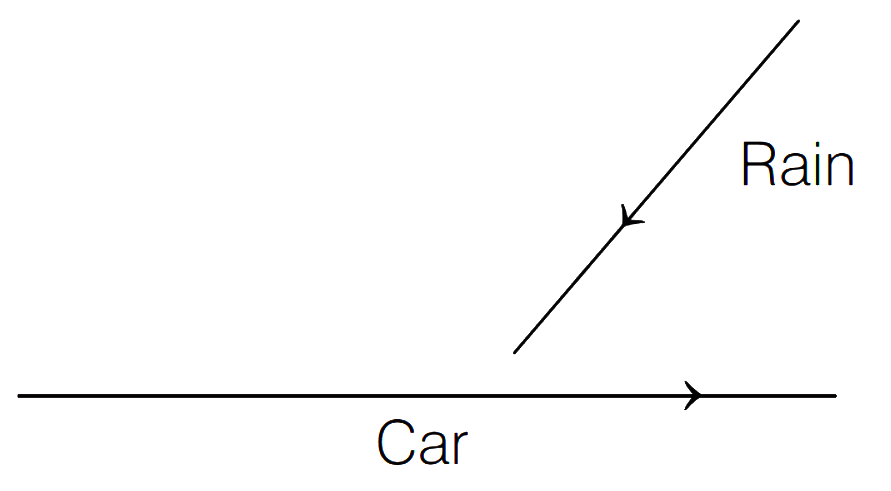
 - Rain is falling at an angle of \(30^{\circ}\) from the vertical due to the wind with a speed of \(40 \mathrm{~m} / \mathrm{s}\). A car is travelling horizontally in the direction opposite to the wind, at a speed of \(40 \mathrm{~m} / \mathrm{s}\). At what angle from the vertical will it experience the rain falling from?
 TS EAMCET 2019 Easy
 - At a given instant of time two particles are having the position vectors \(4 \hat{\mathbf{i}}+4 \hat{\mathbf{j}}+57 \hat{\mathbf{k}}\) metres and \(2 \hat{\mathbf{i}}+2 \hat{\mathbf{j}}+5 \hat{\mathbf{k}}\) respectively. If the velocity of the first particle be \(0.4 \hat{\mathbf{i}} \mathrm{ms}^{-1}\), the velocity of second particle in metre per second if they collide after \(10 \mathrm{sec}\) isTS EAMCET 2004 Medium
- A simple harmonic oscillator consists of a particle of mass \(m\) and an ideal spring with spring constant \(k\). The particle oscillates with a time period \(T\). The spring is cut into two equal parts. If one part oscillates with the same particle, the time period will beTS EAMCET 2011 Medium
- If the force is given by \(F=a t+b t^2\) with \(t\) as time. The dimensions of \(a\) and \(b\) areTS EAMCET 2010 Easy
- Sum of magnitudes of two forces acting at a point is \(16 \mathrm{~N}\). If their resultant is normal to smaller force, and has a magnitude \(8 \mathrm{~N}\), then forces areTS EAMCET 2012 Easy
More PYQs from TS EAMCET
- A particle moves in a circle with speed \(v\) varying with time as \(v(t)=2 t\). The total acceleration of the particle after it completes 2 rounds of cycle isTS EAMCET 2018 Medium
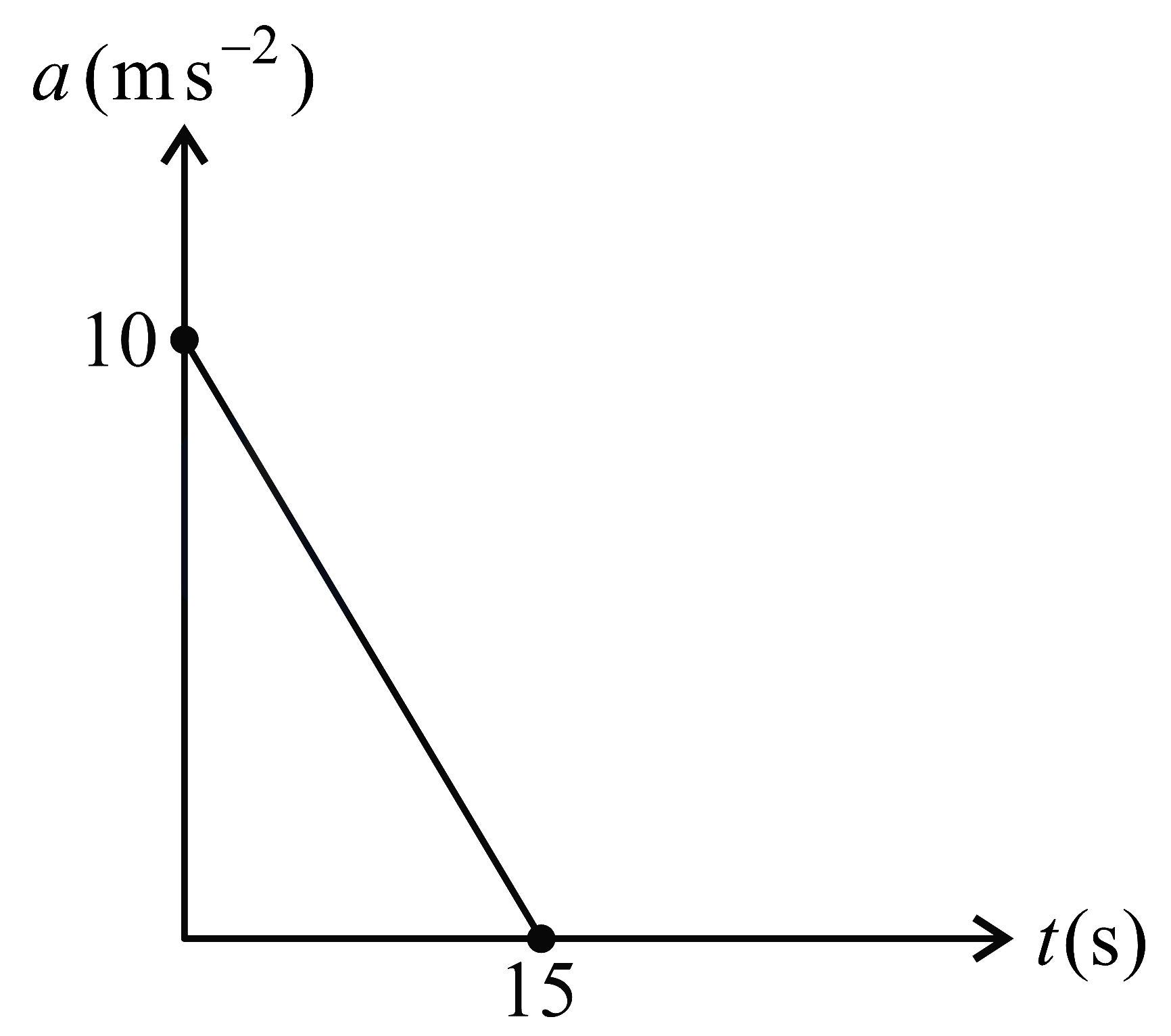
- A particle starts from rest. Its acceleration versus time is as shown in the figure. The maximum speed of the particle will be
 TS EAMCET 2022 Medium
 - A ball \(A\) of mass \(m\) moving along positive \(x\)-direction with kinetic energy \(K\) and momentum \(p\) undergoes elastic head on collision with a stationary ball \(B\) of mass \(M\) after collision the ball \(A\) moves along negative \(x\)-direction with kinetic energy \(\frac{K}{9}\), final momentum of \(B\) isTS EAMCET 2012 Hard
- A particle is executing simple harmonic motion (S.H.M.). Its acceleration at a distance of from the mean position is If its velocity is when it is at a distance of from its mean position, then the amplitude of S.H.M. is,TS EAMCET 2021 Hard
- A body of mass ' \(m\) ' moving with a velocity of ' \(v\) ' collides head on with another body of mass ' 2 m ' at rest. If the coefficient of restitution between the two bodies is ' e ', then the ratio of the velocities of the two bodies after collision isTS EAMCET 2025 Medium
- Two radioactive materials \(R_1\) and \(R_2\) have decay constants \(6 \lambda\) and \(\lambda\), respectively. The half life of \(R_2\) is \(1.4 \times 10^{17} \mathrm{~s}\). Initially they contain some number of nuclei. The time at which the ratio of the remaining nuclei of \(R_2\) to that of \(R_1\) will be \(e\) is \((\) Let \(\ln 2=0.7)\)TS EAMCET 2019 Medium