


TS EAMCET · Physics · Thermal Properties of Matter
A heating element of mass \(100 \mathrm{~g}\) and having specific heat of \(1 \mathrm{~J} /\left(\mathrm{g}^{\circ} \mathrm{C}\right)\) is exposed to surrounding air at \(27^{\circ} \mathrm{C}\). The element attains a steady state temperature of \(127^{\circ} \mathrm{C}\), while absorbing 100W of electric power. If the power is switched Off, then approximate time taken by the element to cool down to \(126^{\circ} \mathrm{C}\) will be (neglect radiation)
- A \(0.1 \mathrm{~s}\)
- B \(1.0 \mathrm{~s}\)
- C \(5.0 \mathrm{~s}\)
- D \(10.0 \mathrm{~s}\)
Answer & Solution
Correct Answer
(B) \(1.0 \mathrm{~s}\)
Step-by-step Solution
Detailed explanation
Given, power absorbed by element, \(P=100 \mathrm{~W}\) Mass of element, \(m=100 \mathrm{~g}=0.1 \mathrm{~kg}\) Change in temperature, \(\Delta T=(127-126)^{\circ} \mathrm{C}=1{ }^{\circ} \mathrm{C}\) Specific heat of heating element,…
See the Complete Solution
Get step-by-step explanations for this and 2.5 Lakh+ more JEE, NEET & CET questions.
- Unlock all solutions
- Practice the full chapter
- Track accuracy across PYQs
4.8 rated on Google Play · 14,000+ reviews
More questions from Physics
- Two particles having position vectors \(\mathbf{r}_1=(3 \hat{\mathbf{i}}+5 \hat{\mathbf{j}})\) metres and \(\mathbf{r}_2=(-5 \hat{\mathbf{i}}-3 \hat{\mathbf{j}})\) metres are moving with velocities \(\mathbf{v}_1=(4 \hat{\mathbf{i}}+3 \hat{\mathbf{j}}) \mathrm{m} / \mathrm{s}\) and \(\mathbf{v}_2=(a \hat{\mathbf{i}}+7 \hat{\mathbf{j}}) \mathrm{m} / \mathrm{s}\). If they collide after \(2 \mathrm{~s}\), then the value of \(a\) is :TS EAMCET 2003 Medium
- A charge \(Q\) is divided into two charges \(q\) and \(Q-q\). The value of \(q\) such that the force between them is maximum, isTS EAMCET 2014 Easy
- The change in surface energy when a big spherical drop fo radius \(R\) is split into \(n\) spherical droplets of radius \(r\) is \((T=\) surface tension)TS EAMCET 2020 Easy
- A long wire carries a current of \(18 \mathrm{~A} \mathrm{kept}\) along the axis of a long solenoid of radius \(1 \mathrm{~cm}\). The field due to the solenoid is \(8.0 \times 10^{-3} \mathrm{~T}\). The magnitude of the resultant field at a point \(0.6 \mathrm{~mm}\) from the solenoid axis is (Assume, \(\mu_0=4 \pi \times 10^{-7} \mathrm{Tm} / \mathrm{A}\) )TS EAMCET 2019 Medium
- A wire of length \(0.4 \mathrm{~m}\) stretched at both ends vibrates 250 times per second. If the length of the wire is increased by \(0.1 \mathrm{~m}\) and the stretching force is reduced to \(1 / 4^{\text {th }}\) of its original value then the new frequency isTS EAMCET 2022 Medium
- A point object \(O\) is placed on the axis of a cylindrical piece of glass of refractive index 1.6 as shown in the figure. One surface of the glass piece is convex with radius of curvature \(3 \mathrm{~mm}\). The point appeared to be at \(5 \mathrm{~mm}\) on the axis when viewed along the axis and from right side of convex surface. The distance of the point object from the convex surface is :
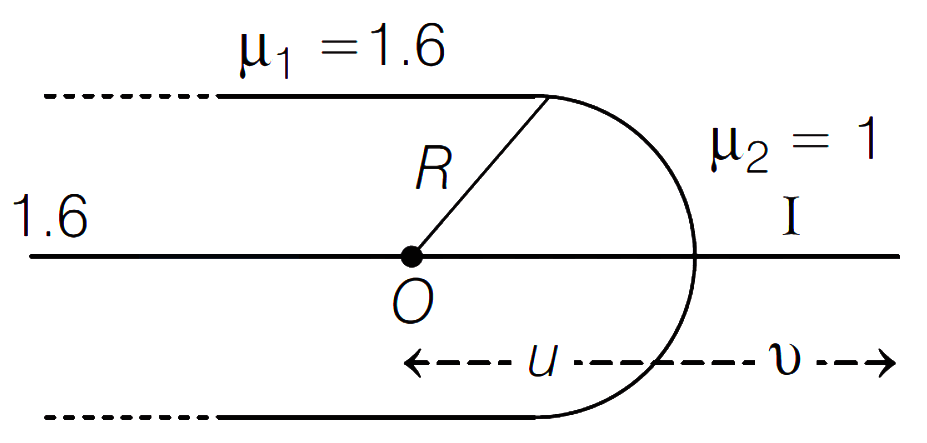 TS EAMCET 2019 Medium
More PYQs from TS EAMCET
- The ratio of the displacements of a freely falling body during first, second and third seconds of its motion isTS EAMCET 2023 Medium
- A voltmeter of \(250 \mathrm{mV}\) range having a resistance of \(10 \Omega\) is converted into an ammeter of \(250 \mathrm{~mA}\) range. The value of necessary shunt is (nearly)TS EAMCET 2015 Easy
- A rocket motor consumes \(100 \mathrm{~kg}\) of fuel per second exhausting it with a speed of \(5 \mathrm{~km} / \mathrm{s}\). The speed of the rocket when its mass is reduced to \(\frac{1^{\text {th }}}{20}\) of its initial mass, is (Assume initial speed to be zero and ignored gravitational and viscous forces.)TS EAMCET 2019 Hard
- The temperature at which the rms speed of molecules in hydrogen gas will be double of its initial value at \(27^{\circ} \mathrm{C}\) isTS EAMCET 2021 Easy
- Two negative charges of equal magnitude are located in \(x y\)-plane as shown below in the figure. The direction of the electric field at point \(P\) is
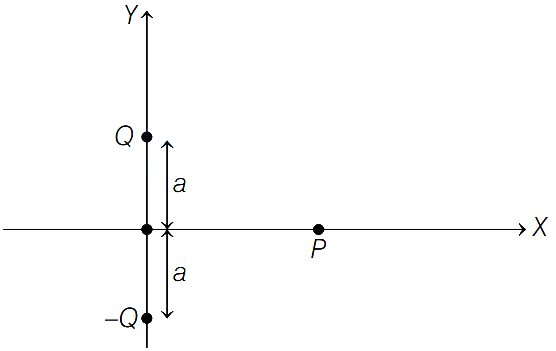 TS EAMCET 2020 Easy
 - An observer moves towards a stationary source of sound with a speed \(\frac{1}{5} t h\) that of sound. The frequency of the sound emitted by the source is \(f\). The apparent frequency recorded by the observer isTS EAMCET 2023 Easy