


TS EAMCET · Physics · Ray Optics
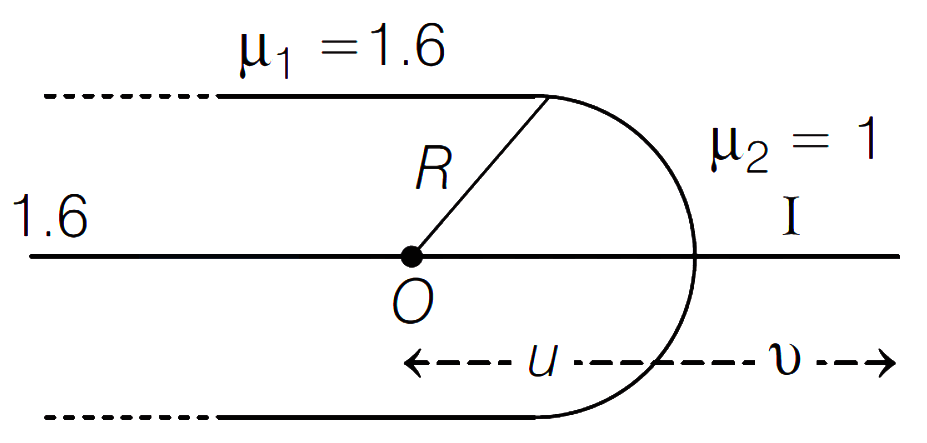
A point object \(O\) is placed on the axis of a cylindrical piece of glass of refractive index 1.6 as shown in the figure. One surface of the glass piece is convex with radius of curvature \(3 \mathrm{~mm}\). The point appeared to be at \(5 \mathrm{~mm}\) on the axis when viewed along the axis and from right side of convex surface. The distance of the point object from the convex surface is :
- A \(4 \mathrm{~mm}\)
- B \(6 \mathrm{~mm}\)
- C \(3 \mathrm{~mm}\)
- D \(2.5 \mathrm{~mm}\)
Answer & Solution
Correct Answer
(A) \(4 \mathrm{~mm}\)
Step-by-step Solution
Detailed explanation
A point object \(O\) is placed on the axis of a cylindrical glass as shown in the figure, For a curved spherical surface, \( \frac{\mu_2}{v}+\frac{\mu_1}{u}=\frac{\mu_1-\mu_2}{R} \) where, \(v=5 \mathrm{~mm}, R=-3 \mathrm{~mm}, \mu_1=1.6\) and \(\mu_2=1\) Putting the given…
See the Complete Solution
Get step-by-step explanations for this and 2.5 Lakh+ more JEE, NEET & CET questions.
- Unlock all solutions
- Practice the full chapter
- Track accuracy across PYQs
4.8 rated on Google Play · 14,000+ reviews
More questions from Physics
- A hollow cylinder and a solid cylinder initially at rest at the top of an inclined plane are rolling down without slipping. If the time taken by the hollow cylinder to reach the bottom of the inclined plane is 2 s , the time taken by the solid cylinder to reach the bottom of the inclined plane isTS EAMCET 2024 Medium
- The voltage-current characteristic of a diode during forward bias is given by \(I=7.8 \times 10^{-5} e^{6.5 V_D}\), where \(I\) is the current in \(\mathrm{mA}\) and \(V_D\) is the diode voltage in \(\mathrm{V}\). Find the dynamic resistance of the diode in \(\Omega\), when the current is \(4 \mathrm{~mA}\)TS EAMCET 2018 Easy
- An air column in a tube \(32 \mathrm{~cm}\) long, closed at one end, is in resonance with a tuning fork. The air column in another tube, open at both ends, of length \(66 \mathrm{~cm}\) is in resonance with another tuning fork. When these two tuning forks are sounded together, they produce 8 beats per second. Then the frequencies of the two tuning forks are, (Consider fundamental frequencies only)TS EAMCET 2013 Hard
- In a galvanometer \(5 \%\) of the total current in the circuit passes through it. If the resistance of the galvanometer is \(G\), the shunt resistance \(S\) connected to the galvanometer isTS EAMCET 2008 Easy
- If the difference in the frequencies of the first and second lines of Lyman series of hydrogen atom is \(f\), then the difference in frequencies of the first and second lines of Balmer series of hydrogen atom isTS EAMCET 2025 Medium
- Which of the following wave has the largest wave speed?TS EAMCET 2022 Easy
More PYQs from TS EAMCET
- A cannon shell fired breaks into two equal parts at its highest point. One part retraces the path to the cannon with kinetic energy \(E_1\) and kinetic energy of the second part is \(E_2\), relation between \(E_1\) and \(E_2\) isTS EAMCET 2014 Hard
- A coil of resistance is connected across a battery. If the current in the coil is found to be after the time battery is connected, then the inductance of the coil isTS EAMCET 2021 Medium
- The limit of resolution of a telescope is \(3.0 \times 10^{-7} \mathrm{rad}\). Assuming that it is used to see the light of wavelength \(525 \mathrm{~nm}\) from a star, what should be the diameter of the objective?TS EAMCET 2020 Easy
- A rocket lifts off from the ground and accelerates upwards at . seconds after liftoff a piece breaks off from the bottom of the rocket. After breaking off, how much time it takes approximately to reach the ground? (Take )TS EAMCET 2021 Medium
- A galvanometer coil has a resistance of and the meter shows full scale deflection for a current of What resistance needs to be connected to convert the meter into a voltmeter of range toTS EAMCET 2021 Medium
- A \(2 \mathrm{~kg}\) ball moving at \(24 \mathrm{~ms}^{-1}\) undergoes inelastic head-on collision with a \(4 \mathrm{~kg}\) ball moving in the opposite direction at \(48 \mathrm{~ms}^{-1}\). If the coefficient of restitution is \(2 / 3\), their velocities in \(\mathrm{ms}^{-1}\) after impact areTS EAMCET 2004 Easy