


TS EAMCET · Maths · Probability
The range of a discrete random variable X is \(\{1,2,3\}\) and the probabilities of its elements are given by \(\mathrm{P}(\mathrm{X}=1)=3 \mathrm{k}^3, \mathrm{P}(\mathrm{X}=2)=2 \mathrm{k}^2\) and \(\mathrm{P}(\mathrm{X}=3)=7-19 \mathrm{k}\). Then \(\mathrm{P}(\mathrm{X}=3)=\)
- A \(\frac{2}{3}\)
- B \(\frac{2}{9}\)
- C \(\frac{1}{9}\)
- D \(\frac{4}{9}\)
Answer & Solution
Correct Answer
(A) \(\frac{2}{3}\)
Step-by-step Solution
Detailed explanation
\(P(X=1)+P(X=2)+P(X=3)=1\) \(3k^3+2k^2+(7-19k)=1\) \(3k^3+2k^2-19k+6=0\) \(k=\frac{1}{3}\) \(P(X=3)=7-19k\) \(P(X=3)=7-19\left(\frac{1}{3}\right)\) \(P(X=3)=\frac{21-19}{3}\) \(P(X=3)=\frac{2}{3}\)
See the Complete Solution
Get step-by-step explanations for this and 2.5 Lakh+ more JEE, NEET & CET questions.
- Unlock all solutions
- Practice the full chapter
- Track accuracy across PYQs
4.8 rated on Google Play · 14,000+ reviews
More questions from Maths
- A real valued function \(f(x)=\left|x^2-3 x+2\right|+2 x-3\) is defined on \([-2,1]\). If m and M are absolute minimum and absolute maximum values of \(f\) respectively then \(\mathrm{M}-4 \mathrm{~m}=\)TS EAMCET 2025 Medium
- If the point of intersection of the lines \(\mathbf{r}=\hat{\mathbf{i}}-6 \hat{\mathbf{j}}+(p \sec \alpha) \hat{\mathbf{k}}+t(\hat{\mathbf{i}}+2 \hat{\mathbf{j}}+\hat{\mathbf{k}})\) and \(\mathbf{r}=4 \hat{\mathbf{j}}+\hat{\mathbf{k}}+\lambda(2 \hat{\mathbf{i}}+(p \tan \alpha) \hat{\mathbf{j}}+2 \hat{\mathbf{k}})\) is \(8 \hat{\mathbf{i}}+8 \hat{\mathbf{j}}+9 \hat{\mathbf{k}}\), (where \(0 < \alpha < \frac{\pi}{2}\) ), then \(p=\)TS EAMCET 2020 Easy
- For \(k>0\), the shortest distance from a point \(P(1, k)\) on the ellipse \(9 x^2+4 y^2-18 x+16 y-11=0\) to one of its directrix isTS EAMCET 2020 Medium
- The general solution of the differential equation \(\left(1+y^2\right) d x=\left(\tan ^{-1} y-x\right) d y\) isTS EAMCET 2020 Medium
- Image of \(A(1,-2)\) with respect to the straight line \(L \equiv 2 x-3 y+5=0\) is \(B\). The foot of the perpendicular from \(P(-4,-1)\) on to the line joining \(A B\) isTS EAMCET 2021 Easy
- The normal at a point on the parabola \(\mathrm{y}^2=4 \mathrm{x}\) passes through \((5,0)\). If there are two more normals to this parabola passing through \((5,0)\), then the equation of one of these normals isTS EAMCET 2023 Medium
More PYQs from TS EAMCET
- The displacement of a particle executing simple harmonic motion is given by \(x=2 \cos (t)\) where \(t\) is the time in seconds then the time period of the particle isTS EAMCET 2023 Easy
- If the partial fractions decomposition of \(\frac{x^4+24 x^2+28}{\left(x^2+1\right)^3}\) is \(\frac{A}{x^2+1}+\frac{B}{\left(x^2+1\right)^2}+\frac{C}{\left(x^2+1\right)^3}\) then \(B-2 A+C=\)TS EAMCET 2020 Medium
- If \(4 x+2 y+n=0\) is a normal to the ellipse \(\frac{x^2}{36}+\frac{y^2}{16}=1\), then \(n=\)TS EAMCET 2023 Medium
- The molecular interactions responsible for hydrogen bonding in \(\mathrm{HF}\)TS EAMCET 2014 Easy
- If \(A\) is a non singular matrix, then \(\operatorname{Adj}\left(A^{-1}\right)=\)TS EAMCET 2024 Easy
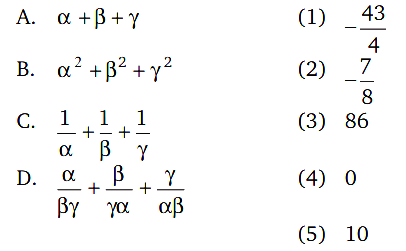
- \(\alpha, \beta, \gamma\) are the roots of the equation \(x^3-10 x^2+7 x+8=0\). Match the following and choose the correct answer.
 TS EAMCET 2004 Hard