


TS EAMCET · Maths · Quadratic Equation
Let \(\alpha\) and \(\beta\) be the roots of the quadratic equation \(a x^2+b x+c=0\). Observe the lists given below 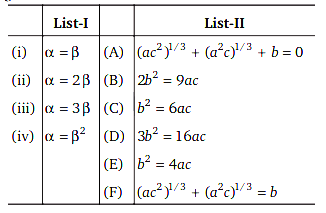
The correct match of List-I from List-II is (i) (ii) (iii) (iv)
- A \(\begin{array}{llll}\mathrm{E} & \mathrm{B} & \mathrm{D} & \mathrm{F}\end{array}\)
- B \(\begin{array}{llll}\mathrm{E} & \mathrm{B} & \mathrm{A} & \mathrm{D}\end{array}\)
- C \(\begin{array}{llll}\mathrm{E} & \mathrm{D} & \mathrm{B} & \mathrm{F}\end{array}\)
- D \(\begin{array}{llll}\mathrm{E} & \mathrm{B} & \mathrm{D} & \mathrm{A}\end{array}\)
Answer & Solution
Correct Answer
(D) \(\begin{array}{llll}\mathrm{E} & \mathrm{B} & \mathrm{D} & \mathrm{A}\end{array}\)
Step-by-step Solution
Detailed explanation
Using the condition that the roots of \(a x^2+b x+c=0\) may be in the ratio \(m: n\) is \(m n b^2=a c(m+n)^2\). (i) If the roots are \(\alpha=\beta\), then \[ \begin{aligned} \alpha \cdot \alpha b^2 & =a c(\alpha+\alpha)^2 \\ \Rightarrow \quad b^2 & =4 a c \end{aligned} \]…
See the Complete Solution
Get step-by-step explanations for this and 2.5 Lakh+ more JEE, NEET & CET questions.
- Unlock all solutions
- Practice the full chapter
- Track accuracy across PYQs
4.8 rated on Google Play · 14,000+ reviews
More questions from Maths
- If \(f: \mathrm{R}-\{0\} \rightarrow \mathrm{R}\) is defined by \(3 f(x)+4 f\left(\frac{1}{x}\right)=\frac{2-x}{x}\) then \(f(3)=\)TS EAMCET 2025 Medium
- If two distinct chords drawn from the point \(A(4,4)\) on the parabola \(y^2=4 x\) are bisected by the line \(y=a x\), then the interval in which \(a\) lies isTS EAMCET 2018 Hard
- A line perpendicular to the \(X\)-axis cuts the circle \(x^2+y^2=9\) at \(A\) and the ellipse \(4 x^2+9 y^2=36\) at \(B\) such that \(A\) and \(B\) lie in the same quadrant. If \(\theta\) is the greatest acute angle between the tangents drawn to the curves at \(A\) and \(B\), then \(\tan \theta=\)TS EAMCET 2019 Medium
- If \(m \cos (\alpha+\beta)-n \cos (\alpha-\beta)=m \cos (\alpha-\beta)+n \cos (\alpha+\beta)\) then \(\tan \alpha \tan \beta=\)TS EAMCET 2024 Hard
- \(\left(\frac{\cos \theta+i \sin \theta}{\sin \theta+i \cos \theta}\right)^8+\left(\frac{1+\cos \theta-i \sin \theta}{1+\cos \theta+i \sin \theta}\right)^{16}=\)TS EAMCET 2020 Medium
- The number of ways is which 3 identical balls can be distributed into 7 distinct bins isTS EAMCET 2019 Easy
More PYQs from TS EAMCET
- If \(|x|\) is so small that \(x^3\) and higher powers of \(x\) can be neglected, then an approximate value of \(\frac{1}{\sqrt{4-x}(2+x)^3}\) isTS EAMCET 2023 Medium
- Amotorcarmovingwithvelocity \(7 \mathrm{~m} / \mathrm{sstopsin} 10 \mathrm{mdistance}\) when brakes are applied. What is the relation between the resistance force \((\mathrm{R})\) and the weight \((\mathrm{W})\) of the car? \(\left(\right.\) Take value of \(g=9.8 \mathrm{~m} / \mathrm{s}^2\) )TS EAMCET 2022 Medium
- Let and be two focal chords of the parabola . If and thenTS EAMCET 2022 Easy
- A particle is moving in -plane crosses the origin at time The equation of motion of the particle is If the velocity of the particle is and acceleration is , then the magnitude of isTS EAMCET 2021 Medium
- A bullet of mass \(m\) enters a wooden block of length \(L\) at a speed \(v_1\) and emerges out of block with a speed \(v_2\). If \(F\) is the average force which impeded its motion through the wooden block, then (Assume uniform deceleration inside the block)TS EAMCET 2021 Easy
- If the equations of the perpendicular bisectors of the sides \(A B\) and \(A C\) of a \(\triangle A B C\) are \(x-y+5=0\) and \(x+2 y=0\) respectively and if \(A\) is \((1,-2)\), then the equation of the perpendicular bisector of the side \(B C\) isTS EAMCET 2019 Hard