


TS EAMCET · Maths · Trigonometric Ratios & Identities
In an isosceles right angled triangle, a straight line is drawn from the mid point of one of the equal sides to the opposite vertex. Then a pair of possible values of the cotangents of the two angles so formed at that vertex are
- A 1 and 2
- B 2 and 3
- C 3 and 4
- D 4 and 5
Answer & Solution
Correct Answer
(B) 2 and 3
Step-by-step Solution
Detailed explanation
\(A B=A C=a\) \(\begin{aligned} & A D=D C=\frac{a}{2} \\ & \angle C=\angle A B C=45^{\circ} \end{aligned}\) In \(\triangle A D B\),…
See the Complete Solution
Get step-by-step explanations for this and 2.5 Lakh+ more JEE, NEET & CET questions.
- Unlock all solutions
- Practice the full chapter
- Track accuracy across PYQs
4.8 rated on Google Play · 14,000+ reviews
More questions from Maths
- Among every 8 units of a product, one is likely to be defective. If a consumer has ordered 5 units of that product, then the probability that atmost one unit is defective among them isTS EAMCET 2025 Medium
- If three cards are drawn randomly from a pack of 52 playing cards then the probability of getting exactly one spade card, exactly one king and exactly one card having a prime number isTS EAMCET 2025 Medium
- The sides of a triangle are in the ratio \(1: \sqrt{3}: 2\). Then the angles are in the ratioTS EAMCET 2017 Easy
- If , thenTS EAMCET 2021 Medium
- If \(\mathrm{P}\left(\frac{1}{2}, 4\right)\) and \(\mathrm{Q}\) are the ends of a focal chord of the parabola \(y^2=32 x\) and \(\mathrm{S}\) is the focus of the parabola then \(\mathrm{SQ}=\)TS EAMCET 2022 Easy
- Let \(E_1 \equiv a x^2+b x+c, E_2 \equiv b x^2+c x+a\), \(E_3 \equiv c x^2+b x+a\) and \(\frac{a^2}{b c}+\frac{b^2}{c a}+\frac{c^2}{a b}=3\). If these quadratic expressions have a common zero, then the quadratic expression having zeroes that are common to \(E_2\) and \(E_3\) and different from the zeroes of \(E_1\) isTS EAMCET 2018 Easy
More PYQs from TS EAMCET
- Which of the given atoms has the greatest electron affinity?TS EAMCET 2021 Easy
- The relation between time \(t\) and distance \(x\) of a particle is \(t=a x^2+b x\), where \(a\) and \(\mathrm{b}\) are constants.
If \(\mathrm{v}\) is the velocity of the particle, then its acceleration isTS EAMCET 2023 Easy - When \(\mathbf{R}\) is the set of all real numbers, \(\left\{x \in \mathbf{R}: \frac{\sqrt{12-x-x^2}}{x+10} \leq \frac{\sqrt{12-x-x^2}}{2 x+9}\right\}=\)TS EAMCET 2020 Easy
- If \(\mathbf{a}, \mathbf{b}, \mathbf{c}\) are three mutually perpendicular vectors such that the magnitudes of \(\mathbf{b}\) and \(\mathbf{c}\) are \(1 / 2\) times and \(\sqrt{3} / 2\) times that of \(\mathbf{a}\), respectively, then the angle between the vectors \(\mathbf{a}+\mathbf{b}+\mathbf{c}\) and \(\mathbf{b}\) isTS EAMCET 2020 Medium
- Match the following :
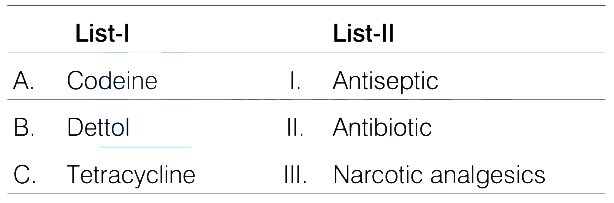
The correct match is \(\text { A B } C\)TS EAMCET 2020 Easy - If \(\alpha, \beta\) and \(\gamma\) are length of the altitudes of a \(\triangle A B C\) with area \(\Delta\), then \(\frac{\Delta^2}{R^2}\left(\frac{1}{\alpha^2}+\frac{1}{\beta^2}+\frac{1}{\gamma^2}\right)\) is equal toTS EAMCET 2012 Medium