


TS EAMCET · Maths · Application of Derivatives
If the curves \(a x^2+b y^2=1\) and \(c x^2+d y^2=1\) intersect orthogonally, then \(\frac{b-a}{d-c}=\)
- A \(\frac{a}{c} \cdot \frac{b}{d}\)
- B \(\frac{a+b}{c+d}\)
- C 1
- D 0
Answer & Solution
Correct Answer
(A) \(\frac{a}{c} \cdot \frac{b}{d}\)
Step-by-step Solution
Detailed explanation
Given curves \(a x^2+b y^2=1\) ...(i) and \(c x^2+d y^2=1\) ...(ii) From Eqs. (i) and (ii), \((a-c) x^2+(b-d) y^2=0\) \(\frac{x^2}{y^2}=-\left(\frac{b-d}{a-c}\right)\) ...(iii) Differentiating Eq. (i) w.r.t.' \(x^{\prime}\), we get…
See the Complete Solution
Get step-by-step explanations for this and 2.5 Lakh+ more JEE, NEET & CET questions.
- Unlock all solutions
- Practice the full chapter
- Track accuracy across PYQs
4.8 rated on Google Play · 14,000+ reviews
More questions from Maths
- If any tangent drawn to the ellipse \(\frac{x^2}{16}+\frac{y^2}{9}=1\) touches one of the circles \(x^2+y^2=\alpha^2\), then the range of \(\alpha\) isTS EAMCET 2025 Medium
- If the pair of straight lines given by \(A x^2+2 H x y+B y^2=0\left(H^2>A B\right)\) forms an equilateral triangle with line \(a x+b y+c=0\), then \((A+3 B)(3 A+B)\) is equal to :TS EAMCET 2003 Medium
- A bag contains \(n\) white and \(n\) black balls. Pairs of balls are drawn at random without replacement successively, until the bag is empty. If the number of ways in which each pair consists of one white and one black ball is 14400 , then \(n\) is equal toTS EAMCET 2011 Medium
- For any integer \(n \geq 1, \sum_{K=1}^n K(K+2)=\)TS EAMCET 2017 Easy
- The angle between the curves \(x^2=8 y\) and \(x y=8\) isTS EAMCET 2017 Medium
- If the angle between the circles \(x^2+y^2-2 x+\mathrm{k} y+1=0\) and \(x^2+y^2-\mathrm{k} x-2 y+1=0\) is \(\operatorname{Cos}^{-1}\left(\frac{1}{4}\right)\) and \(\mathrm{k} < 0\) then the point which lies on the radical axis of the given circles isTS EAMCET 2025 Medium
More PYQs from TS EAMCET
- The concentration of electrons in an intrinsic semiconductor is \(6 \times 10^{15} \mathrm{~m}^{-3}\). On doping with an impurity the electron concentration increases to \(4 \times 10^{22}\) \(\mathrm{m}^{-3}\). In thermal equilibrium, the concentration of the holes in the doped semiconductor isTS EAMCET 2024 Medium
- The major product of the following reaction is
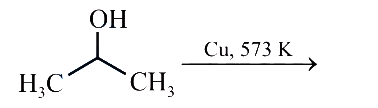 TS EAMCET 2022 Easy
 - A particle of mass \(4 m\) explodes into three pieces of masses \(m, m\) and \(2 \mathrm{~m}\). The equal masses move along \(X\)-axis and \(Y\)-axis with velocities \(4 \mathrm{~ms}^{-1}\) and \(6 \mathrm{~ms}^{-1}\) respectively. The magnitude of the velocity of the heavier mass isTS EAMCET 2009 Medium
- Aluminium reacts with dilute \(\mathrm{HCl}\) and liberates a gas 'A' and with aqueous alkali liberates a gas 'B'. A and B respectively areTS EAMCET 2023 Easy
- Let \(\vec{c}\) be a vector coplanar with the unit vectors \(\vec{a}, \vec{b}\) and let \(\vec{d}\) be the unit vector perpendicular to \(\vec{a}, \vec{b}\) and \(\vec{c}\). If \([\vec{a} \vec{b} \vec{d}] \vec{c}-[\vec{a} \vec{b} \vec{c}] \vec{d}=\hat{i}+2 \hat{j}+2 \hat{k}\) and the angle between \(\vec{a}\) and \(\vec{b}\) is \(30^{\circ}\), then \(|\vec{c}|=\)TS EAMCET 2023 Easy
- Assertion (A) : \(\mathrm{NaCl}\) is less soluble in heavy water than in ordinary water. Reason (R) : Dielectric constant of ordinary water is more than that of heavy water. The correct answer isTS EAMCET 2007 Easy