


TS EAMCET · Maths · Probability
If \(E_1, E_2 \ldots, E_n\) are an independent events such that \(P\left(E_r\right)=\frac{1}{1+r},(r=1,2, \ldots, n)\), then the probability that atleast one of \(E_1, E_2, \ldots, E_n\) happens is
- A \(\frac{1}{n+1}\)
- B \(\frac{n+1}{n(2 n+1)}\)
- C \(\frac{n}{n+1}\)
- D \(\frac{1}{2 n+1}\)
Answer & Solution
Correct Answer
(C) \(\frac{n}{n+1}\)
Step-by-step Solution
Detailed explanation
We have, \(P\left(E_r\right)=\frac{1}{1+r}\) \(\therefore P\left(\bar{E}_r\right)=1-P\left(E_r\right)=1-\frac{1}{1+r}=\frac{r}{1+r}\) \(\therefore\) Required probability \(=P\left(E_1 \cup E_2 \cup E_3 \ldots \cup E_n\right)\)…
See the Complete Solution
Get step-by-step explanations for this and 2.5 Lakh+ more JEE, NEET & CET questions.
- Unlock all solutions
- Practice the full chapter
- Track accuracy across PYQs
4.8 rated on Google Play · 14,000+ reviews
More questions from Maths
- Let \(\lim _{t \rightarrow 0}(1+5 t)^{\frac{1}{t}}=K\) and \(X\) be the random variable representing number of successes in 100 independent trials. If the probability of success in each trial is 0.05 , then the probability of getting at least one success isTS EAMCET 2019 Easy
- The locus of the centre of the circles passing through the origin and cutting off a chord of length units on the line isTS EAMCET 2021 Medium
- If the vectors \(\mathbf{i}-2 x \mathbf{j}-3 y \mathbf{k}\) and \(\mathbf{i}+3 x \mathbf{j}+2 y \mathbf{k}\) are orthogonal to each other, then the locus of the point \((x, y)\) isTS EAMCET 2011 Easy
- The value of \(\sqrt{42+\sqrt{42+\sqrt{42+\ldots \ldots .}}}\) is equalTS EAMCET 2004 Easy
- The equation of the circle that touches the -axis at a distance of units from the origin and cuts off an intercept of units on the -axis isTS EAMCET 2019 Easy
- The number of ways that 8 beads of different colours be strung as a necklace isTS EAMCET 2002 Easy
More PYQs from TS EAMCET
- The mass number and the volume of a nucleus is and respectively. If the mass number is increased to then the volume is changed toTS EAMCET 2021 Medium
- If the equilibrium constant for the reaction, \(\mathrm{H}_2(g)+\mathrm{I}_2(g) \rightleftharpoons 2 \mathrm{HI}(g) \text { is } K\) what is the equilibrium constant of \(\mathrm{HI}(g) \rightleftharpoons \frac{1}{2} \mathrm{H}_2(g)+\frac{1}{2} \mathrm{I}_2(g) ?\)TS EAMCET 2010 Easy
- If are the cube roots of unity, and then the least value of such that is a root of isTS EAMCET 2022 Easy
- Observe the following reactions
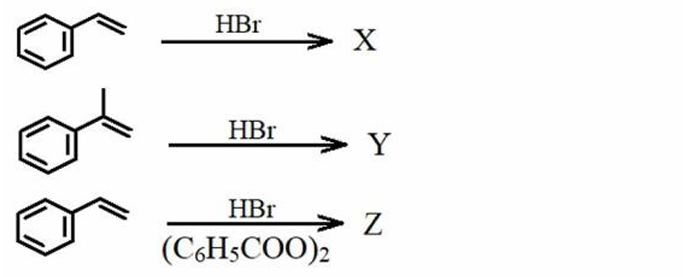
The correct order of reactivity of \(\mathrm{X}, \mathrm{Y}, \mathrm{Z}\) towards \(\mathrm{S}_{\mathrm{N}} 1\) reaction isTS EAMCET 2025 Medium - The line \(\mathrm{L} \equiv 6 x+3 y+\mathrm{k}=0\) divides the line segment joining the points \((3,5)\) and \((4,6)\) in the ratio \(-5: 4\). If the point of intersection of the lines \(\mathrm{L}=0\) and \(x-y+1=0\) is \(\mathrm{P}(\mathrm{g}, \mathrm{h})\) then \(\mathrm{h}=\)TS EAMCET 2025 Medium
- In the Freundlich isotherm \(\left(\frac{\chi}{m}=k_P{ }^{1 / n}\right)\) plot of \(\log \frac{x}{m} v s \log p\), the intercept is (where, \(x, m, p\) and \(k\) are mass of the gas, mass of adsorbent, pressure and constant which depend on the nature of the adsorbent, respectively)TS EAMCET 2018 Medium