


TS EAMCET · Maths · Straight Lines
The line \(\mathrm{L} \equiv 6 x+3 y+\mathrm{k}=0\) divides the line segment joining the points \((3,5)\) and \((4,6)\) in the ratio \(-5: 4\). If the point of intersection of the lines \(\mathrm{L}=0\) and \(x-y+1=0\) is \(\mathrm{P}(\mathrm{g}, \mathrm{h})\) then \(\mathrm{h}=\)
- A 2 g
- B \(2 g-1\)
- C 3 g
- D \(\mathrm{g}+1\)
Answer & Solution
Correct Answer
(D) \(\mathrm{g}+1\)
Step-by-step Solution
Detailed explanation
Point of division: \((x,y) = \left(\frac{(-5)(4) + (4)(3)}{-5+4}, \frac{(-5)(6) + (4)(5)}{-5+4}\right) = (8,10)\) Substitute point into L: \(6(8) + 3(10) + k = 0 \Rightarrow 48 + 30 + k = 0 \Rightarrow k = -78\) Line L: \(6x + 3y - 78 = 0 \Rightarrow 2x + y - 26 = 0\)…
See the Complete Solution
Get step-by-step explanations for this and 2.5 Lakh+ more JEE, NEET & CET questions.
- Unlock all solutions
- Practice the full chapter
- Track accuracy across PYQs
4.8 rated on Google Play · 14,000+ reviews
More questions from Maths
- The solutions of the equation \(z^2\left(1-z^2\right)=16\), \(z \in \mathbf{C}\), lie on the curveTS EAMCET 2020 Medium
- The quadratic equation whose roots are \(l\) and \(m\), where \[ \begin{aligned} & l=\lim _{\theta \rightarrow 0}\left(\frac{3 \sin \theta-4 \sin ^2 \theta}{\theta}\right), \ & m=\lim _{\theta \rightarrow 0} \frac{2 \tan \theta}{\theta\left(1-\tan ^2 \theta\right)}, \text { is } \end{aligned} \]TS EAMCET 2002 Hard
- If \(y=\frac{e^{\sin x}+\sin \mathrm{h}^3 x}{\cosh x-\tan x}\), then \(\mathrm{y}^{\prime}(0)=\)TS EAMCET 2022 Medium
- The area bounded by \(y=x^2+2, x\)-axis, \(x=1\) and \(x=2\) isTS EAMCET 2004 Medium
- If \(\alpha, \beta, \gamma\) are the roots of the equation \(x^3+3 x^2-x-3=0\), then \(\left(1+\alpha^2\right)\left(1+\beta^2\right)\left(1+\gamma^2\right)=\)TS EAMCET 2020 Easy
- If \(A+B+C=270^{\circ}\), then \(\cos 2 A+\cos 2 B+\cos 2 C\) is equal to :TS EAMCET 2003 Easy
More PYQs from TS EAMCET
- A straight line through the point \(\mathrm{P}(1,2)\) makes an angle \(\theta\) with positive X -axis in anticlockwise direction and meets the line \(x+\sqrt{3} y-2 \sqrt{3}=0\) at Q. If \(\mathrm{PQ}=\frac{1}{2}\), then \(\theta=\)TS EAMCET 2025 Medium
- A solution of concentration \(C g\) equiv/L has a specific resistance \(R\). The equivalent conductance of the solution isTS EAMCET 2010 Easy
- A value of \(n\) such that \(\left(\frac{\sqrt{3}}{2}+\frac{i}{2}\right)^n=1\) isTS EAMCET 2007 Medium
- If the locus of a point which divides a chord with slope 2 of the parabola \(y^2=4 x\), internally in the ratio \(1: 3\) is a parabola, then its vertex isTS EAMCET 2019 Medium
- The equation of the ellipse with directrix \(3 x+4 y-5=0\), focus \((1,2)\) and eccentricity \(\frac{1}{2}\), isTS EAMCET 2020 Easy
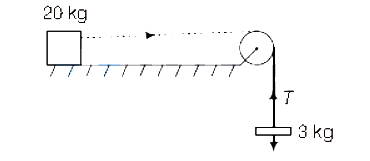
- A body of mass \(20 \mathrm{~kg}\) is moving on a rough horizontal plane. A block of mass \(3 \mathrm{~kg}\) is connected to the \(20 \mathrm{~kg}\) mass by a string of negligible mass through a smooth pulley as shown in the below figure. The tension in the string is \(27 \mathrm{~N}\). The coefficient of kinetic friction between the heavier mass and the swrface is \(\left(g=10 \mathrm{~m} / \mathrm{s}^2\right.\) )
 TS EAMCET 2016 Hard