


TS EAMCET · Maths · Differentiation
If \(\cos ^{-1}\left(\frac{y}{b}\right)=2 \log \left(\frac{x}{2}\right)\), where \(x>0\), then \(x^2 \frac{d^2 y}{d x^2}+x \frac{d y}{d x}\) is equal to
- A \(4 y\)
- B \(-4 y\)
- C \(0\)
- D \(-8 y\)
Answer & Solution
Correct Answer
(B) \(-4 y\)
Step-by-step Solution
Detailed explanation
\[ \cos ^{-1}\left(\frac{y}{b}\right)=2 \log \left(\frac{x}{2}\right), x>0 \] On differentiating w.r.t. \(x\) we get…
See the Complete Solution
Get step-by-step explanations for this and 2.5 Lakh+ more JEE, NEET & CET questions.
- Unlock all solutions
- Practice the full chapter
- Track accuracy across PYQs
4.8 rated on Google Play · 14,000+ reviews
More questions from Maths
- If \(\{x\}=x-[x]\) where \([x]\) is the greatest integer \(\leq x\) and \(\lim _{x \rightarrow 0^{-}} \frac{\operatorname{Cos}^{-1}\left(1-\{x\}^2\right) \operatorname{Sin}^{-1}(1-\{x\})}{\{x\}-\{x\}^4}=\theta\), then \(\tan \theta=\)TS EAMCET 2025 Hard
- The values of \(x\) at which the real valued function \(f(x)=7|2 x+1|-19|3 x-5|\) is not differentiable isTS EAMCET 2025 Medium
- The area (in sq. units) bounded by the curve \(y=2 x-x^2\) and the line \(y=-x\) isTS EAMCET 2023 Easy
- In a triangle \(\mathrm{ABC},\left(r_2+r_3\right) \operatorname{cosec}^2\left(\frac{\mathrm{~A}}{2}\right)=\)TS EAMCET 2025 Medium
- If the two curves and cut each other at right angles, then a possible value of isTS EAMCET 2021 Easy
- If \(\int(\sqrt{\operatorname{cosec} x+1}) d x=k \tan ^{-1}(f(x))+c\), then \(\frac{1}{k} f\left(\frac{\pi}{6}\right)=\)TS EAMCET 2024 Hard
More PYQs from TS EAMCET
- The length of the latusrectum of the conic \(25\left[(x-2)^2+(y-3)^2\right]=(3 x-4 y+7)^2\) isTS EAMCET 2021 Medium
- Equation of the plane through the mid-point of the line segment joining the points \(\mathrm{A}(4,5,-10)\) and \(\mathrm{B}(-1,2,1)\) and perpendicular to \(\mathrm{AB}\) isTS EAMCET 2023 Medium
- Observe the following data ( \(\Delta_i \mathrm{H}_1, \Delta_i \mathrm{H}_2\) and \(\Delta_{\text {eg }} \mathrm{H}\) represent the first, second ionisation enthalpies and electron gain enthalpy respectively).
Element \(\begin{gathered}\Delta_i \mathrm{H}_1 \\ \left(\mathrm{~kJ}\mathrm{~mol}^{-1}\right)\end{gathered}\) \(\begin{gathered}\Delta_i \mathrm{H}_2 \\ \left(\mathrm{~kJ}\mathrm{~mol}^{-1}\right)\end{gathered}\) \(\begin{gathered}\Delta_{\text{eg}}\mathrm{H}\\ \left(\mathrm{kJ}\mathrm{mol}^{-1}\right)\end{gathered}\) I \(520\) \(7300\) \(-60\) II \(490\) \(3051\) \(-48\) III \(1681\) \(3374\) \(-328\) IV \(2372\) \(5251\) \(+48\)
Using the data identify the most reactive metal.TS EAMCET 2025 Medium - In a quadrilateral \(A B C D\), the point \(P\) divides \(D C\) in the ratio \(1: 2\) and \(Q\) is the mid point of \(A C\). If \(\overrightarrow{\mathbf{A B}}+2 \overrightarrow{\mathbf{A D}}+\overrightarrow{\mathbf{B C}}-2 \overrightarrow{\mathbf{D C}}=k \overrightarrow{\mathbf{P Q}}\), then \(k\) is equal toTS EAMCET 2009 Medium
- The possible final products and of the following reaction sequence are
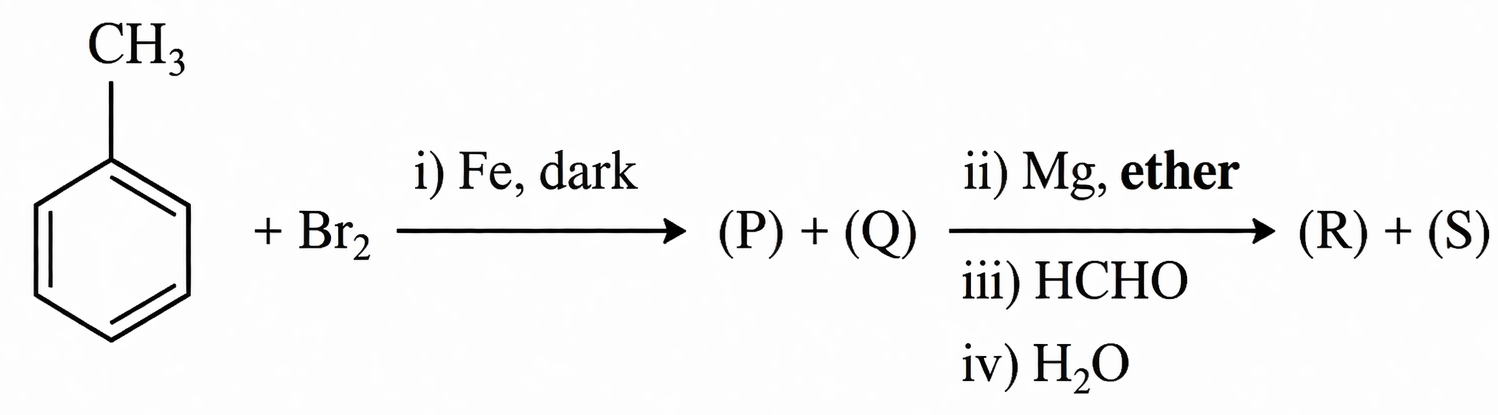 TS EAMCET 2021 Hard
 - The function \(f: C \rightarrow C\) defined by \(f(x)=\frac{a x+d}{c x+d}\) for \(x \in C\) where \(b d \neq 0\) reduces to a constant function, ifTS EAMCET 2005 Easy