


TS EAMCET · Maths · Application of Derivatives
Consider the function \(f(x)=2 x^3-3 x^2-x+1\) and the intervals \(Y_1=[-1,0], Y_2=[0,1]\), \(r_3=[1,2], r_4=[-2,-1]\). Then,
- A \(f(x)=0\) has a root in the intervals \(f_1\) and \(f_4\) only
- B \(f(x)=\) ohas a root in the intervals \(f_1\) and \(f_2\) only
- C \(f(x)=0\) has a root in every interval except in \(f_4\)
- D \(f(x)=0\) has a root in all the four given intervals
Answer & Solution
Correct Answer
(C) \(f(x)=0\) has a root in every interval except in \(f_4\)
Step-by-step Solution
Detailed explanation
We have, \[ f(x)=2 x^3-3 x^2-x+1 \] Let \[ \begin{aligned} & g(x)=\frac{x^4}{2}-x^3-\frac{x^2}{2}+x \\ & g(-1)=\frac{1}{2}+1-\frac{1}{2}-1=0 \end{aligned} \] and \[ g(0)=0 \] \(\therefore f(x)=0\) has roots lie in \([-1,0]\). Similarly, \(g(0)=g(1)=0\)…
See the Complete Solution
Get step-by-step explanations for this and 2.5 Lakh+ more JEE, NEET & CET questions.
- Unlock all solutions
- Practice the full chapter
- Track accuracy across PYQs
4.8 rated on Google Play · 14,000+ reviews
More questions from Maths
- The maximum value of the function \(f(x)=3 \sin ^{12} x+\) \(4 \cos ^{16} x\) isTS EAMCET 2024 Medium
- If \((1+x)^n=C_0+C_1 x+C_2 x^2+\ldots+C_n x^n\) for \(n \in N\), then \(C_0+\frac{C_1}{2}+\frac{C_2}{3}+\ldots+\frac{C_n}{n+1}=\)TS EAMCET 2023 Medium
- For a square matrix \(B\) of order 3, if \(B^T=B^{-1}\) and \(|B|=1\), then \(|B-I|=\)TS EAMCET 2020 Hard
- In any \(\triangle A B C, \frac{b-c \cos A}{c-b \cos A}\) is equal toTS EAMCET 2021 Medium
- The solution of \(\frac{d y}{d x}=\frac{x+y}{x-y}\) isTS EAMCET 2017 Medium
- The quadratic equation whose roots are \(\sin ^2 18^{\circ}\) and \(\cos ^2 36^{\circ}\) isTS EAMCET 2023 Easy
More PYQs from TS EAMCET
- The freezing point depression of of is . If the oxidation state of is and , then the total number of possibilities for different types of and cations areTS EAMCET 2020 Hard
- The number of arbitrary constants that appear in the general solution of the differential equation \[ \left(\frac{d^4 y}{d x^4}+\frac{d^2 y}{d x^2}\right)^{3 / 2}=5 \frac{d^3 y}{d x^3} \text { is } \]TS EAMCET 2022 Easy
- Observe the following complex ions
\(\left[\mathrm{Mn}(\mathrm{CN})_6\right]^{3-}\) \(\left[\mathrm{Fe}(\mathrm{CN})_6\right]^{3-}\) \(\left[\mathrm{CoF}_6\right]^{3-}\) \(\left[\mathrm{Co}\left(\mathrm{C}_2 \mathrm{O}_4\right)_3\right]^{3-}\) A B C D
Identify the option in which the unpaired electrons in the complex ions are in correct increasing orderTS EAMCET 2025 Medium - The molality (in mol \(\mathrm{kg}^{-1}\) ) of 1 mole of solute in \(50 \mathrm{~g}\) of solvent isTS EAMCET 2019 Easy
- If the system of equations \(x+y+z=5, x+2 y+2 z=6\) and \(x+3 y+\lambda z=\mu(\lambda, \mu \in \mathbb{R})\) is solvable by Matrix Inversion Method, thenTS EAMCET 2023 Easy
- Match the following.
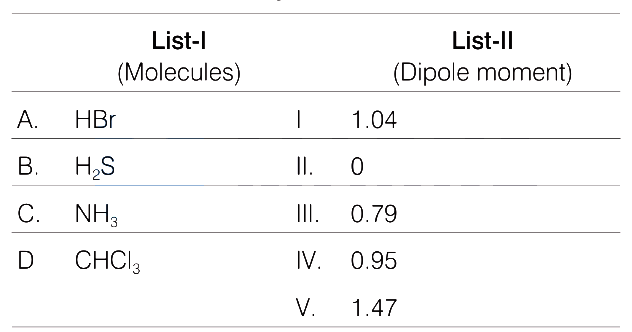
The correct match is A B C DTS EAMCET 2021 Hard