


TS EAMCET · Chemistry · Chemical Bonding and Molecular Structure
Which of the following is a favourable factor for cation formation?
- A High electronegativity
- B High electron affinity
- C Low ionisation potential
- D Smaller atomic size
Answer & Solution
Correct Answer
(C) Low ionisation potential
Step-by-step Solution
Detailed explanation
Low ionisation energy means that electron can be easily lost and cation formation is easier.
See the Complete Solution
Get step-by-step explanations for this and 2.5 Lakh+ more JEE, NEET & CET questions.
- Unlock all solutions
- Practice the full chapter
- Track accuracy across PYQs
4.8 rated on Google Play · 14,000+ reviews
More questions from Chemistry
- Enthalpy of formation of \(\mathrm{CO}(\mathrm{g}), \mathrm{CO}_2(\mathrm{~g})\) are \(-110,-393\) \(\mathrm{kJ} \mathrm{mol}^{-1}\) respectively. The enthalpy of combustion of CO (in \(\mathrm{kJ} \mathrm{mol}^{-1}\) ) isTS EAMCET 2023 Medium
- The following plot represents the de-Broglie wavelength as a function of the kinetic energy (K.E.) of two particles \(A\) and \(B\). Identify the correct relation
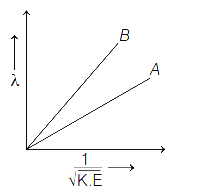 TS EAMCET 2018 Easy
 - In which of the following ions the spin only magnetic moment is lowest?TS EAMCET 2024 Medium
- The organic compound 5-allylcyclohex-3-ene-1-ol is reacted with cold, dilute, aqueous solution of \(\mathrm{KMnO}_4\). The total number of hydroxyl group \((\mathrm{s})(-\mathrm{OH})\) present in the product isTS EAMCET 2022 Easy
- Which of the following is only a redox reaction but not a disproportionation reaction?TS EAMCET 2023 Medium
- For a first order reaction \((A \rightarrow B)\), the temperature \((T)\) dependent rate constant \((k)\) in \(\mathrm{s}^{-1}\) was found to follow the equation : \(\log k=\left(-\frac{20}{T}\right)+4\). The activation energy \(\left(E_a\right)\) and pre-exponential factor \((A)\) respectively, areTS EAMCET 2020 Hard
More PYQs from TS EAMCET
- If a random variable \(X\) has the following probability distribution, then the mean of \(X\) is \(\begin{array}{|l|c|c|c|c|}\hline X=x i & 1 & 2 & 3 & 5 \ \hline p(X=x i) & 2 k^2 & k & k & k^2 \ \hline \end{array}\)TS EAMCET 2024 Easy
- A parallel-plate capacitor with circular plates is being discharged. The radius of the circular plate is \(10 \mathrm{~cm}\). A circular loop of radius \(20 \mathrm{~cm}\) is concentric with the capacitor and located halfway between the plates. If the electric field between the plates is charging at the rate \(3.6 \times 10^{12} \mathrm{~V} /(\mathrm{ms})\), then the displacement current through the loop is (Assume \(\frac{1}{4 \pi \varepsilon_0}=9 \times 10^9 \mathrm{Nm}^2 / \mathrm{C}^2\) )TS EAMCET 2020 Medium
- The energy of an electron in the orbit of -atom (in ) is approximately:TS EAMCET 2018 Easy
- The solution set of the equation \(\cos ^2 2 x+\sin ^2 3 x=1\) isTS EAMCET 2024 Hard
- Magnetic induction at the centre of a circular loop of area \(\pi \mathrm{m}^2\) is 0.1 tesla. The magnetic moment of the loop is ( \(\mu_0=\) permeability of air \()\)TS EAMCET 2004 Easy
- The member of significant figures in 2.0400 isTS EAMCET 2022 Easy