


TS EAMCET · Chemistry · Redox Reactions
Which of the following is only a redox reaction but not a disproportionation reaction?
- A \(4 \mathrm{H}_3 \mathrm{PO}_3 \rightarrow 3 \mathrm{H}_3 \mathrm{PO}_4+\mathrm{PH}_3\)
- B \(2 \mathrm{H}_2 \mathrm{O}_2 \rightarrow 2 \mathrm{H}_2 \mathrm{O}+\mathrm{O}_2\)
- C \(\mathrm{P}_4+3 \mathrm{NaOH}+3 \mathrm{H}_2 \mathrm{O} \rightarrow 3 \mathrm{NaH}_2 \mathrm{PO}_2+\mathrm{PH}_3\)
- D \(\mathrm{P}_4+8 \mathrm{SOCl}_2 \rightarrow 4 \mathrm{PCl}_3+2 \mathrm{~S}_2 \mathrm{Cl}_2+4 \mathrm{SO}_2\)
Answer & Solution
Correct Answer
(D) \(\mathrm{P}_4+8 \mathrm{SOCl}_2 \rightarrow 4 \mathrm{PCl}_3+2 \mathrm{~S}_2 \mathrm{Cl}_2+4 \mathrm{SO}_2\)
Step-by-step Solution
Detailed explanation
The reaction \(\mathrm{P}_4+8 \mathrm{SOCl}_2 \rightarrow 4 \mathrm{PCl}_3+2 \mathrm{~S}_2 \mathrm{Cl}_2+4 \mathrm{SO}_2\) involves change of oxidation state of \(\mathrm{P}\) from 0 to +3 and that of \(S\) from +4 to +2 . Thus, it is a redox reaction but not a…
See the Complete Solution
Get step-by-step explanations for this and 2.5 Lakh+ more JEE, NEET & CET questions.
- Unlock all solutions
- Practice the full chapter
- Track accuracy across PYQs
4.8 rated on Google Play · 14,000+ reviews
More questions from Chemistry
- Which of the following has the least electron gain enthalpy?TS EAMCET 2024 Easy
- can react with in presence of a catalyst to form as per the following reaction, The amount of in grams required to produce grams of isTS EAMCET 2020 Medium
- Which of the following set of compounds react with \(\mathrm{NaHCO}_3\) ?
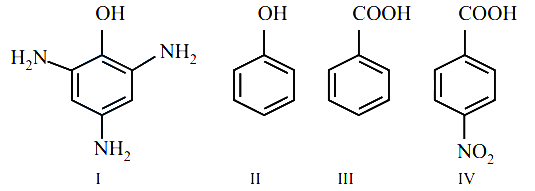 TS EAMCET 2022 Hard
 - White metal is an alloy ofTS EAMCET 2015 Medium
-
The decreasing order of the reaction rate with nucleophile is
TS EAMCET 2021 Easy - Which of the following element is extracted using \(\mathrm{I}_2\) as the reactant?TS EAMCET 2018 Easy
More PYQs from TS EAMCET
- In a process, the work done by the system is equal to the decrease in its internal energy. The process that the system undergoes isTS EAMCET 2023 Easy
- If \(x\) is real, then the maximum and minimum values of \(\frac{x^2+14 x+9}{x^2+2 x+3}\) are respectivelyTS EAMCET 2020 Medium
- If \(y=y(x)\) is the solution of the differential equation \(\left(\frac{2+\sin x}{y+1}\right) \frac{d y}{d x}+\cos x=0 \quad\) with \(y(0)=1\), then \(y\left(\frac{\pi}{2}\right)\) is equal toTS EAMCET 2011 Medium
- Assertion (A): Both Glucose and Fructose have the same D-configuration.
Reason (R): Both Glucose and Fructose are dextrorotatory. The correct option among the following is:TS EAMCET 2022 Easy - If \(\tan \theta+\tan \left(\theta+\frac{\pi}{3}\right)+\tan \left(\theta+\frac{2 \pi}{3}\right)=3\), then which of the following is equal to 1 ?TS EAMCET 2008 Medium
- Which one among the following reaction products gives iodoform test?TS EAMCET 2020 Hard