


TS EAMCET · Chemistry · Haloalkanes and Haloarenes
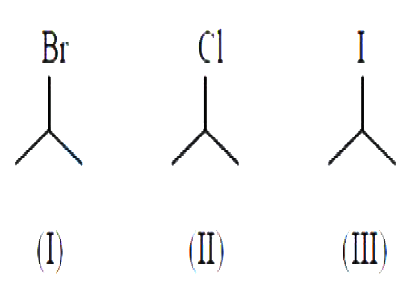
The correct order of rate of dehydrohologenation of the following halides in the presence of alcoholic KOH is
- A
- B
- C
- D
Answer & Solution
Correct Answer
(C)
Step-by-step Solution
Detailed explanation
When the alkyl halides are reacted in the presence of alcoholic KOH alkene formation will take place as according to Saytzeff rule i.e. an alkyl halide that gives a more highly substituted (more stable) alkene undergoes dehydrohalogenation faster than the one which gives a less…
See the Complete Solution
Get step-by-step explanations for this and 2.5 Lakh+ more JEE, NEET & CET questions.
- Unlock all solutions
- Practice the full chapter
- Track accuracy across PYQs
4.8 rated on Google Play · 14,000+ reviews
More questions from Chemistry
- Match the following:
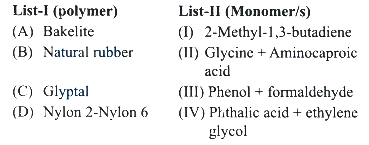
The correct answer isTS EAMCET 2023 Easy - The volume of water required to dissolve \(0.1 \mathrm{~g} \mathrm{PbCl}_2\) to get a saturated solution (in mL ) is \(\left(\right.\) Given \(\mathrm{K}_{\mathrm{sp}}\left(\mathrm{PbCl}_2\right)=3.2 \times 10^{-8} ;\) Atomic mass of \(\left.\mathrm{Pb}=207 \mathrm{u}\right)\)TS EAMCET 2025 Easy
- Which of the following salts can accommodate more number of \(\mathrm{H}_2 \mathrm{O}\) molecules per molecule in their halide hydrates?TS EAMCET 2022 Medium
- Identify the correct statements from the folluwing (A) At 298 K, the potential of hydrogen electrode placed in a solution of \(\mathrm{pH}=10\), is -0.59 V (B) The limiting molar conductivity of \(\mathrm{Ca}^{2+}\) and \(\mathrm{Cl}^{-}\)is 119 and \(76 \mathrm{~S} \mathrm{~cm}^2 \mathrm{~mol}^{-1}\) respectively. The limiting molar conductivity of \(\mathrm{CaCl}_2\) is \(195 \mathrm{~S} \mathrm{~cm}^2 \mathrm{~mol}^{-\frac{1}{2}}\) (C) The correct relationship between \(\mathrm{K}_{\mathrm{c}}\) and \(\mathrm{E}_{\text {cell }}^0\) is \(\mathrm{E}_{\mathrm{ccll}}^{-}=\frac{2.303 \mathrm{RT}}{\mathrm{nF}} \log \mathrm{~K}_{\mathrm{c}}\)TS EAMCET 2024 Medium
- Calculate \(\Delta H\) in \(\mathrm{kJ}\) for the following reaction \[ \mathrm{C}(\mathrm{g})+\mathrm{O}_2(\mathrm{~g}) \longrightarrow \mathrm{CO}_2(\mathrm{~g}) \] Given that, \[ \begin{gathered} \mathrm{H}_2 \mathrm{O}(g)+\mathrm{C}(g) \longrightarrow \mathrm{CO}(g)+\mathrm{H}_2(g) ; \ \Delta H=+131 \mathrm{~kJ} \ \mathrm{CO}(g)+\frac{1}{2} \mathrm{O}_2(g) \longrightarrow \mathrm{CO}_2(g) ; \ \Delta H=-282 \mathrm{~kJ} \ \mathrm{H}_2(g)+\frac{1}{2} \mathrm{O}_2(g) \longrightarrow \mathrm{H}_2 \mathrm{O}(g) ; \ \Delta H=-242 \mathrm{~kJ} \end{gathered} \]TS EAMCET 2008 Easy
- For the formation of ammonia gas from its constituent elements, the isTS EAMCET 2022 Medium
More PYQs from TS EAMCET
- \(e^{\int_0^{\pi / 2} \sqrt{\frac{1-\sin 2 x}{1+\sin 2 x}} d x}=\)TS EAMCET 2018 Easy
- The vector that is parallel to the vector and coplanar with the vectors and isTS EAMCET 2018 Medium
- The energy of an electromagnetic radiation is \(19.875 \times 10^{-13}\) ergs. What is its wave number in \(\mathrm{cm}^{-1}\) ? \(\left(h=6.625 \times 10^{-27}\right.\) erg sec, \(\left.c=3 \times 10^{10} \mathrm{~cm} \mathrm{sec}^{-1}\right)\)TS EAMCET 2002 Easy
- Two convex lenses of focal lengths \(f_1\) and \(f_2\) form images with magnification \(m_1\) and \(m_2\), when used individually for an object kept at the same distance from the lenses. Then, \(f_1 / f_2\) isTS EAMCET 2016 Hard
- If a plane \(x+y+z-5=0\) intersects the line joining \(\mathrm{A}(1,1,1)\) and \(\mathrm{B}(2,2,2)\) at \(\mathrm{P}\) then \(\mathrm{AP}: \mathrm{PB}=\)TS EAMCET 2022 Hard
- Suppose a line makes an angle of \(120^{\circ}\) with the positive direction of \(X\)-axis. If the length of the perpendicular from origin to that line Is 4 , then the equation of the line isTS EAMCET 2019 Easy