


KCET · Physics · Wave Optics
Young's double slit experiment gives interference fringes of width \(0.3 \mathrm{~mm}\). A thin glass plate made of material of refractive index \(1.5\) is kept in the path of light from one of the slits, then the fringe width becomes
- A zero
- B \(0.3 \mathrm{~mm}\)
- C \(0.45 \mathrm{~mm}\)
- D \(0.15 \mathrm{~mm}\)
Answer & Solution
Correct Answer
(B) \(0.3 \mathrm{~mm}\)
Step-by-step Solution
Detailed explanation
When a this glass plate of thickness \(t\) and refractive index \(\mu\) is introduced in one of the paths of the interfering waves then the path increases by \((\mu-1) \mathrm{t}\) and the whole pattern shifts by
\[
\mathrm{y}_{0}=\frac{\mathrm{D}}{\mathrm{d}}(\mu-1) \mathrm{t}
\]
Shifting is towards the side in which the plate is introduced without any change in fringe width. Therefore, when a glass plate of refractive index \(1.5\) is kept in the path of light from one of the slits, only the fringes get shifted but the fringe width remains unchanged.
\[
\mathrm{y}_{0}=\frac{\mathrm{D}}{\mathrm{d}}(\mu-1) \mathrm{t}
\]
Shifting is towards the side in which the plate is introduced without any change in fringe width. Therefore, when a glass plate of refractive index \(1.5\) is kept in the path of light from one of the slits, only the fringes get shifted but the fringe width remains unchanged.
See the Complete Solution
Get step-by-step explanations for this and 2.5 Lakh+ more JEE, NEET & CET questions.
- Unlock all solutions
- Practice the full chapter
- Track accuracy across PYQs
4.8 rated on Google Play · 14,000+ reviews
More questions from Physics
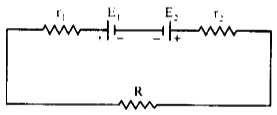
- Two cells of emf \( E_{1} \) and \( E_{2} \) are joined in opposition (such that \( E_{1}>E_{2} \) ). If \( r_{1} \) and \( r_{2} \) be the internal resistance and \( R \) be the external resistance, then the terminal potential difference is
 KCET 2015 Hard
 - An \(\alpha\)-particle and a proton moving with the same kinetic energy enter a region of uniform magnetic field at right angles to the field. The ratio of the radii of the paths of \(\alpha\)-particle to that of the proton isKCET 2012 Medium
- If \( \vec{E}_{a x} \) and \( \vec{E}_{e q} \) represents electric field at a point on the axial and equatorial line of a dipole. If points are at a distance \( r \) from the centre of the dipole, for \( r>> \) aKCET 2016 Medium
- A \( 12 \mathrm{~kg} \) bomb at rest explodes into two pieces of \( 4 \mathrm{~kg} \) and \( 8 \mathrm{~kg} \). If the momentum of \( 4 \mathrm{~kg} \) piece
is \( 20 \mathrm{Ns} \), the kinetic energy of the \( 8 \mathrm{~kg} \) piece isKCET 2016 Medium - A ray of light passes through an equilateral glass prism in such a manner that the angle of incidence is equal to the angle of emergence and each of these angles is equal to \(\frac{3}{4}\) of the angle of the prism. The angle of deviation isKCET 2022 Medium
- Two identical metal spheres charged with \(+12 \mu \mathrm{F}\) and \(-8 \mu \mathrm{F}\) are kept at certain distance in air. They are brought into contact and then kept at the same distance. The ratio of the magnitudes of electrostatic forces between them before and after contact isKCET 2008 Medium
More PYQs from KCET
- Which of the following structure of a molecule is expected to have three bond pairs and one
lone pair of electrons?KCET 2017 Easy - If \(A\) is a square matrix, such that \(A^2=A\) then \((I+A)^3\) is equal toKCET 2024 Easy
- After adding non-volatile solute freezing point of water decreases to \( -0.186^{\circ} \mathrm{C} . \) Calculate
\( \Delta T_{b} \) if \( K_{\mathrm{f}}=1.86 K \mathrm{~kg} \mathrm{~mol}^{-1} \) and \( K_{b}=0.521 K \mathrm{~kg} \mathrm{~mol}^{-1} \)KCET 2015 Hard - Anti-histamine among the following isKCET 2019 Easy
- A cyclotron's oscillator frequency is \( 10 \mathrm{MHz} \) and the operating magnetic field is \( 0.66 \mathrm{~T} \). If the
radius of its dees is \( 60 \mathrm{~cm} \), then the kinetic energy of the proton beam produced by the
accelerator isKCET 2018 Medium - A pure breeding pea plant with round yellow seeds was crossed with pea plant having wrinkled green seeds. On selfing of \(F_1\) hybrid of his cross, 64 progenies were obtained in \(F_2\) generation. Find out the number of \(F_2\) progenies showing non-parental characters.KCET 2020 Medium