


KCET · Physics · Ray Optics
A ray of light passes through an equilateral glass prism in such a manner that the angle of incidence is equal to the angle of emergence and each of these angles is equal to \(\frac{3}{4}\) of the angle of the prism. The angle of deviation is
- A \(39^{\circ}\)
- B \(20^{\circ}\)
- C \(30^{\circ}\)
- D \(45^{\circ}\)
Answer & Solution
Correct Answer
(C) \(30^{\circ}\)
Step-by-step Solution
Detailed explanation
For an equilateral glass prism,
Angle of prism, \(A=60^{\circ}\)
If \(i\) and \(c\) be the angle of incidence and angle of cmergence respectively, then
\(i=\frac{3}{4} A=\frac{3}{4} \times 60^{\circ}=45^{\circ} \text { and } e=i=45^{\circ}\)
For a prism, we know that
\(\begin{aligned}A+\delta & =i+c \Rightarrow \delta=i+e-A \\\delta & =45^{\circ}+45^{\circ}-60^{\circ}=90^{\circ}-60^{\circ}=30^{\circ}\end{aligned}\)
Angle of prism, \(A=60^{\circ}\)
If \(i\) and \(c\) be the angle of incidence and angle of cmergence respectively, then
\(i=\frac{3}{4} A=\frac{3}{4} \times 60^{\circ}=45^{\circ} \text { and } e=i=45^{\circ}\)
For a prism, we know that
\(\begin{aligned}A+\delta & =i+c \Rightarrow \delta=i+e-A \\\delta & =45^{\circ}+45^{\circ}-60^{\circ}=90^{\circ}-60^{\circ}=30^{\circ}\end{aligned}\)
See the Complete Solution
Get step-by-step explanations for this and 2.5 Lakh+ more JEE, NEET & CET questions.
- Unlock all solutions
- Practice the full chapter
- Track accuracy across PYQs
4.8 rated on Google Play · 14,000+ reviews
More questions from Physics
- The figure shows variation of \(R, X_L\) and \(X_C\) with frequency \(f\) in a series \(L-C-R\) circuit. Then, for what frequency point is the circuit capacitive?
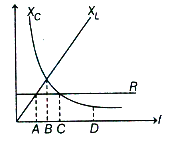 KCET 2024 Medium
 - A dipole moment \(p\) and moment of inertia \(I\) is placed in a uniform electric field \(\mathbf{E}\). If it is displaced slightly from its stable equilibrium position, the period of oscillation of dipole isKCET 2020 Easy
- A point object is moving at a constant speed of \(1 \mathrm{~ms}^{-1}\) along the principal axis of a convex lens of focal length \(10 \mathrm{~cm}\). The speed of the image is also \(1 \mathrm{~ms}^{-1}\), when the object is at \(\mathrm{cm}\) from the optical centre of the lens.KCET 2023 Hard
- The angular momentum of a moving body remains constant, ifKCET 2026 Easy
- When a neutron is disintegrated to give a \(\beta\)-particle,KCET 2010 Easy
- Magnetic field at the centre of a circular coil of radius \(R\) due to \(i\) flowing through it is \(B\). The magnetic field at a point along the axis at distance \(R\) from the centre isKCET 2010 Easy
More PYQs from KCET
- Let \( { }^{*} \) be a binary operation defined on \( R \) by \( a * b=\frac{a+b}{4} \forall a, b \in R \) then the operation \( * \) is
O examsnet com)KCET 2016 Hard - The feasible region of an LPP is shown in the figure. If \( z=3 x+9 y \), then the minimum value of
z occurs at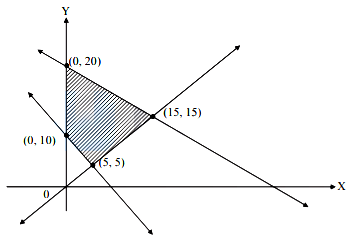 KCET 2018 Easy
 - The following truth table with \(\mathrm{A}\) and \(\mathrm{B}\) as inputs is for ........ gate.
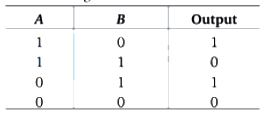 KCET 2012 Easy
 - The degree of the differential equation \( \left[1+\left(\frac{d y}{d x}\right)^{2}\right]^{2}=\frac{d^{2} y}{d x^{2}} \) isKCET 2017 Easy
- A person wants a real image of his own, \( 3 \) times enlarged. Where should he stand infront of a concave mirror of radius of curvature \( 30 \mathrm{~cm} \) ?KCET 2015 Easy
- If \(\mathrm{x}=\mathrm{t}^{2}+2\) and \(\mathrm{y}=2 \mathrm{t}\) represent the parametric equation of the parabolaKCET 2012 Easy