


KCET · Physics · Waves and Sound
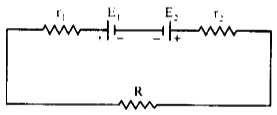
Two cells of emf \( E_{1} \) and \( E_{2} \) are joined in opposition (such that \( E_{1}>E_{2} \) ). If \( r_{1} \) and \( r_{2} \) be the internal resistance and \( R \) be the external resistance, then the terminal potential difference is
- A \( \frac{E_{1}+E_{2}}{r_{1}+r_{2}} \times R \)
- B \( \frac{E_{1}+E_{2}}{r_{1}+r_{2}+R} \times R \)
- C \( \frac{E_{1}-E_{2}}{r_{1}+r_{2}} \times R \)
- D \( \frac{E_{1}-E_{2}}{r_{1}+r_{2}+R} \times R \)
Answer & Solution
Correct Answer
(D) \( \frac{E_{1}-E_{2}}{r_{1}+r_{2}+R} \times R \)
Step-by-step Solution
Detailed explanation
Here, current through the circuit \( =I=\frac{\text { net emf }}{\text { effective resistance }} \)
\( \Rightarrow I=\frac{E_{1}-E_{2}}{r_{1}+r_{2}+R} \)
Using ohm's law, \( V=I R \),
Terminal potential difference \( =\frac{\left(E_{1}-E_{2}\right)}{\left(r_{1}+r_{2}+R\right)} \times R \)
\( \Rightarrow I=\frac{E_{1}-E_{2}}{r_{1}+r_{2}+R} \)
Using ohm's law, \( V=I R \),
Terminal potential difference \( =\frac{\left(E_{1}-E_{2}\right)}{\left(r_{1}+r_{2}+R\right)} \times R \)
See the Complete Solution
Get step-by-step explanations for this and 2.5 Lakh+ more JEE, NEET & CET questions.
- Unlock all solutions
- Practice the full chapter
- Track accuracy across PYQs
4.8 rated on Google Play · 14,000+ reviews
More questions from Physics
- A square loop of side 2 m lies in the \(Y-Z\) plane in a region having a magnetic field \(\vec{B}=(5 \hat{\mathrm{i}}+3 \hat{\mathrm{j}}-4 \hat{\mathrm{k}}) \mathrm{T}\). The magnitude of magnetic flux through the square loop isKCET 2025 Easy
- Which of the following statements is not true?KCET 2025 Easy
- Identify the correct statementKCET 2025 Easy
- A resistor has a colour code of green, blue, brown and silver. What is its resistance?KCET 2011 Easy
- A rectangular coil of 100 turns and size \(0.1 \mathrm{~m} \mathrm{} \times 0.05 \mathrm{~m}\) is placed perpendicular to a magnetic field of \(0.1 \mathrm{~T}\). If the field drops to \(0.05 \mathrm{~T}\) in \(0.05 \mathrm{~s}\), the magnitude of the e.m.f. iniduced in the coil isKCET 2013 Medium
- Two identical circular coils \(A\) and \(B\) are kept on a horizontal tube side by side without touching each other. If the current in the coil \(A\) increases with time, in response, the coil \(B\)KCET 2013 Medium
More PYQs from KCET
- \(\int_{-\pi}^\pi\left(1-x^2\right) \sin x \cdot \cos ^2 x d x\) isKCET 2024 Easy
- The complex number \(\frac{1+2 \mathrm{i}}{1-\mathrm{i}}\) lies inKCET 2009 Easy
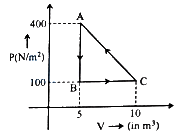
- A thermodynamic system undergoes a cyclic process \( A B C \) as shown in the diagram. The work done by the system per cycle is
 KCET 2019 Medium
 - "Heat cannot be flow itself from a body at lower temperature to a body at higher temperature". This statement corresponds toKCET 2022 Easy
- An electron is moving in a circle of radius \( r \) in a magnetic field B. Suddenly the field is reduced to \( \frac{B}{2} \). The radius of the circular path isKCET 2018 Easy
- The value of \(\int \frac{x e^{x} d x}{(1+x)^{2}}\) is equal toKCET 2021 Hard