


KCET · BIOLOGY · STD 11 - 6. Anatomy of Flowering Plants
In which type of vascular bundles are xylem and phloem present at the same radius?
- A Radial
- B Closed
- C Conjoint
- D Exarch
Answer & Solution
Correct Answer
(C) Conjoint
Step-by-step Solution
Detailed explanation
(C) Conjoint,
In conjoint type of flowering plants, both xylem and phloem are present on the same radius.
In conjoint type of flowering plants, both xylem and phloem are present on the same radius.
See the Complete Solution
Get step-by-step explanations for this and 2.5 Lakh+ more JEE, NEET & CET questions.
- Unlock all solutions
- Practice the full chapter
- Track accuracy across PYQs
4.8 rated on Google Play · 14,000+ reviews
More questions from BIOLOGY
- Read the statements A and B and select the correct option.
Statement A: Atherosclerosis is a disease characterized by the thickening of arterial walls.
Statement B: Deposition of cholesterol and triglycerides in the arterial walls causes atherosclerosis.KCET 2005 Easy - The drug prescribed to the patients who have undergone organ transplant is __________ and is produced by __________KCET 2025 Hard
- During citric acid cycle, the various organic acids undergo decarboxylation. Which of the following organic acids of the above cycle have 4C, 5C and 6C respectively?KCET 2020 Medium
- Cells in the quiescent stage\(\left(G_0\right)\)KCET 2019 Hard
- In Bougainvillea and Cucurbita, the axillary bud is modified into thorn and tendril respectively. This is an example ofKCET 2019 Medium
- The method of directly injecting a sperm into ovum is calledKCET 2021 Hard
More PYQs from KCET
- Identify the enzyme that catalyses the step labelled as 'M' in the given schematic representation of replication of retrovirus.
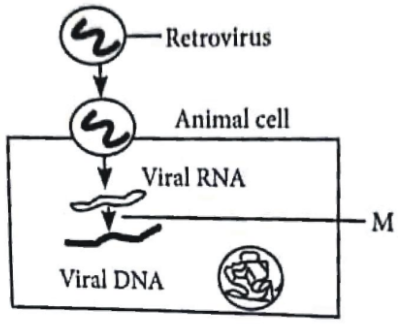 KCET 2019 Hard
 - In the given circuit, the current through \( 2 \Omega \) resistor is
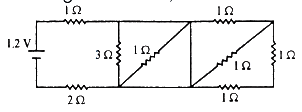 KCET 2019 Easy
 - Which one of these is not an accessory gland in male reproductive system?KCET 2016 Medium
- The modulus and amplitude of \(\frac{1+2 i}{1-(1-i)^{2}}\) areKCET 2013 Easy
- The derivative of \(\tan ^{-1}\left[\frac{\sin x}{1+\cos x}\right]\) with respect to \(\tan ^{-1}\left[\frac{\cos x}{1+\sin x}\right]\) isKCET 2011 Hard
- If ' \(a\) ' and ' \(b\) ' are the order and degree respectively of the differentiable equation. \(\left(\frac{d^2 y}{d x^2}\right)^2+\left(\frac{d y}{d x}\right)^3+x^4=0\), then \(a-b=\)KCET 2025 Easy