


KCET · Physics · Magnetic Effects of Current
Two identical circular current loops carrying equal currents are placed with their axes inclined at \(45^\circ\) to each other as shown in the figure. The resultant magnetic field at P is

- A \(\dfrac{\mu_0 I}{16\sqrt{2}R}\left[(\sqrt{2}+1)\hat{i} + \hat{j}\right]\)
- B \(\dfrac{\mu_0 I}{16\sqrt{2}R}\left[\sqrt{2}\hat{i} + \hat{j}\right]\)
- C \(\dfrac{\mu_0 I}{16R}\left[(\sqrt{2}+1)\hat{i} + \hat{j}\right]\)
- D \(\dfrac{\mu_0 I}{16R}\left[\sqrt{2}\hat{i} + \hat{j}\right]\)
Answer & Solution
Correct Answer
(A) \(\dfrac{\mu_0 I}{16\sqrt{2}R}\left[(\sqrt{2}+1)\hat{i} + \hat{j}\right]\)
Step-by-step Solution
Detailed explanation
The magnetic field at a point on the axis of a circular current loop is given by:
\(B = \dfrac{\mu_0 I R^2}{2(R^2 + x^2)^{3/2}}\)
where \(R\) is the radius of the loop and \(x\) is the distance from the center to the point.
For both loops, the distance from the center to point P is \(x = \sqrt{3}R\). Substituting this value:
\(B_1 = B_2 = \dfrac{\mu_0 I R^2}{2(R^2 + (\sqrt{3}R)^2)^{3/2}} = \dfrac{\mu_0 I R^2}{2(R^2 + 3R^2)^{3/2}} = \dfrac{\mu_0 I R^2}{2(4R^2)^{3/2}} = \dfrac{\mu_0 I R^2}{2(8R^3)} = \dfrac{\mu_0 I}{16R}\)
Let the magnetic field due to the first loop be \(\vec{B}_1\). Based on the geometry, its axis is along the x-axis, so the field is directed along the positive x-axis:
\(\vec{B}_1 = \dfrac{\mu_0 I}{16R} \hat{i}\)
The second loop is inclined such that its axis makes an angle of \(45^\circ\) with the first loop's axis. The magnetic field \(\vec{B}_2\) due to this loop is directed along its axis towards P. Resolving this field into components gives:
\(\vec{B}_2 = \dfrac{\mu_0 I}{16R} (\cos 45^\circ \hat{i} + \sin 45^\circ \hat{j}) = \dfrac{\mu_0 I}{16R} \left( \dfrac{1}{\sqrt{2}} \hat{i} + \dfrac{1}{\sqrt{2}} \hat{j} \right)\)
The resultant magnetic field at P is the vector sum of the fields from both loops:
\(\vec{B}_{net} = \vec{B}_1 + \vec{B}_2\)
\(\vec{B}_{net} = \dfrac{\mu_0 I}{16R} \hat{i} + \dfrac{\mu_0 I}{16R} \left( \dfrac{1}{\sqrt{2}} \hat{i} + \dfrac{1}{\sqrt{2}} \hat{j} \right)\)
\(\vec{B}_{net} = \dfrac{\mu_0 I}{16R} \left( \left( 1 + \dfrac{1}{\sqrt{2}} \right) \hat{i} + \dfrac{1}{\sqrt{2}} \hat{j} \right)\)
\(\vec{B}_{net} = \dfrac{\mu_0 I}{16R} \left( \dfrac{\sqrt{2} + 1}{\sqrt{2}} \hat{i} + \dfrac{1}{\sqrt{2}} \hat{j} \right)\)
\(\vec{B}_{net} = \dfrac{\mu_0 I}{16\sqrt{2}R} [(\sqrt{2} + 1)\hat{i} + \hat{j}]\)
\(B = \dfrac{\mu_0 I R^2}{2(R^2 + x^2)^{3/2}}\)
where \(R\) is the radius of the loop and \(x\) is the distance from the center to the point.
For both loops, the distance from the center to point P is \(x = \sqrt{3}R\). Substituting this value:
\(B_1 = B_2 = \dfrac{\mu_0 I R^2}{2(R^2 + (\sqrt{3}R)^2)^{3/2}} = \dfrac{\mu_0 I R^2}{2(R^2 + 3R^2)^{3/2}} = \dfrac{\mu_0 I R^2}{2(4R^2)^{3/2}} = \dfrac{\mu_0 I R^2}{2(8R^3)} = \dfrac{\mu_0 I}{16R}\)
Let the magnetic field due to the first loop be \(\vec{B}_1\). Based on the geometry, its axis is along the x-axis, so the field is directed along the positive x-axis:
\(\vec{B}_1 = \dfrac{\mu_0 I}{16R} \hat{i}\)
The second loop is inclined such that its axis makes an angle of \(45^\circ\) with the first loop's axis. The magnetic field \(\vec{B}_2\) due to this loop is directed along its axis towards P. Resolving this field into components gives:
\(\vec{B}_2 = \dfrac{\mu_0 I}{16R} (\cos 45^\circ \hat{i} + \sin 45^\circ \hat{j}) = \dfrac{\mu_0 I}{16R} \left( \dfrac{1}{\sqrt{2}} \hat{i} + \dfrac{1}{\sqrt{2}} \hat{j} \right)\)
The resultant magnetic field at P is the vector sum of the fields from both loops:
\(\vec{B}_{net} = \vec{B}_1 + \vec{B}_2\)
\(\vec{B}_{net} = \dfrac{\mu_0 I}{16R} \hat{i} + \dfrac{\mu_0 I}{16R} \left( \dfrac{1}{\sqrt{2}} \hat{i} + \dfrac{1}{\sqrt{2}} \hat{j} \right)\)
\(\vec{B}_{net} = \dfrac{\mu_0 I}{16R} \left( \left( 1 + \dfrac{1}{\sqrt{2}} \right) \hat{i} + \dfrac{1}{\sqrt{2}} \hat{j} \right)\)
\(\vec{B}_{net} = \dfrac{\mu_0 I}{16R} \left( \dfrac{\sqrt{2} + 1}{\sqrt{2}} \hat{i} + \dfrac{1}{\sqrt{2}} \hat{j} \right)\)
\(\vec{B}_{net} = \dfrac{\mu_0 I}{16\sqrt{2}R} [(\sqrt{2} + 1)\hat{i} + \hat{j}]\)
See the Complete Solution
Get step-by-step explanations for this and 2.5 Lakh+ more JEE, NEET & CET questions.
- Unlock all solutions
- Practice the full chapter
- Track accuracy across PYQs
4.8 rated on Google Play · 14,000+ reviews
More questions from Physics
- When a metal conductor connected to left gap of a meter bridge is heated, the balancing pointKCET 2022 Easy
- A Carnot's engine operates with source at \(127^{\circ} \mathrm{C}\) and sink at \(27^{\circ} \mathrm{C}\). If the source supplies \(40 \mathrm{~kJ}\) of heat energy, the work done by the engine isKCET 2007 Easy
- The end product of decay of \( { }_{90} T h^{232} \) is \( { }_{82} P b^{208} . \) The number of \( \alpha \) and \( \beta \) particles emitted are
respectivelyKCET 2019 Medium - A tightly wound long solenoid has \(n\) turns per unit length, a radius \(r\) and carries a current \(I\). A particle having charge \(q\) and mass \(m\) is projected from a point on the axis in a direction perpendicular to the axis. The maximum speed of the particle for which the particle does not strike the solenoid isKCET 2021 Easy
- Three conductors draw currents of \(1 \mathrm{~A}, 2 \mathrm{~A}\) and 3 A respectively, when connected in turn across a battery. If they are connected in series and the combination is connected across the same battery, the current drawn will beKCET 2013 Medium
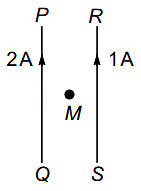
- \(\mathrm{PQ}\) and RS are long parallel conductors separated by certain distance. \(M\) is the midpoint between them (see the figure). The net magnetic field at \(M\) is B. Now, the current 2 A is switched off. The field at \(M\) now becomes
 KCET 2010 Medium
More PYQs from KCET
- Which of the following is not a biodegradablepolymer?KCET 2017 Hard
- The rate constant \(k_1\) and \(k_2\) for two different reactions are \(10^{16} \times e^{-2000 / T}\) and \(10^{15} \times e^{-1000 / T}\) respectively. The temperature at which \(k_1=k_2\) isKCET 2023 Medium
- If \(\mathbf{a}, \mathbf{b}\) and \(\mathbf{c}\) are unit vectors such that \(\mathbf{a}+\mathbf{b}+\mathbf{c}=\mathbf{0}\), then angle between \(\mathbf{a}\) and \(\mathbf{b}\) isKCET 2011 Medium
- The hormone 'melatonin ' is secreted by the glandKCET 2016 Hard
- If \(A=\left|\begin{array}{ll}x & 1 \\ 1 & x\end{array}\right|\) and \(B=\left|\begin{array}{lll}x & 1 & 1 \\ 1 & x & 1 \\ 1 & 1 & x\end{array}\right|\), then \(\frac{d B}{d x}\) isKCET 2024 Easy
- Left auricle receives pure blood from theKCET 2013 Medium