


KCET · Physics · Motion In Two Dimensions
Three projectiles \( A, B \) and \( C \) are projected at an angle of \( 30^{\circ}, 45^{\circ}, 60^{\circ} \) respectively. If
\( R_{A}, R_{B} \) and \( R_{C} \) are ranges of \( A, B \) and \( C \) respectively, then (velocity of projection is same for \( A \),
\( B \& C) \)
- A \( R_{A}=R_{B}=R_{C} \)
- B \( R_{A}=R_{C}>R_{B} \)
- C \( R_{A} < R_{B} < R_{C} \)
- D \( R_{A}=R_{C} < R_{B} \)
Answer & Solution
Correct Answer
(D) \( R_{A}=R_{C} < R_{B} \)
Step-by-step Solution
Detailed explanation
Given, angle of projection of \(A=30^{\circ} ;\) angle of projection of \(B=45^{\circ} ;\) angle of projection of \(C=60^{\circ} .\) Range of \(A=R A ;\)
rangeof \(B=R_{B}\) irange of \(C=R_{C}\)
Now, Horizontal range
\(=\frac{(\text { Initial velocity })^{2} \times \sin (2 \times \text { Launch angle })}{2 \times \text { Acceleration due to gravity }}\)
\(\Rightarrow R=\frac{v_{0}^{2} \sin 2 \theta}{g}\)
\(\Rightarrow R \propto \sin 2 \theta\)
\(\therefore R_{A} \propto \sin \left(2 \times 30^{\circ}\right)=\sin \left(60^{\circ}\right)\)
\(\Rightarrow R_{A}=\frac{\sqrt{3}}{2}\)
\(R_{B} \propto \sin \left(2 \times 45^{\circ}\right)=\sin \left(90^{\circ}\right)\)
\(\Rightarrow R_{B}=1\)
\(R_{C} \propto \sin \left(2 \times 60^{\circ}\right)=\sin \left(120^{\circ}\right)\)
\(\Rightarrow R_{C}=\frac{\sqrt{3}}{2}\)
Thus, \(R_{A}=R_{C} < R_{B}\)
rangeof \(B=R_{B}\) irange of \(C=R_{C}\)
Now, Horizontal range
\(=\frac{(\text { Initial velocity })^{2} \times \sin (2 \times \text { Launch angle })}{2 \times \text { Acceleration due to gravity }}\)
\(\Rightarrow R=\frac{v_{0}^{2} \sin 2 \theta}{g}\)
\(\Rightarrow R \propto \sin 2 \theta\)
\(\therefore R_{A} \propto \sin \left(2 \times 30^{\circ}\right)=\sin \left(60^{\circ}\right)\)
\(\Rightarrow R_{A}=\frac{\sqrt{3}}{2}\)
\(R_{B} \propto \sin \left(2 \times 45^{\circ}\right)=\sin \left(90^{\circ}\right)\)
\(\Rightarrow R_{B}=1\)
\(R_{C} \propto \sin \left(2 \times 60^{\circ}\right)=\sin \left(120^{\circ}\right)\)
\(\Rightarrow R_{C}=\frac{\sqrt{3}}{2}\)
Thus, \(R_{A}=R_{C} < R_{B}\)
See the Complete Solution
Get step-by-step explanations for this and 2.5 Lakh+ more JEE, NEET & CET questions.
- Unlock all solutions
- Practice the full chapter
- Track accuracy across PYQs
4.8 rated on Google Play · 14,000+ reviews
More questions from Physics
- Two resistors of resistances \( 2 \Omega \) and \( 6 \Omega \) are connected in parallel. This combination is then connected to a battery of emf \( 2 \mathrm{~V} \) and internal resistance \( 0.5 \Omega \). What is the current flowing through the battery?KCET 2014 Easy
- The circuit has two oppositely connected ideal diodes in parallel. What is the current flowing in
the circuit?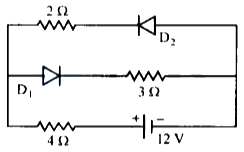 KCET 2015 Medium
 - A charge \( q \) is accelerated through a potential difference \( V \). It is then passed normally through
a uniform magnetic field, where it moves in a circle of radius \( \mathrm{r} \). The potential difference
required to move it in a circle of radius \( 2 r \) isKCET 2018 Easy - The displacement-time graph of two moving particles make angles of \(30^{\circ}\) and \(45^{\circ}\) with the \(X\)-axis. The ratio of their velocities is
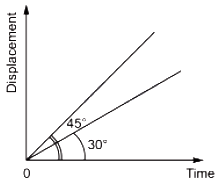 KCET 2011 Easy
 - A magnetic needle has a magnetic moment of \( 5 \times 10^{-2} \mathrm{Am}^{2} \) and moment of inertia \( 8 \times \) \( 10^{-6} \mathrm{kgm}^{2} \). It hasa period of oscillation of \( 2 \mathrm{~s} \) in a magnetic field \( \vec{B} \). The magnitude of magnetic field is approximatelyKCET 2019 Medium
- Frequencies of light incident on a system of scattering particles are in the ratio of \(1: 2\). Then, the intensity of scattered light in a particular directions isKCET 2012 Medium
More PYQs from KCET
- The mature infective stages of malarial parasite which are transferred from mosquito to man areKCET 2014 Easy
- The circuit given represents which of the logic operations?
 KCET 2021 Easy
 - Which of the following is a negatively charged bidentate ligand?KCET 2012 Hard
- A particle moves along the curve \(\frac{x^2}{16}+\frac{y^2}{4}=1\). When the rate of change of abscissa is 4 times that of its ordinate, then the quadrant in which the particle lies isKCET 2023 Easy
- The natural logarithm of the activity \(R\) of a radioactive sample varies with time \(t\) as shown. At \(t=0\), there are \(N_0\) undecayed nuclei. Then, \(N_0\) is equal to [Take \(e^2=7.5\) ]
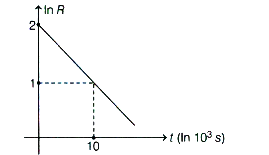 KCET 2024 Easy
 - \[
\mathrm{P} \stackrel{\mathrm{H}_{2} / \mathrm{Pd}-\mathrm{BaSO}_{4}}{\rightarrow} \mathrm{Q} \stackrel{\text { (i) conc. } \mathrm{NaOH}}{\rightarrow} \mathrm{R}+\mathrm{S}
\]
\( R \) and \( S \) form benzyl benzoate when treated with each other. Hence, \( P \) isKCET 2019 Hard