


KCET · Physics · Dual Nature of Matter
The work-function of a metal is \(1 \mathrm{eV}\). Light of wavelength \(3000 Å\) is incident on this metal surface. The velocity of emitted photoelectrons will be
- A \(10 \mathrm{~ms}^{-1}\)
- B \(1 \times 10^{3} \mathrm{~ms}^{-1}\)
- C \(1 \times 10^{4} \mathrm{~ms}^{-1}\)
- D \(1 \times 10^{6} \mathrm{~ms}^{-1}\)
Answer & Solution
Correct Answer
(D) \(1 \times 10^{6} \mathrm{~ms}^{-1}\)
Step-by-step Solution
Detailed explanation
Given, Work-function, \(\phi_{0}=\mathrm{leV}=1.6 \times 10^{-19} \mathrm{~J}\) Wavelength, \(\lambda=3000 Å=3000 \times 10^{-10} \mathrm{~m}\)
As, we know that,
\(E=h v=\frac{h c}{\lambda}=\frac{6.6 \times 10^{-34} \times 3 \times 10^{8}}{3000 \times 10^{-10}}\)
\(=6.6 \times 10^{-19} \mathrm{~J}\)
Also, \(E=\phi_{0}+\mathrm{KE}\)
\(\Rightarrow \quad \mathrm{KE}=E-\phi_{0} \Rightarrow \frac{1}{2} m v^{2}=E-\phi_{0}\)
\(v^{2}=\frac{\left(6.6 \times 10^{-19}-1.6 \times 10^{-19}\right) \times 2}{9.1 \times 10^{-31}}\)
\(=\frac{5 \times 10^{-19} \times 2}{9.1 \times 10^{-31}}=1.1 \times 10^{12}\)
\(v=1.01 \times 10^{6}\)
\(\simeq 1 \times 10^{6} \mathrm{~m} / \mathrm{s}\)
As, we know that,
\(E=h v=\frac{h c}{\lambda}=\frac{6.6 \times 10^{-34} \times 3 \times 10^{8}}{3000 \times 10^{-10}}\)
\(=6.6 \times 10^{-19} \mathrm{~J}\)
Also, \(E=\phi_{0}+\mathrm{KE}\)
\(\Rightarrow \quad \mathrm{KE}=E-\phi_{0} \Rightarrow \frac{1}{2} m v^{2}=E-\phi_{0}\)
\(v^{2}=\frac{\left(6.6 \times 10^{-19}-1.6 \times 10^{-19}\right) \times 2}{9.1 \times 10^{-31}}\)
\(=\frac{5 \times 10^{-19} \times 2}{9.1 \times 10^{-31}}=1.1 \times 10^{12}\)
\(v=1.01 \times 10^{6}\)
\(\simeq 1 \times 10^{6} \mathrm{~m} / \mathrm{s}\)
See the Complete Solution
Get step-by-step explanations for this and 2.5 Lakh+ more JEE, NEET & CET questions.
- Unlock all solutions
- Practice the full chapter
- Track accuracy across PYQs
4.8 rated on Google Play · 14,000+ reviews
More questions from Physics
- A transformer works on the principle ofKCET 2011 Easy
- A gyromagnetic ratio of the electron revolving in a circular orbit of hydrogen atom is \( 8.8 \times 10^{10} \mathrm{C} \mathrm{kg}^{-1} \). What is the mass of the electron ? Given charge of the electron = \( 1.6 \times 10^{-19} \mathrm{C} \).KCET 2014 Easy
- One mole of an ideal monoatomic gas is taken round the cyclic process MNOM. The work done by the gas is
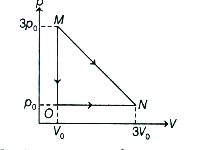 KCET 2024 Easy
 - When a potential difference of \(10^{3} \mathrm{~V}\) is applied between \(A\) and \(B\), a charge of \(0.75 \mathrm{mC}\) is value of \(\mathrm{C}\) is (in \(\mu \mathrm{F}\) )
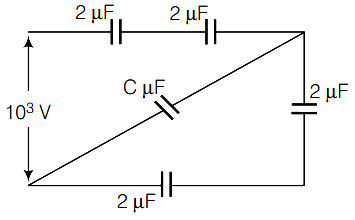 KCET 2013 Medium
 - In a permanent magnet at room temperatureKCET 2020 Easy
- Which one of the following is \(v_{m}-T\) graph for perfectly black body? \(v_{m}\) is the frequency of radiation with maximum intensity. \(T\) is the absolute temperature.
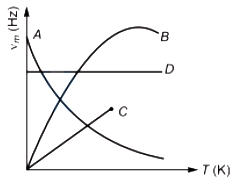 KCET 2011 Medium
More PYQs from KCET
- An example for a neutral buffer isKCET 2013 Medium
- A copper wire of length \(1 \mathrm{~m}\) and uniform cross-sectional area \(5 \times 10^{-7} \mathrm{~m}^{2}\) carries a current of \(1 \mathrm{~A}\). Assuming that, there are \(8 \times 10^{28}\) free electrons per \(\mathrm{m}^{3}\) in copper, how long will an electron take to drift from one end of the wire to the other?KCET 2021 Hard
- A microscope is having objective of focal length \( 1 \mathrm{~cm} \) and eyepiece of focal length \( 6 \mathrm{~cm} \). If tube
length is \( 30 \mathrm{~cm} \) and image is formed at the least distance of distinct vision, what is the
magnification produced by the microscope ? Take D \( =25 \mathrm{~cm} \).KCET 2014 Easy - How many number of atoms are there in a cube based unit cell, having one atom on each corner and 2 atoms on each body diagonal of cube?KCET 2022 Easy
- \(\beta\)-decay means emission of electron fromKCET 2009 Easy
- If \( \vec{a} \) and \( \vec{b} \) are two unit vectors inclined at an angle \( \frac{\Pi}{3} \), then the value of \( |\vec{a}+\vec{b}| \) isKCET 2014 Easy