


KCET · Physics · Dual Nature of Matter
The value of acceleration due to gravity at adepth of \( 1600 \mathrm{~km} \) is equal to:
[Radius of earth \( =6400 \mathrm{~km} \) ]
- A \( 9.8 \mathrm{~ms}^{-2} \)
- B \( 4.9 \mathrm{~ms}^{-2} \)
- C \( 19.6 \mathrm{~ms}^{-2} \)
- D \( 7.35 \mathrm{~ms}^{-2} \)
Answer & Solution
Correct Answer
(D) \( 7.35 \mathrm{~ms}^{-2} \)
Step-by-step Solution
Detailed explanation
Acceleration due to gravity at a depth \( d \) and radius \( R \) isgiven as
\[
\begin{array}{l}
g=g\left[1-\frac{d}{R}\right]=g\left(1-\frac{1600}{6400}\right)=g\left(1-\frac{1}{4}\right)=g \times \frac{3}{4} \\
\Rightarrow g=9.8 \times \frac{3}{4}=7.35 m_{S}^{-2}
\end{array}
\]
Therefore, the acceleration due to gravity at a depth of \( 1600 \mathrm{~km} \) is equal to \( 7.35 \mathrm{~ms}^{-2} \)
\[
\begin{array}{l}
g=g\left[1-\frac{d}{R}\right]=g\left(1-\frac{1600}{6400}\right)=g\left(1-\frac{1}{4}\right)=g \times \frac{3}{4} \\
\Rightarrow g=9.8 \times \frac{3}{4}=7.35 m_{S}^{-2}
\end{array}
\]
Therefore, the acceleration due to gravity at a depth of \( 1600 \mathrm{~km} \) is equal to \( 7.35 \mathrm{~ms}^{-2} \)
See the Complete Solution
Get step-by-step explanations for this and 2.5 Lakh+ more JEE, NEET & CET questions.
- Unlock all solutions
- Practice the full chapter
- Track accuracy across PYQs
4.8 rated on Google Play · 14,000+ reviews
More questions from Physics
- The upper level of valence band and lower level of conduction band overlap in the case ofKCET 2024 Medium
- The period of revolution of an electron revolving in nth orbit of H-atom is proportional toKCET 2020 Easy
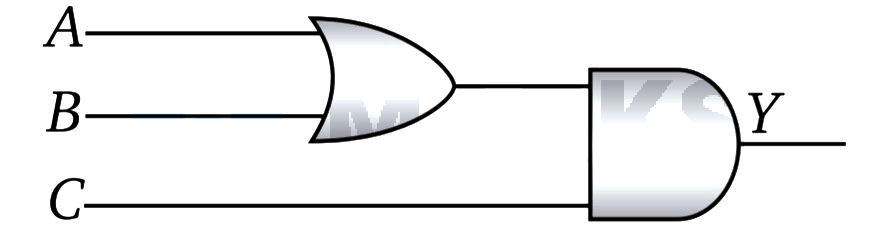
- To get an output \(Y=1\) from the circuit shown, the inputs and must be respectively
 KCET 2008 Easy
 - A cubical Gaussian surface has side of length \(a=10 \mathrm{~cm}\). Electric field lines are parallel to \(X\)-axis as shown in figure. The magnitudes of electric fields through surfaces \(A B C D\) and \(E F G H\) are \(6 \mathrm{kNC}^{-1}\) and \(9 \mathrm{kNC}^{-1}\) respectively. Then, the total charge enclosed by the cube is
[Take, \(\varepsilon_0=9 \times 10^{-12} \mathrm{Fm}^{-1}\) ]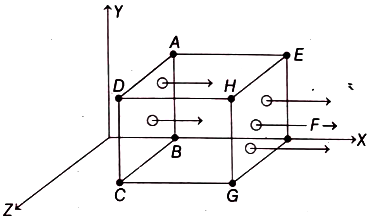 KCET 2023 Medium
 - Though the electron drift velocity is small and electron charge is very small, a conductor can
carry an appreciably large current becauseKCET 2019 Easy - Kichhoff's junction rule is a reflection ofKCET 2019 Easy
More PYQs from KCET
- Electric field at a distance \(r\) from an infinitely long uniformly charged straight conductor, having linear charge density \(\lambda\) is \(E_1\). Another uniformly charged conductor having same linear charge density \(\lambda\) is bent. into a semicircle of radius \(r\). The electric field at its centre is \(E_2\). ThenKCET 2023 Easy
- An object approaches a convergent lens from the left of the lens with a uniform speed \(5 \mathrm{~m} / \mathrm{s}\) and stops at the focus, the imageKCET 2020 Hard
- In the circuit shown in the figure, the potential difference across the \(4 \mu\text{F}\) capacitor is
 KCET 2026 Medium
 - \(\lim _{y \rightarrow 0} \frac{\sqrt{3+y^3}-\sqrt{3}}{y^3}=\)KCET 2022 Easy
- If the roots of the equation \(x^{3}+a x^{2}+b x+c=0\) are in \(\mathrm{AP}\), then \(2 a^{3}-9 a b\) is equal toKCET 2013 Medium
- A cylindrical conductor of diameter \( 0.1 \mathrm{~mm} \) carries a current of \( 90 \mathrm{~mA} \). The current density (in \(\mathrm{Am}^{-2})\) is \( (\pi \simeq 3) \)KCET 2017 Hard