


KCET · Physics · Electrostatics
A cubical Gaussian surface has side of length \(a=10 \mathrm{~cm}\). Electric field lines are parallel to \(X\)-axis as shown in figure. The magnitudes of electric fields through surfaces \(A B C D\) and \(E F G H\) are \(6 \mathrm{kNC}^{-1}\) and \(9 \mathrm{kNC}^{-1}\) respectively. Then, the total charge enclosed by the cube is
[Take, \(\varepsilon_0=9 \times 10^{-12} \mathrm{Fm}^{-1}\) ]
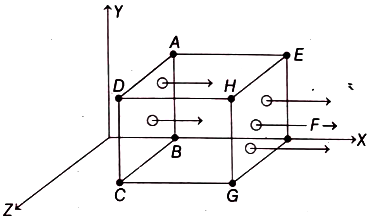
- A \(-0.27 \mathrm{nC}\)
- B \(1.35 \mathrm{nC}\)
- C \(-1.35 \mathrm{nC}\)
- D \(0.27 \mathrm{nC}\)
Answer & Solution
Correct Answer
(D) \(0.27 \mathrm{nC}\)
Step-by-step Solution
Detailed explanation
Total flux \(\phi_E=E \cdot d s\)
\(=9 \mathrm{k}-6 \mathrm{k} \times\left(10^{-2} \times 10\right)^2\)
\(=3 \times 10^3 \times 10^{-2}=30 \mathrm{NC}^{-1} \mathrm{~m}^2\)
According to Gauss' law, \(\frac{q}{\varepsilon_0}=\phi_E\)
\(\Rightarrow q_{\text {endosed }} =3 \times \varepsilon_0 \)
\( =30 \times 9 \times 10^{-12} \mathrm{C}=270 \times 10^{-9} \times 10^{-3} \)
\( =0.27 \times 10^{-9} \mathrm{C}=0.27 \mathrm{nC}\)
\(=9 \mathrm{k}-6 \mathrm{k} \times\left(10^{-2} \times 10\right)^2\)
\(=3 \times 10^3 \times 10^{-2}=30 \mathrm{NC}^{-1} \mathrm{~m}^2\)
According to Gauss' law, \(\frac{q}{\varepsilon_0}=\phi_E\)
\(\Rightarrow q_{\text {endosed }} =3 \times \varepsilon_0 \)
\( =30 \times 9 \times 10^{-12} \mathrm{C}=270 \times 10^{-9} \times 10^{-3} \)
\( =0.27 \times 10^{-9} \mathrm{C}=0.27 \mathrm{nC}\)
See the Complete Solution
Get step-by-step explanations for this and 2.5 Lakh+ more JEE, NEET & CET questions.
- Unlock all solutions
- Practice the full chapter
- Track accuracy across PYQs
4.8 rated on Google Play · 14,000+ reviews
More questions from Physics
- Which of the following expression can be deduced on the basis of dimensional analysis? (All symbols have their usual meanings)KCET 2025 Medium
- A block of mass \(m\) is connected to a light spring of force constant \(k\). The system is placed inside a damping medium of damping constant \(b\). The instantaneous values of displacement, acceleration and energy of the block are \(x, a\) and \(E\) respectively. The initial amplitude of oscillation is \(A\) and \(\omega^{\prime}\) is the angular frequency of oscillations. The incorrect
expression related to the damped oscillations isKCET 2023 Easy - Two wires A and B are made of same material. Their diameters are in the ratio of \(1: 2\) and lengths are in the ratio of \(1: 3\). If they are stretched by the same force, then increase in their lengths will be in the ratio ofKCET 2025 Medium
- A tuned amplifier circuit is used to generate a carrier frequency of \( 2 \mathrm{MHz} \) for the amplitude modulation. The value of \( \sqrt{\mathrm{LC}} \) isKCET 2014 Medium
- In a Young's double slit experiment the slit separation is \( 0.5 \mathrm{~m} \) from the slits. For a
monochromatic light of wavelength \( 500 \mathrm{~nm} \), the distance of \( 3^{r d} \) maxima from \( 2^{\text {nd }} \) minima on
the other side isKCET 2015 Hard - Two capillary tubes \(P\) and \(Q\) are dipped vertically in water. The height of water level in capillary tube \(P\) is \(\frac{2}{3}\) of the height in capillary tube \(Q\). The ratio of their diameter isKCET 2021 Medium
More PYQs from KCET
- Verhulst-Pearl logistic growth is described by the equation \(\frac{ dN }{ dt }= rN \left[\frac{ K - N }{ K }\right]\), where 'r' and 'K' represent.KCET 2018 Easy
- Biolistics method is suitable for gene transfer into __________KCET 2020 Medium
- A spring is stretched by applying a load to its free end. The strain produced in the spring isKCET 2016 Easy
- The distance of the point \( P(a, b, c) \) from the \( x \)-axis isKCET 2014 Easy
- Water is heated from \( 0^{\circ} \mathrm{C} \) to \( 10^{\circ} \mathrm{C} \). then its volumeKCET 2015 Easy
- The correct order of ionisation energy of \(C, N, O\), \(F\) isKCET 2009 Easy