


KCET · Maths · Quadratic Equation
If the roots of the equation \(x^{3}+a x^{2}+b x+c=0\) are in \(\mathrm{AP}\), then \(2 a^{3}-9 a b\) is equal to
- A \(9 \mathrm{c}\)
- B \(18 \mathrm{c}\)
- C \(27 \mathrm{c}\)
- D \(-27 c\)
Answer & Solution
Correct Answer
(D) \(-27 c\)
Step-by-step Solution
Detailed explanation
Given equation is
\(x^{3}+a x^{2}+b x+c=0\)
Let \((\alpha, \beta, \gamma)\) be the roots of the given equation then according to given condition, we have
\(2 \beta=\alpha+\gamma...(i)(\because \alpha, \beta, \gamma are in AP)\)
\(\begin{array}{ll}
\text { Now, } & \alpha+\beta+\gamma=-a \\
\Rightarrow & \beta+2 \beta=-a (Using Eq. (i)\\
\Rightarrow & \beta=-\frac{a}{3}
\end{array}\)
Since, \(\beta\) is a root of given equation.
\(\begin{array}{lc}
\text { So, } & \beta^{3}+a \beta^{2}+b \beta+c=0 \\
\Rightarrow & \left(-\frac{a}{3}\right)^{3}+a\left(\frac{-a}{3}\right)^{2}+b\left(\frac{-a}{3}\right)+c=0 \\
\Rightarrow & -\frac{a^{3}}{27}+\frac{a^{3}}{9}-\frac{a b}{3}+c=0 \\
\Rightarrow & -a^{3}+3 a^{3}-9 a b+27 c=0 \\
\Rightarrow & 2 a^{3}-9 a b+27 c=0
\end{array}\)
\(x^{3}+a x^{2}+b x+c=0\)
Let \((\alpha, \beta, \gamma)\) be the roots of the given equation then according to given condition, we have
\(2 \beta=\alpha+\gamma...(i)(\because \alpha, \beta, \gamma are in AP)\)
\(\begin{array}{ll}
\text { Now, } & \alpha+\beta+\gamma=-a \\
\Rightarrow & \beta+2 \beta=-a (Using Eq. (i)\\
\Rightarrow & \beta=-\frac{a}{3}
\end{array}\)
Since, \(\beta\) is a root of given equation.
\(\begin{array}{lc}
\text { So, } & \beta^{3}+a \beta^{2}+b \beta+c=0 \\
\Rightarrow & \left(-\frac{a}{3}\right)^{3}+a\left(\frac{-a}{3}\right)^{2}+b\left(\frac{-a}{3}\right)+c=0 \\
\Rightarrow & -\frac{a^{3}}{27}+\frac{a^{3}}{9}-\frac{a b}{3}+c=0 \\
\Rightarrow & -a^{3}+3 a^{3}-9 a b+27 c=0 \\
\Rightarrow & 2 a^{3}-9 a b+27 c=0
\end{array}\)
See the Complete Solution
Get step-by-step explanations for this and 2.5 Lakh+ more JEE, NEET & CET questions.
- Unlock all solutions
- Practice the full chapter
- Track accuracy across PYQs
4.8 rated on Google Play · 14,000+ reviews
More questions from Maths
- Write the set builder form \( A=\{-1,1\}: \)KCET 2015 Medium
- The negation of the statement " \( 72 \) is divisible by \( 2 \) and \( 3 \) " isKCET 2018 Medium
- If
\[
f(x)=\left\{\begin{array}{cl}
\frac{\sqrt{1+\mathrm{kx}}-\sqrt{1-\mathrm{kx}}}{\mathrm{x}} ; & \text { if }-1 \leq \mathrm{x} \leq 0 \\
\frac{2 \mathrm{x}+1}{\mathrm{x}-1} ; & \text { if } 0 \leq \mathrm{x} \leq 1
\end{array}\right.
\]
is continuous at \( x=0 \), then the value of \( k \) isKCET 2018 Medium - If \(\omega\) is an imaginary cube root of unity, then the value of \(\left[\begin{array}{ccc}1 & \omega^{2} & 1-\omega^{4} \\ \omega & 1 & 1+\omega^{5} \\ 1 & \omega & \omega^{2}\end{array}\right]\) isKCET 2011 Easy
- \(\boldsymbol{f}: \boldsymbol{R} \rightarrow \boldsymbol{R}\) and \(g:[0, \infty) \rightarrow R\) defined by \(f(x)=x^2\) and \(g(x)=\sqrt{x}\). Which one of the following is not true?KCET 2023 Easy
- If \( \cos x=|\sin x| \) then, the general solution isKCET 2019 Medium
More PYQs from KCET
- \( \int_{0}^{1} \frac{d x}{e^{x}+e^{-x}} \) is equal toKCET 2018 Easy
- Which of the following will be the most stable diazonium salt \( \left(\mathrm{RN}_{2}{ }^{+} \mathrm{X}^{-}\right) \)?KCET 2018 Medium
- The correct IUPAC name of
 isKCET 2026 Medium
 - Which of the following statement is wrong regarding lanthanoids?KCET 2017 Easy
- Genome of HIV replicates in the macrophages with the help of an enzyme calledKCET 2024 Medium
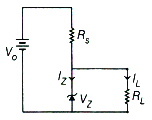
- In the diagram shown, the Zener diode has a reverse breakdown voltage of \(V_Z\). The current through the load resistance \(R_L\) is \(I_L\). The current through the Zener diode is
 KCET 2024 Medium